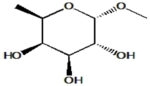
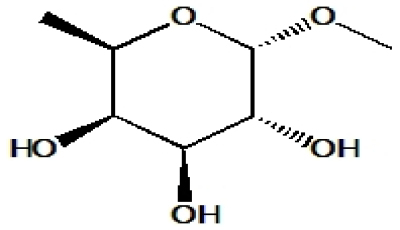


Methyl α-D-fucopyranoside is a synthetic derivative of the naturally occurring sugar L-fucose, where the anomeric hydroxyl group is replaced by a methyl group in the α-configuration of the pyranose ring. This compound is characterized by its white crystalline solid form and is widely used as a stable glycoside intermediate in carbohydrate chemistry. The methylation confers resistance to mutarotation and improves stability, making it suitable for glycosylation reactions and synthesis of functional glycoconjugates, oligosaccharides, and glycomimetics. With the molecular formula C7H14O5 and a molecular weight of approximately 178.18 g/mol, methyl α-D-fucopyranoside retains the sugar specificity of D-fucose but in a non-reducing form. It is produced through acid-catalyzed glycosylation with methanol, purified to high purity (≥98%), and validated by NMR and chromatographic methods. Produced under controlled, sterile conditions, it shows minimal microbial contamination. Proper storage at cool, dry, and dark conditions extends its shelf life up to two years. Applications include biochemical assays, medicinal chemistry, and glycobiology research focused on molecular recognition, enzyme specificity, and drug design.
IUPAC Name
Appearance
Source
Molecular Weight and Structure
Sugar Specificity
Biological Activity
Purity and Microbial Contamination
Identity and Quality Control
Shelf Life and Storage
Application
Key Characteristics
Citation Links
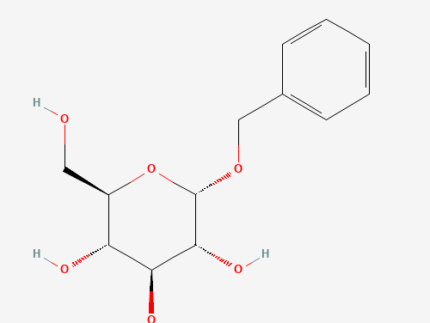
Catalog No: A10GD-4825
Cas No: 14897-46-2
Properties: Mol Formula: C13H18O6, Mol Weight: 270.28
IUPAC Name: (2R,3R,4S,5R,6R)-2-(hydroxymethyl)-6-phenylmethoxyoxane-3,4,5-triol
Synonym: Benzyl b-D-galactopyranoside, (2R,3R,4S,5R,6R)-2-(hydroxymethyl)-6-phenylmethoxyoxane-3,4,5-triol, benzyl beta-d-galactopyranoside
10 in stock
Catalog No: A10GD-4827
Cas No: 25320-99-4
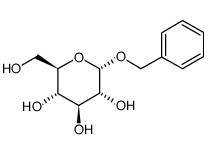
Properties: Mol Formula: C13H18O6, Mol Weight: 270.28
IUPAC Name: (2R,3S,4S,5R,6S)-2-(hydroxymethyl)-6-phenylmethoxyoxane-3,4,5-triol
Synonym: benzyl-alpha-d-glucopyranoside, Benzyl a-D-glucopyranoside, Benzyl b-D-glucopyranoside
10 in stock
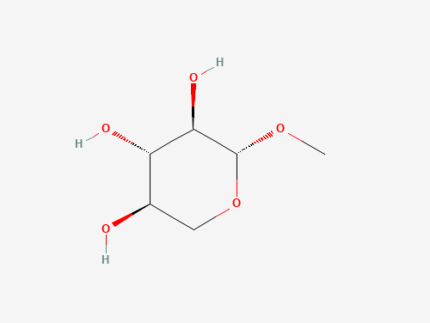
Catalog No: A10GD-4836
Cas No: 612-05-5
Properties: Mol Formula: C6H12O5, Mol Weight: 164.16
IUPAC Name: (2R,3R,4S,5R)-2-methoxyoxane-3,4,5-triol
Synonym: Methyl-beta-D-xylopyranoside, Methyl beta-D-xyloside, (2R,3R,4S,5R)-2-Methoxytetrahydro-2H-pyran-3,4,5-triol
10 in stock
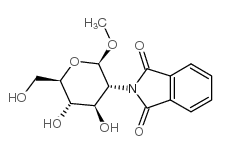
Catalog No: A10GD-4837
Cas No: 76101-14-9
Properties: Mol Formula: C15H17NO7, Mol Weight: 323.3
IUPAC Name: 2-[4,5-dihydroxy-6-(hydroxymethyl)-2-methoxyoxan-3-yl]isoindole-1,3-dione
Synonym: METHYL 2-DEOXY-2-N-PHTHALIMIDO-B-D-GLUCOPYRANOSIDE, 2-((2R,3R,4R,5S,6R)-4,5-Dihydroxy-6-(hydroxymethyl)-2-methoxytetrahydro-2H-pyran-3-yl)isoindoline-1,3-dione, Methyl 2-deoxy-2-phthalimido-b-D-glucopyranoside
10 in stock




Reviews
There are no reviews yet.