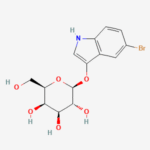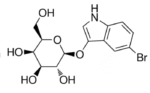
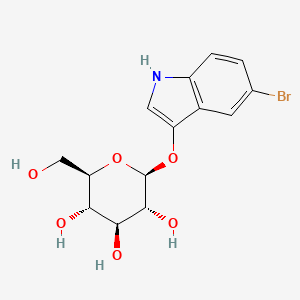

Blue‑Glc (CAS 16934‑09‑1), systematically 5‑bromo‑3‑indolyl β‑D‑glucopyranoside, is a synthetic β‑D‑glucosidase‑specific chromogenic substrate in which a 5‑bromo‑3‑indoxyl aglycone is linked via a β‑glycosidic bond to D‑glucose. When hydrolyzed by β‑D‑glucosidase (EC 3.2.1.21), the indoxyl moiety is released and undergoes aerial oxidation to form an insoluble blue indigo‑type precipitate, enabling clear visual detection of enzyme activity. This substrate is commonly used in enzymatic‑activity assays, high‑throughput screening of β‑glucosidase inhibitors, and microbial‑activity profiling on selective agar media. The blue color provides good contrast against most background pigments, making it suitable for plate‑based screening and histochemical staining. Blue‑Glc is compatible with standard aqueous buffers and microbiological media and is supplied as a high‑purity, research‑use‑only reagent for glycobiology, biochemistry, and food‑science applications.
Appearance
Off‑white to pale yellow crystalline or lyophilized powder.
Free‑flowing solid suitable for accurate weighing and dissolution in aqueous or mixed aqueous‑organic solvents.
Source / synthesis
Synthetically produced by coupling 5‑bromo‑3‑indoxyl with β‑D‑glucose under glycosylation conditions to form the β‑D‑glucopyranoside derivative.
Commercially manufactured and distributed by fine‑chemical and enzyme‑substrate suppliers (e.g., Glentham Life Sciences, ChemImpex, BOC Sciences) as a ≥95–98% pure reagent.
Molecular weight and structure
Molecular formula: C14H16BrNO6C14H16BrNO6.
Molecular weight: 374.18 g/mol.
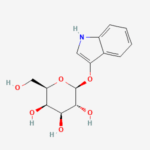
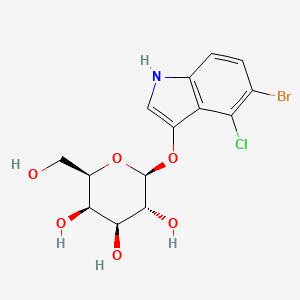
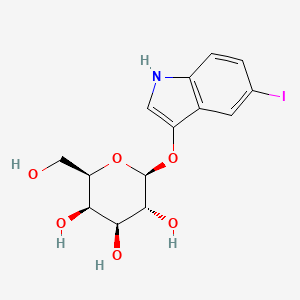
Structure: 5‑bromo‑1H‑indol‑3‑yl β‑D‑glucopyranoside, with a β‑glycosidic linkage between the indole C3‑O and the D‑glucose ring.
Sugar specificity
Specifically hydrolyzed by β‑D‑glucosidases (EC 3.2.1.21); shows minimal activity with α‑glycosidases under standard assay conditions.
Used as a selective reporter for β‑glucosidase activity in plant, fungal, and microbial systems.
Biological activity
Acts as a chromogenic reporter for β‑D‑glucosidase‑mediated hydrolysis of β‑D‑glucosyl linkages in glucosides, disaccharides, and oligosaccharides.
Enzymatic cleavage releases 5‑bromo‑3‑indoxyl, which oxidizes and dimerizes into an insoluble blue dye, enabling sensitive detection in solution assays, plates, and tissue sections.
Purity and microbial contamination
Typically supplied at ≥95–98% purity as determined by HPLC or similar methods, with product data sheets from major suppliers.
Indicated as low‑contamination, non‑sterile material suitable for biochemical and microbiological use when handled under standard sterile‑practice conditions.
Identity and quality control
Identity confirmed by molecular formula, mass spectrometry, and NMR‑type spectral data consistent with 5‑bromo‑3‑indolyl β‑D‑glucopyranoside.
Quality‑control checks include appearance, solubility, UV/Vis spectral profile, and performance in a defined β‑glucosidase assay (e.g., Aspergillus or almond β‑glucosidase).
Shelf life and storage
Shelf life is generally 12–24 months when stored as a dry powder at –20 °C in a tightly sealed container, protected from moisture and light.
Stock solutions should be prepared immediately before use or stored frozen for short periods to minimize degradation and nonspecific oxidation of the indoxyl.
Application
Enzymatic‑activity assays and inhibitor screening for β‑glucosidase in plant, fungal, and microbial extracts.
Screening and phenotypic differentiation of β‑glucosidase‑producing microorganisms on selective agar media.
Histochemical or cytochemical localization of β‑D‑glucosidase activity in tissue sections and cell preparations.
Key characteristics
High sensitivity and low background due to formation of an insoluble blue dye upon β‑D‑glucosidase hydrolysis.
Defined β‑D‑glucopyranoside linkage providing selectivity for β‑D‑glucosidases over many other glycosidases.
Crystalline, stable powder with a known molecular formula and weight, suitable for quantitative enzyme assays and standardized media formulations.
PubChem‑style chemical‑property overview (for analogous 5‑bromo‑3‑indolyl‑β‑D‑hexosides and dye‑behavior context): https://pubchem.ncbi.nlm.nih.gov/ (search for “5‑bromo‑3‑indolyl‑β‑D‑glucopyranoside” or “16934‑09‑1”)
General enzyme‑substrate catalog (β‑glucosidase‑chromogenic‑substrate entries, e.g., X‑Glc and related analogs): https://www.medchemexpress.com/
Specialty‑chemical catalog linking 5‑bromo‑3‑indolyl‑β‑D‑glucopyranoside to enzymatic‑assay‑kit and screening‑applications: https://www.chemicalbook.com/ (search for “16934‑09‑1”)
Reviews
There are no reviews yet.