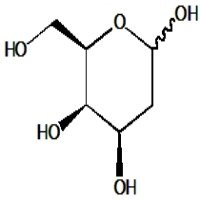
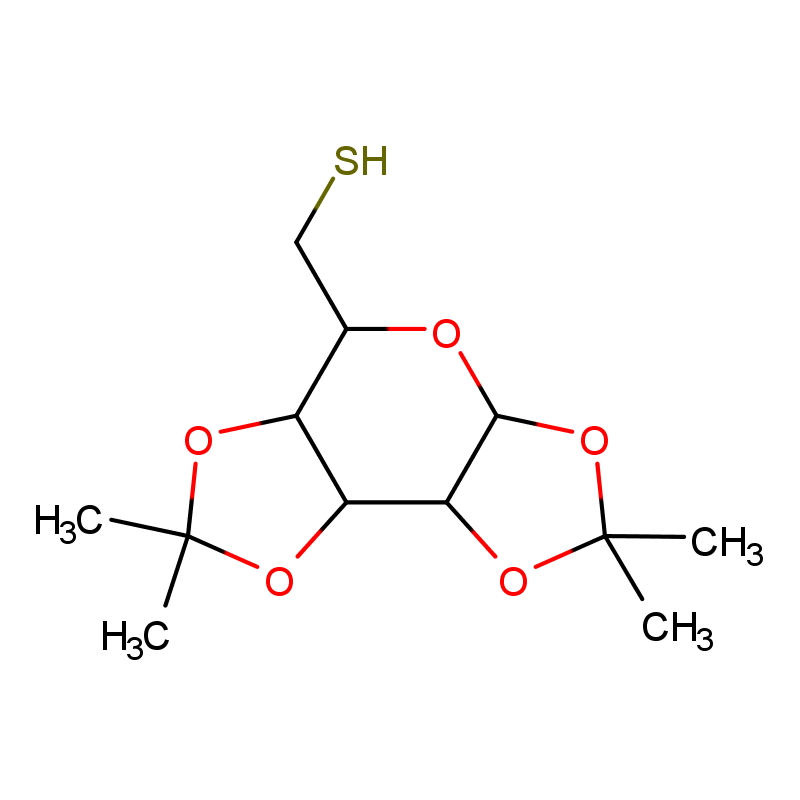

1,2;3,4-Di-O-isopropylidene-α-D-fucopyranose
| CAS Number | 4026-27-1 |
| Synonyms | 6-Deoxy-1,2;3,4-di-O-isopropylidene-α-D-galactopyranose; 1,2,3,4-Di-O-isopropylidene-alpha-D-fucopyranose |
| Molecular Formula | C12H20O5 |
| Molecular Weight | 244.28 g/mol |
| Purity | Typically ≥95% to ≥99% (GC or HPLC analysis depending on supplier) |
| Packaging | Custom packs |
| Specification | No spec file available |
1,2;3,4-Di-O-isopropylidene-α-D-fucopyranose is a synthetic derivative of the deoxy sugar fucose, a monosaccharide commonly found in mammalian glycoconjugates and bacterial polysaccharides. The term “di-O-isopropylidene” indicates that two isopropylidene protecting groups are attached to the fucose molecule. Specifically, one isopropylidene group protects the hydroxyl groups at positions 1 and 2, forming a cyclic ketal, and another protects the hydroxyl groups at positions 3 and 4, also forming a cyclic ketal. These protecting groups are employed to selectively block the reactivity of these hydroxyls, allowing for controlled chemical modifications at the remaining position, which is typically at C-6 (the methyl group) or after selective deprotection. This compound is valuable in the synthesis of more complex fucosylated oligosaccharides, glycoconjugates, and other fucose-containing molecules, where the controlled introduction of fucose is essential. It serves as a versatile building block for constructing diverse carbohydrate structures with defined linkages and biological activities.
IUPAC Name
- IUPAC Name: (3aR,6R,6aR)-5-((4R,5R)-2,2-dimethyl-1,3-dioxolan-4-yl)-2,2-dimethyltetrahydrofuro[2,3-d]dioxole
Appearance
- Typically colorless to white crystalline solid or powder
Source
- Synthetically derived
- Prepared through chemical reactions starting from fucose
- Protection of hydroxyl groups at positions 1,2 and 3,4 via isopropylidene groups under acidic conditions
Molecular Weight and Structure
- Molecular Weight: 244.28 g/mol
- Molecular Formula: C12H20O5
- Structure: Six-membered fucose ring (6-deoxy sugar)
- Two isopropylidene groups form cyclic ketals at positions 1,2 and 3,4
- Anomeric carbon (C1) locked in α configuration
Sugar Specificity
- No inherent biological sugar-binding specificity as a protected derivative
- Specificity arises when incorporated into complex fucosylated molecules
Biological Activity
- Compound itself inactive biologically
- Biological roles depend on incorporated fucosylated molecules
- Fucose residues involved in cell-cell recognition, immune response, and signaling
Purity and Microbial Contamination
- High purity essential for chemical synthesis
- Purity assessed by HPLC, TLC, GC, and NMR spectroscopy
- Microbial contamination generally not a concern for chemical use
- Sterility testing required if used for biological studies
Identity and Quality Control
- Confirmed by ^1H and ^13C NMR spectroscopy
- Mass spectrometry used for structure confirmation
- Optical rotation and melting point measurements for QC
- Water content determined by Karl Fischer titration
Shelf Life and Storage
- Several years’ stability if protected from moisture, light, and air
- Stored under inert atmosphere at refrigerated temperatures
Application
- Intermediate in synthesis of fucosylated oligosaccharides
- Used to introduce fucose residues into glycoconjugates (glycoproteins, glycolipids)
- Important in carbohydrate-protein interaction studies
- Utilized in medicinal chemistry for drug discovery targeting fucose-binding proteins
Key Characteristics
- Protected fucose with isopropylidene groups
- Versatile for controlled fucosylation reactions
- Stable under proper storage conditions
- Soluble in chloroform, dichloromethane, ethyl acetate
- Locked α-anomeric configuration
Citation
- Product and application overview — Chem-Impex
https://www.chemimpex.com/products/28165 - Compound entry and properties — PubChem
https://pubchem.ncbi.nlm.nih.gov/compound/10977680 - Usage and synthesis details — ChemicalBook
https://www.chemicalbook.com/ProductChemicalPropertiesCB1311963_EN.htm - Enzyme substrate synthesis information — ChemDad
https://chemdad.com/index.php?c=article&id=14646 - Protected intermediate in glycoconjugate synthesis — Atomfair
https://atomfair.com/product/atomfair-1234-di-o-isopropylidene-alpha-d-fucopyranose-c12h20o5-cas-4026-27-1/ - General glycosylation procedure involving isopropylidene sugars — ACS Publications
https://pubs.acs.org/doi/10.1021/acs.joc.8b02613 - Fucosylated antigen synthesis in cancer research — PMC NIH
https://pmc.ncbi.nlm.nih.gov/articles/PMC298681/ - Fluorinated fucose analogs in cancer proliferation inhibition — PMC NIH
https://pmc.ncbi.nlm.nih.gov/articles/PMC10901565/ - Lewis antigen biosynthesis structural basis — PMC NIH
https://pmc.ncbi.nlm.nih.gov/articles/PMC10726971/ - Glycoengineering and E-selectin ligand studies — PubMed
https://pubmed.ncbi.nlm.nih.gov/27335219/
Based on 0 reviews
| 0% | ||
| 0% | ||
| 0% | ||
| 0% | ||
| 0% |
Related Products
| CAS No. | 34371-14-7 |
| Synonyms | 2-Deoxy-D-ribono-1,4-lactone |
| Formula | C5H8O4 |
| Molecular Weight | 132.11 g/mol |
| Packaging | Custom packs |
| Specification | No spec file |
| CAS No. | 15814-59-2 |
| Synonyms | Methyl 6-deoxy-α-D-mannopyranoside |
| Molecular Formula | C7H14O5 |
| Molecular Weight | 178.18 g/mol |
| Packaging | Custom packs |
| Specification | No spec file |
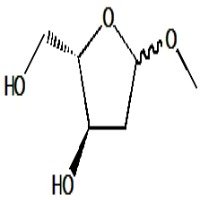
| CAS No. | 446251-73-6 |
| Synonyms | (2S,3R)-2-(Hydroxymethyl)-5-methoxytetrahydrofuran-3-ol |
| Formula | C6H12O4 |
| Molecular Weight | 148.16 g/mol |
| Packaging | Custom packs |
| Specification | No spec |
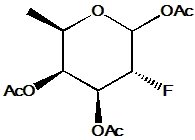
| CAS Number | Not specifically found in current sources |
| Synonyms | 1,3,4-Tri-O-acetyl-2-deoxy-2-fluoro-D-fucose; 2-Fluoro-acetylated fucose derivative |
| Molecular Formula | C12H17FO7 |
| Molecular Weight | 292.26 g/mol |
| Packaging | Custom packs |
| Specification | No spec file available |


Reviews
There are no reviews yet.