Request a quote
Catalog No: A10GD-4451
Cas No: 123437-16-1
Properties: Mol Formula: C26H20FN3O2, Mol Weight: 425.5
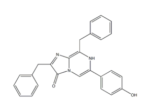
IUPAC Name: 8-benzyl-2-[(4-fluorophenyl)methyl]-6-(4-hydroxyphenyl)imidazo[1,2-a]pyrazin-3-ol
Synonym: 8-benzyl-2-[(4-fluorophenyl)methyl]-6-(4-hydroxyphenyl)imidazo[1,2-a]pyrazin-3-ol, coelenterazine-f, SCHEMBL13401854
Coelenterazine F is a light-emitting molecule that has been shown to emit light when it binds to cytosolic Ca2+. In addition, it can be used in the detection of Ca2+ changes. The molecular structure consists of two disulfide bonds and a reactive cysteine residue that can form covalent bonds with other molecules. This reaction releases energy in the form of light. Coelenterazine F has been shown to produce fluorescence resonance energy transfer (FRET) with luciferase, which is a reconstituted protein complex that emits light when oxidized by coelenterazine F. Coelenterazine F has also been shown to induce pro-inflammatory cytokines, such as IL-6 and TNF-?, which are involved in inflammatory response.
| CAS Number | 123437-16-1 |
| Product Name | Coelenterazine f |
| IUPAC Name | 8-benzyl-2-[(4-fluorophenyl)methyl]-6-(4-hydroxyphenyl)imidazo[1,2-a]pyrazin-3-ol |
| Molecular Formula | C26H20FN3O2 |
| Molecular Weight | 425.5 g/mol |
| InChI | InChI=1S/C26H20FN3O2/c27-20-10-6-18(7-11-20)15-23-26(32)30-16-24(19-8-12-21(31)13-9-19)28-22(25(30)29-23)14-17-4-2-1-3-5-17/h1-13,16,31-32H,14-15H2 |
| InChI Key | VEADHSBKGZIWMA-UHFFFAOYSA-N |
| SMILES | C1=CC=C(C=C1)CC2=NC(=CN3C2=NC(=C3O)CC4=CC=C(C=C4)F)C5=CC=C(C=C5)O |
| Canonical SMILES | C1=CC=C(C=C1)CC2=C3N=C(C(=O)N3C=C(N2)C4=CC=C(C=C4)O)CC5=CC=C(C=C5)F |
| Isomeric SMILES | C1=CC=C(C=C1)CC2=C3N=C(C(=O)N3C=C(N2)C4=CC=C(C=C4)O)CC5=CC=C(C=C5)F |
| Size | 1 G, 100 MG, 5 G, Other |
|---|
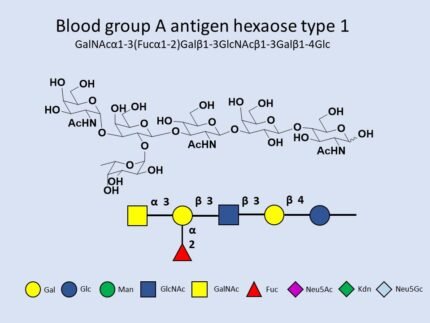
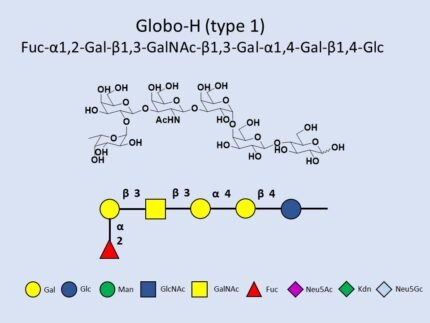
IUPAC:Fuc(a1-2)[GalNAc(a1-3)]Gal(b1-3)GlcNAc(b1-3)Gal(b1-4)b-Glc, G82858KU
10 in stock
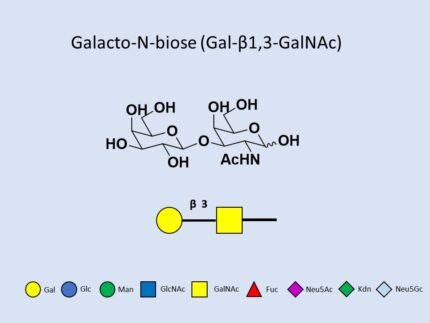
Gal-b1,3-GalNac, CAS:20972-29-6; 3554-90-3, G01534TU
10 in stock
10 in stock
10 in stock