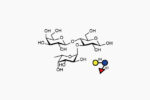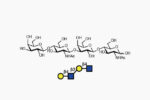
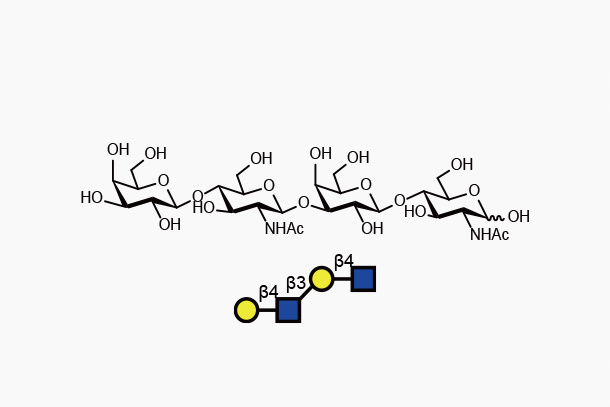


DiLacNAc is a structurally defined tetrasaccharide glycan composed of two repeating N-acetyllactosamine (LacNAc) units, represented as Galβ1-4GlcNAcβ1-3Galβ1-4GlcNAc. The molecule contains alternating β-linked galactose (Gal) and N-acetylglucosamine (GlcNAc) residues, forming a characteristic LacNAc repeat motif commonly found in complex glycans of glycoproteins and glycolipids.
N-acetyllactosamine repeats are fundamental structural components of many N-linked and O-linked glycans present on mammalian cell surfaces. These glycan motifs play critical roles in cell recognition, immune regulation, pathogen interaction, and carbohydrate-mediated signaling pathways. Because of its defined structure and biological relevance, DiLacNAc serves as an important reagent for glycobiology research and glycan engineering studies.
DiLacNAc is widely used as a model glycan for studying carbohydrate-protein interactions, particularly in investigations involving lectins, antibodies, and glycan-binding proteins. It also serves as a synthetic intermediate and building block for the preparation of more complex glycans and glycoconjugates used in biological and pharmaceutical research.
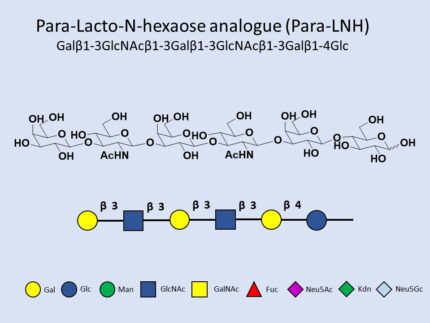
The molecule consists of two repeating LacNAc units, which are disaccharides formed by galactose linked to N-acetylglucosamine via a β1-4 glycosidic bond. These repeating units are connected through a β1-3 linkage, creating the tetrasaccharide structure.
Such LacNAc repeating sequences are important components of poly-N-acetyllactosamine chains, which are frequently involved in biological processes such as cell adhesion, immune recognition, and glycan-mediated cell signaling.
DiLacNAc is frequently used as a model compound for studying the biological roles of LacNAc motifs in glycoproteins and glycolipids, particularly in cell surface glycan interactions.
Many lectins and glycan-binding proteins recognize LacNAc motifs. DiLacNAc can be used to investigate carbohydrate recognition mechanisms and binding specificity.
This compound serves as an important intermediate for synthesizing larger oligosaccharides, glycoproteins, and glycoconjugates, making it valuable for glycoengineering and synthetic carbohydrate chemistry.
DiLacNAc can be used as a substrate or model compound in studies involving glycosyltransferases and glycosidases, enzymes that participate in glycan biosynthesis and degradation.Immunology and Cell Signaling Research
LacNAc-containing glycans are known to participate in immune modulation, cell adhesion, and signaling pathways, making DiLacNAc a useful molecule in biomedical research.
Typically supplied as a white to off-white powder suitable for biochemical and analytical applications.
DiLacNAc is available in flexible packaging sizes ranging from milligram quantities for research laboratories to kilogram-scale production for industrial and large-scale applications.
10 in stock
Catalog No: G01534TU
CAS No: 64309-01-9
Molecular Formula: C₅₂H₈₈N₂O₃₉
Molecular Weight: 1365.25 g/mol
Packaging: Available in research quantities
10 in stock
10 in stock
10 in stock