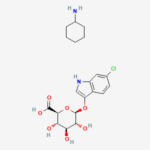
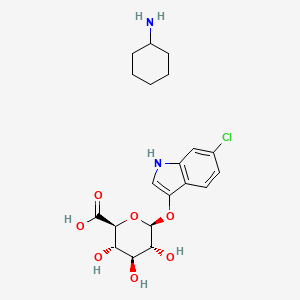
Salmon‑GlcA CHX Salt (CAS 138182‑20‑4), systematically 6‑chloro‑3‑indolyl‑β‑D‑glucuronide cyclohexylammonium salt, is a synthetic β‑D‑glucuronidase‑specific chromogenic substrate in which a 6‑chloro‑3‑indoxyl aglycone is linked via a β‑glycosidic bond to β‑D‑glucuronic acid and provided as the cyclohexylammonium (CHA) salt. When hydrolyzed by β‑D‑glucuronidase (EC 3.2.1.31) or GUS‑expressing systems, the indoxyl moiety is released and oxidizes to form an insoluble salmon‑colored precipitate, enabling clear visual detection of enzyme activity. The CHA salt form is highly soluble in organic solvents such as DMF or DMSO, allowing preparation of concentrated stock solutions that are then diluted into aqueous media for use in bacterial‑colony screening, GUS‑reporter assays, and histochemical staining of β‑glucuronidase activity in plant and animal tissues. The salmon hue provides good contrast with background pigmentation and can be combined with blue‑forming substrates such as X‑Gal for multiplex detection of GUS and lacZ activities on the same plate. The compound is supplied as a high‑purity, research‑use‑only reagent compatible with standard microbiological and molecular‑biology buffers.
Appearance
- Off‑white to pale yellow crystalline or lyophilized powder.
- Freely soluble in organic solvents (e.g., DMF, DMSO, methanol) for stock solutions and sufficiently dispersible in aqueous media to generate a homogeneous working solution.
Source / synthesis
- Synthetically produced by coupling 6‑chloro‑3‑indoxyl with β‑D‑glucuronic acid and then converting the free acid into its cyclohexylammonium salt form to improve solubility and handling.
- Commercially manufactured by specialty enzyme‑substrate suppliers (e.g., Duchefa Biochemie, MuseChem, Sigma‑Aldrich‑style vendors, and India‑based carbohydrate‑chemistry houses) as a high‑purity GUS‑assay reagent.
Molecular weight and structure
- Molecular formula: C20H27ClN2O7C20H27ClN2O7.
- Molecular weight: 442.89 g/mol.
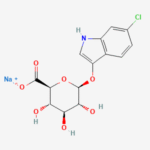
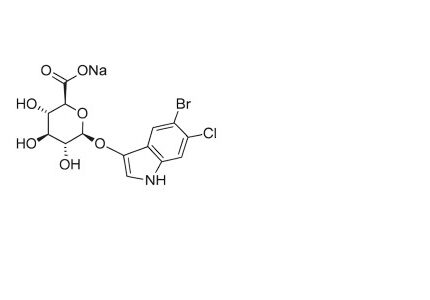
- Structure: 6‑chloro‑1H‑indol‑3‑yl β‑D‑glucopyranuronate present as the monofumarate‑type cyclohexylammonium salt, with a β‑glycosidic linkage between the indole C3‑O and the D‑glucuronic‑acid ring.
Sugar specificity
- Specifically hydrolyzed by β‑D‑glucuronidases (GUS, EC 3.2.1.31) and β‑glucuronide‑cleaving enzymes.
- Shows high selectivity over other β‑glycosidases, making it ideal for detection of β‑glucuronidase activity in bacteria, transgenic plants, and histochemical preparations.
Biological activity
- Acts as a chromogenic reporter for β‑glucuronidase‑mediated hydrolysis of β‑D‑glucuronosyl linkages in glucuronides and glycosaminoglycan‑derived substrates.
- Enzymatic cleavage releases 6‑chloro‑3‑indoxyl, which oxidizes and dimerizes into a salmon‑colored, water‑insoluble dye, enabling sensitive detection in bacterial colonies, plant‑tissue GUS assays, and histological sections.
Purity and microbial contamination
- Typically supplied at ≥90–95% assay purity as determined by HPLC, TLC, or equivalent methods.
- Product data sheets and supplier entries indicate acceptable levels of residual solvents, heavy metals, and low‑microbial‑contamination status suitable for microbiological and biochemical use.
Identity and quality control
- Identity inferred from molecular formula, molecular weight, and spectral data (UV/Vis, NMR), with reference to standard indolyl‑β‑D‑glucuronide and cyclohexylammonium‑salt profiles.
- Quality‑control procedures include checks for appearance, solubility, and performance in a defined β‑glucuronidase assay (e.g., E. coli GUS⁺ colonies or plant GUS staining).
Shelf life and storage
- Shelf life is generally 12–24 months when stored as a dry powder at –20 °C in a tightly sealed, desiccated container, protected from moisture and light.
- Stock solutions in DMF or DMSO should be prepared immediately before use or stored frozen for short periods to minimize degradation and nonspecific oxidation of the indoxyl moiety.
Application
- Screening and identification of β‑glucuronidase‑positive bacteria (e.g., certain E. coli strains) on selective agar media.
- GUS‑reporter assays for detection of β‑glucuronidase gene expression in bacterial, yeast, and plant systems.
- Simultaneous detection of GUS and lacZ activities when used with X‑Gal on the same plate or section.
Key characteristics
- High sensitivity and low background due to formation of an insoluble salmon‑colored dye upon β‑glucuronidase hydrolysis.
- Defined β‑D‑glucuronide linkage with a cyclohexylammonium counterion, providing improved solubility in organic stock solvents.
- Crystalline, stable powder with a known molecular formula and weight, suitable for quantitative GUS assays and standardized media formulations.
Citations




Reviews
There are no reviews yet.