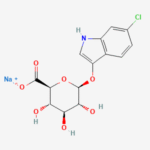
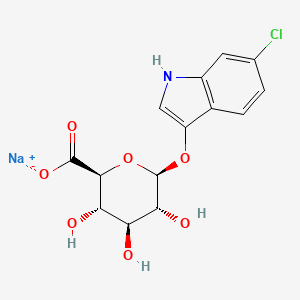

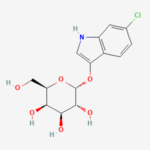
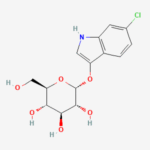
Salmon‑GlcA Sodium Salt (CAS 216971‑56‑1), systematically 6‑chloro‑3‑indolyl β‑D‑glucuronide sodium salt, is a synthetic β‑D‑glucuronidase‑specific chromogenic substrate in which a 6‑chloro‑3‑indoxyl aglycone is linked via a β‑glycosidic bond to β‑D‑glucuronic acid and presented as the monosodium salt. When hydrolyzed by β‑D‑glucuronidase (EC 3.2.1.31) or GUS‑expressing systems, the indoxyl moiety is released and oxidizes to an insoluble salmon‑colored indigo‑type precipitate, enabling clear visual detection of enzyme activity. This sodium‑salt form is highly soluble in aqueous buffers and is commonly used in bacterial‑colony screening, GUS‑reporter assays, and histochemical staining of β‑glucuronidase activity in plants, tissues, and cell cultures. The salmon‑pink color provides good contrast with background pigmentation and can be combined with other chromogenic substrates (e.g., X‑Gal) for multiplex detection of different enzyme activities on the same plate. The compound is supplied as a high‑purity, research‑use‑only reagent compatible with standard microbiological and molecular‑biology buffers.
Appearance
Source / synthesis
Molecular weight and structure
Sugar specificity
Biological activity
Purity and microbial contamination
Identity and quality control
Shelf life and storage
Application
Key characteristics
Citations
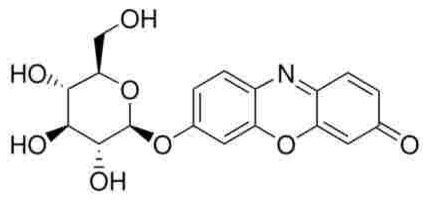
| Name | Resorufin-Glc Sodium Salt |
| Synonyms | Resorufin-β-D-glucuronide sodium salt |
| CAS Number | 12540-91-7 |
| Molecular Formula | C18H14NNaO9 |
| Molecular Weight | 431.30 g/mol |
| Specifications & Purity | ≥95% (Vacuum foil packaging) |
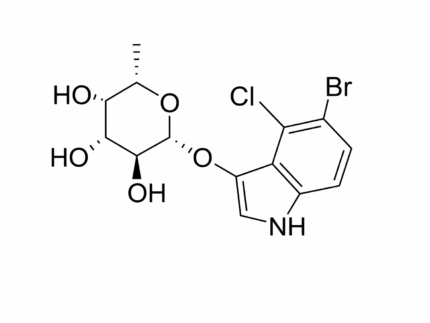
| Name | X-β-L-Fuc |
| Synonyms | 5-Bromo-4-chloro-3-indolyl-β-L-fucopyranoside |
| CAS Number | 125280-49 |
| Molecular Formula | C14H15BrClNO5 |
| Molecular Weight | 392.63 g/mol |
| Specifications & Purity | ≥95% (Vacuum foil packaging) |
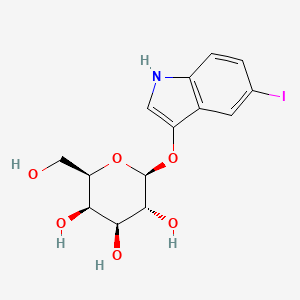
| Name | Purple-Gal |
| Synonyms | 5-Iodo-3-indolyl-β-D-galactopyranoside |
| CAS Number | 306473-36-6 |
| Molecular Formula | C14H16INO6 |
| Molecular Weight | 421.18 g/mol |
| Specifications & Purity | ≥95% (Vacuum foil packaging) |
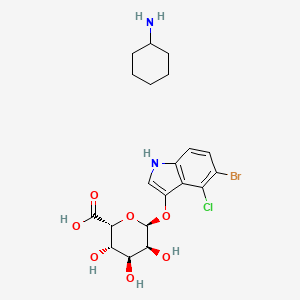
| Name | X-GlcA CHX Salt Monohydrate |
| Synonyms | 5-Bromo-4-chloro-3-indolyl-β-D-glucuronic acid cyclohexylammonium salt monohydrate |
| CAS Number | 114162-0 |
| Molecular Formula | C20H26BrClN2O8 |
| Molecular Weight | 538.0 g/mol |
| Specifications & Purity | ≥95% (Vacuum foil packaging) |


Reviews
There are no reviews yet.