UDP-b-L-Ara.2Na
$1,196.00 – $5,632.00
| Synonyms | UDP-B-L-Ara, Uridine 5’diphospho-B-L-arabinose Disodium Salt |
| Catalog No. | GN02026 |
| CAS Number | 15839-78-8; 331001-44-6 |
| Formula | C14H20N2Na2O16P2 |
| M.W. | 580.24 |
UDP-b-L-Ara.2Na
UDP-B-L-Ara, Uridine 5’diphospho-B-L-arabinose Disodium Salt?
UDP-b-L-Ara.2Na (Uridine Diphosphate beta-L-Arabinose disodium salt) is a nucleotide sugar involved in the biosynthesis of various glycans, including polysaccharides and glycoproteins. Arabinose is a five-carbon sugar that plays a critical role in the structure and function of plant cell walls, as well as in the glycosylation pathways of certain bacteria and fungi.
Structure & Properties:
- Molecular Weight (MW): Approximately 582 g/mol (depending on specific form and substitutions)
- Chemical Formula: C15H23N2Na2O17P2 (approximate)
- Synonyms: UDP-beta-L-arabinose, UDP-L-arabinose disodium salt
- Functional Groups: UDP-b-L-Ara consists of uridine diphosphate (UDP) linked to beta-L-arabinose, a sugar unit commonly found in the arabinose form of polysaccharides.
Biological Role:
- Biosynthesis Pathway: UDP-b-L-Ara is synthesized from UDP-glucose through a series of enzymatic reactions that convert glucose to arabinose. This sugar nucleotide serves as a donor in the biosynthesis of arabinose-containing glycans, including arabinogalactans, hemicellulose, and other polysaccharides.
- Function: It is involved in the transfer of arabinose units to growing polysaccharide chains in the cell walls of plants, bacteria, and fungi. In plants, UDP-b-L-Ara is crucial for the biosynthesis of arabinoxylans and pectins, which are essential for cell wall integrity and function.
Applications:
- Plant Cell Wall Biosynthesis: UDP-b-L-Ara is vital for the formation of arabinose-rich polysaccharides in plant cell walls, which contribute to the structural stability, flexibility, and resilience of plants.
- Bacterial and Fungal Glycosylation: In certain bacteria and fungi, UDP-b-L-Ara participates in the glycosylation of lipopolysaccharides and other surface glycans, influencing cell wall structure and pathogenicity.
Significance in Research:
- Plant Biology and Agriculture: Understanding the role of UDP-b-L-Ara in plant cell wall biosynthesis has important implications for agricultural research, particularly in developing crops with improved structural properties, disease resistance, and biomass production.
- Glycobiology: Research into the glycosylation pathways involving UDP-b-L-Ara contributes to our understanding of bacterial and fungal pathogenesis, as well as potential targets for antimicrobial development.
Key Roles:
- Plant Cell Wall Formation: UDP-b-L-Ara is essential for the incorporation of arabinose into plant cell wall polysaccharides, such as pectins and hemicellulose, which are critical for cell wall strength, growth, and defense mechanisms.
- Microbial Glycoconjugate Biosynthesis: In microorganisms, it plays a role in the construction of glycoconjugates that are important for cell wall structure, biofilm formation, and immune evasion.
Storage and Stability:
- Storage: UDP-b-L-Ara should be stored at -20°C in a moisture-free environment for optimal stability.
- Stability: The compound is stable under these conditions but may degrade if exposed to heat, moisture, or light.
Research Applications:
- Plant Cell Wall Engineering: UDP-b-L-Ara is used in research to manipulate plant cell wall composition, potentially enhancing crop resilience, digestibility, and biomass yield for biofuel production.
- Microbial Glycosylation: It is utilized in the study of bacterial and fungal glycosylation pathways to explore new antimicrobial targets by disrupting cell wall synthesis.
Potential Impact:
- Agriculture and Bioenergy: Engineering plants with modified arabinose-containing polysaccharides could lead to improved agricultural productivity and biofuel production.
- Antimicrobial Strategies: Understanding the role of UDP-b-L-Ara in microbial glycosylation could inform the development of new antimicrobial agents targeting bacterial and fungal cell walls.
Conclusion:
UDP-b-L-Ara.2Na is a key sugar nucleotide involved in the biosynthesis of arabinose-containing glycans, crucial for plant cell wall formation and microbial glycosylation. Its role in these processes makes it a valuable molecule in plant biology, agriculture, and microbial research, with implications for crop improvement, bioenergy production, and the development of antimicrobial therapies.
| Size | 10 MG, 2 MG, 5 MG, Other |
|---|
Related Products
| Name | UDP-a-L-Rha Sodium Salt |
| Catalog No. | GN02020 |
| CAS Number | 1526988-33-9 |
| Formula | C15H22N2Na2O16P2 |
| M.W. | 594.27 |
10 in stock
| Chemical Name | Cytidine-5’-monophospho-N-acetylneuraminic acid, Disodium Salt |
|---|---|
| Synonyms | CMP-Neu5Ac·2Na, CMP-Sialic Acid Disodium Salt, CMP-NANA, CMP-NAN |
| Molecular Formula | C20H29N4O16P · 2Na |
| Molecular Weight | 658.41 g/mol |
| CAS No. | 149007-28-3 (disodium salt); 3063-71-6 (free acid) |
| Appearance | White lyophilized powder |
| Purity | ≥95% (HPLC) |
| Source | Enzymatic synthesis |
| Solubility | Soluble in water |
| Storage | −20°C, protect from moisture |
| Application | Activated sugar nucleotide donor substrate for sialyltransferases; used in enzymatic sialylation of glycoproteins, glycolipids, and oligosaccharides |
10 in stock
| Chemical Name | Uridine-5’-diphospho-N-azidoacetyl-α-D-galactosamine, Disodium Salt |
|---|---|
| Synonyms | UDP-GalNAz·2Na, UDP-N-Azidoacetylgalactosamine Disodium Salt, UDP-GalNAz Disodium |
| Molecular Formula | C17H24N6Na2O17P2 |
| Molecular Weight | 692.33 g/mol (disodium salt) |
| CAS No. | 653600-61-4 |
| Appearance | White to off-white lyophilized powder |
| Purity | ≥95% (HPLC) |
| Solubility | Soluble in water |
| Storage | −20°C, protect from moisture and light |
| Application | Azido-modified analogue of UDP-GalNAc; serves as a substrate for N-acetylgalactosaminyltransferases (ppGalNAc-Ts) enabling metabolic and chemoenzymatic glycan labeling; the azidoacetyl handle permits bioorthogonal conjugation via copper-catalyzed azide–alkyne cycloaddition (CuAAC) and strain-promoted azide–alkyne cycloaddition (SPAAC); widely used in O-GalNAc glycoproteomics, mucin-type glycan imaging, and site-specific antibody–drug conjugate (ADC) construction |
10 in stock
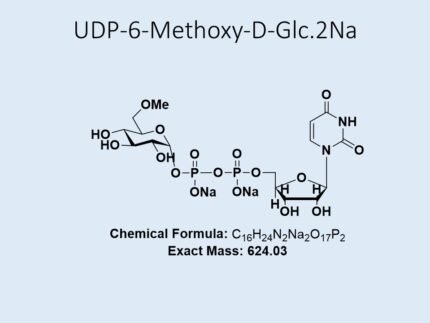
| Name | UDP-6-Methyl-6-deoxy-D-Glc.2Na |
| Catalog No. | GN02023 |
| CAS Number | N/A |
| Formula | C16H24N2Na2O17P2 |
| M.W. | 624.29 |
10 in stock