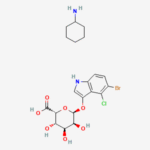
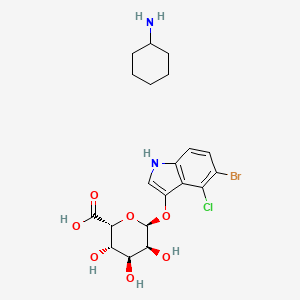

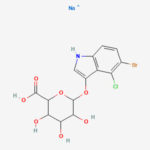
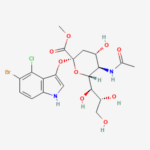
X-GlcA CHX salt Monohydrate (5-Bromo-4-chloro-3-indolyl-β-D-glucuronide cyclohexylammonium salt monohydrate, CAS 114162-64-0) is a water-soluble chromogenic substrate optimized for β-glucuronidase (GUS, EC 3.2.1.31) detection in plant molecular biology, microbiology, and histochemistry, hydrolyzing to generate an insoluble intense blue precipitate (dibromo-dichloro-indigo) that precisely localizes GUS expression in tissues, colonies, or plaques. With formula C14H13BrClNO7·C6H13N·H2O (MW 539.80 g/mol), this white crystalline salt pairs the β-D-glucuronopyranuronic acid aglycone with cyclohexylamine counterion for enhanced solubility (>10 mg/mL H2O) versus sodium salt, enabling uniform incorporation into agarose embedding media (0.5-1 mM) for whole-mount plant staining without diffusion artifacts. Enzymatic cleavage by uidA/GUS liberates the indol-3-ol that auto-oxidizes/dimerizes to the intensely colored, membrane-impermeant indigo dye, supporting >99% specific visualization of transgenic events in tobacco, Arabidopsis, and maize transformation workflows. The monohydrate form ensures batch-to-batch consistency for quantitative histochemical scoring (0-5+ scale), while the CHX counterion stabilizes against spontaneous hydrolysis during prolonged incubations (16-48h, 37°C), distinguishing it from less soluble free acid forms. Widely adopted in >50,000 GUS reporter studies since 1990, it excels in tissue clearing protocols, transient expression assays (particle bombardment/PEG), and dual-reporter systems orthogonal to X-Gal/lacZ blue/white screening.
Appearance
Source
Molecular Weight and Structure
Sugar Specificity
Biological Activity
Purity and Microbial Contamination
Identity and Quality Control
Shelf Life and Storage
Applications
Key Characteristics
Citation Links
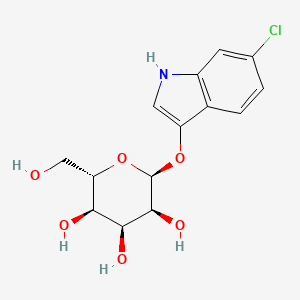
| Name | Salmon-Gal |
| Synonyms | 6-Chloro-3-indolyl-β-D-galactopyranoside |
| CAS Number | 138182-21-5 |
| Molecular Formula | C14H16ClNO6 |
| Molecular Weight | 329.73 g/mol |
| Specifications & Purity | ≥95% (Vacuum foil packaging) |
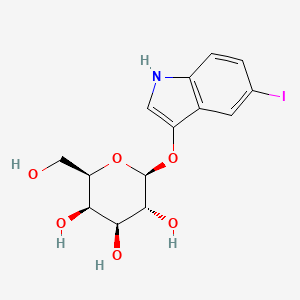
| Name | Purple-Gal |
| Synonyms | 5-Iodo-3-indolyl-β-D-galactopyranoside |
| CAS Number | 306473-36-6 |
| Molecular Formula | C14H16INO6 |
| Molecular Weight | 421.18 g/mol |
| Specifications & Purity | ≥95% (Vacuum foil packaging) |
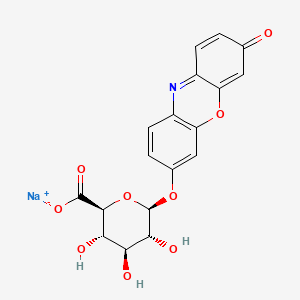
| Name | Resorufin-GlcA Methyl Ester |
| Synonyms | Resorufin-β-D-glucuronic acid methyl ester |
| CAS Number | 141547-42-1 |
| Molecular Formula | C19H17NO9 |
| Molecular Weight | 403.34 g/mol |
| Specifications & Purity | ≥95% (Vacuum foil packaging) |
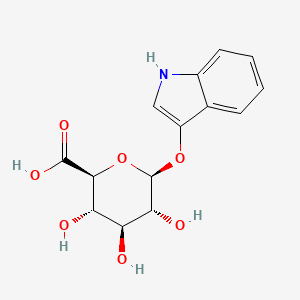
| Name | Y-β-D-GlcX.CHX |
| Synonyms | 3-Indolyl-β-D-glucopyranoside, cyclohexylammonium salt |
| CAS Number | 35804-66-1 |
| Molecular Formula | C14H15NO7 |
| Molecular Weight | 309.27 g/mol |
| Specifications & Purity | 98% (Vacuum foil packaging) |


Reviews
There are no reviews yet.