
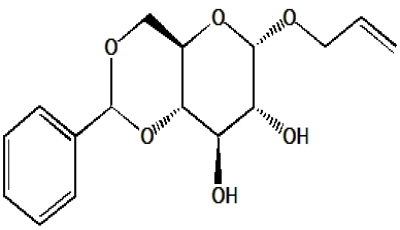


Allyl 4,6-O-benzylidene-α-D-glucopyranoside is a chemically synthesized glucose derivative where the hydroxyl groups at positions 4 and 6 are protected by a benzylidene acetal, and the anomeric hydroxyl is substituted with an allyl group. This white crystalline solid provides enhanced stability and reactivity for synthetic carbohydrate chemistry applications. The benzylidene protection imposes conformational rigidity and selective reactivity, while the allyl group at the anomeric position serves as a versatile reactive handle useful in glycosylation and further functionalization. It has a molecular formula of C16H20O6 and a molecular weight of approximately 296.32 g/mol. Allyl 4,6-O-benzylidene-α-D-glucopyranoside is a key intermediate in the synthesis of complex oligosaccharides, glycoconjugates, and glycomimetics, and is critical for medicinal chemistry, chemical biology, and glycobiology research. It is supplied with high purity and validated identity, requiring storage under refrigerated, moisture-free conditions to maintain a stable shelf life. The compound is widely applied in drug design, enzymatic studies, targeted delivery systems, and biomolecular labeling.
IUPAC Name
Appearance
Source
Molecular Weight and Structure
Sugar Specificity
Biological Activity
Purity and Microbial Contamination
Identity and Quality Control
Shelf Life and Storage
Application
Key Characteristics
Citations
Catalog No: A10GD-4829
Cas No: 97-30-3
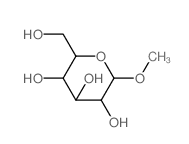
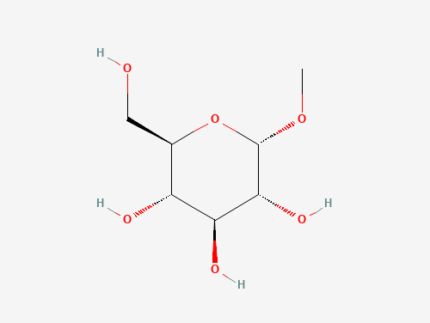
Properties: Mol Formula: C7H14O6, Mol Weight: 194.18
IUPAC Name: (2R,3S,4S,5R,6S)-2-(hydroxymethyl)-6-methoxyoxane-3,4,5-triol
Synonym: Methyl-alpha-D-glucopyranoside, alpha-Methylglucoside, Methyl alpha-D-glucoside
10 in stock
Catalog No: A10GD-4820
Cas No: 60134-26-1
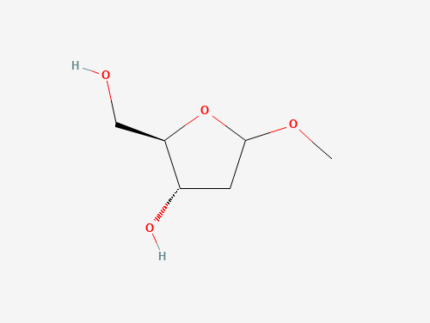
Properties: Mol Formula: C6H12O4, Mol Weight: 148.16
IUPAC Name: (2R,3S)-2-(hydroxymethyl)-5-methoxyoxolan-3-ol
Synonym: (2R,3S)-2-(Hydroxymethyl)-5-methoxytetrahydrofuran-3-ol, Methyl 2-Deoxy-D-ribofuranoside, (2R,3S)-2-(hydroxymethyl)-5-methoxyoxolan-3-ol
10 in stock
Catalog No: A10GD-4836
Cas No: 612-05-5
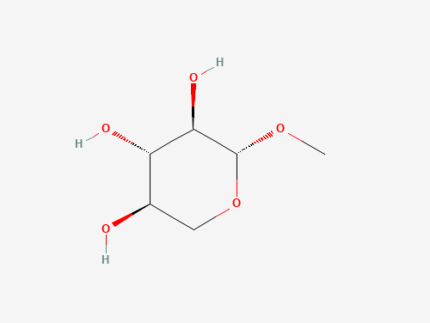
Properties: Mol Formula: C6H12O5, Mol Weight: 164.16
IUPAC Name: (2R,3R,4S,5R)-2-methoxyoxane-3,4,5-triol
Synonym: Methyl-beta-D-xylopyranoside, Methyl beta-D-xyloside, (2R,3R,4S,5R)-2-Methoxytetrahydro-2H-pyran-3,4,5-triol
10 in stock
Catalog No: A10GD-4825
Cas No: 14897-46-2
Properties: Mol Formula: C13H18O6, Mol Weight: 270.28
IUPAC Name: (2R,3R,4S,5R,6R)-2-(hydroxymethyl)-6-phenylmethoxyoxane-3,4,5-triol
Synonym: Benzyl b-D-galactopyranoside, (2R,3R,4S,5R,6R)-2-(hydroxymethyl)-6-phenylmethoxyoxane-3,4,5-triol, benzyl beta-d-galactopyranoside
10 in stock






Reviews
There are no reviews yet.