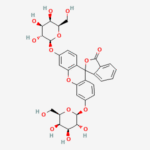
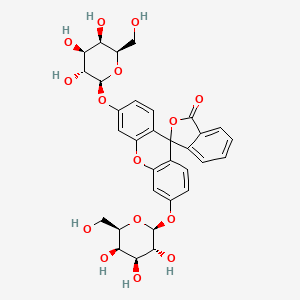
FDG (fluorescein‑di‑β‑D‑galactopyranoside, CAS 17817‑20‑8) is a synthetic β‑galactosidase‑specific fluorogenic substrate in which a fluorescein aglycone is linked via two β‑glycosidic bonds to two β‑D‑galactopyranose units. When hydrolyzed by β‑galactosidase or other β‑galactoside‑cleaving enzymes, the glycosidic bonds are cleaved to release fluorescein and β‑D‑galactose, with full fluorescence developing only after complete deglycosylation. The released fluorescein exhibits strong green fluorescence under visible‑light excitation, allowing highly sensitive, continuous monitoring of enzyme activity in microplate‑based assays and in situ cell‑based imaging. FDG is widely used to characterize β‑galactosidase activity in bacterial, plant, fungal, and mammalian systems, to study enzyme‑substrate specificity among galactosyl‑glycosides, and to quantify activity in kinetic experiments (Km, Vmax) and inhibitor‑screening assays. The compound is supplied as a high‑purity, water‑ or DMSO‑soluble powder and is suitable for reporter‑gene assays (e‑g., lacZ or β‑galactosidase‑complementation), in situ histochemical staining, and diagnostic‑type β‑galactosidase‑activity measurements. Its high quantum yield and compatibility with standard fluorometers and microplate readers make FDG a preferred tool for sensitive, fluorimetric detection of β‑galactosidase activity in both research and diagnostic applications.
Appearance
- Off‑white to pale yellow crystalline or amorphous solid.
- Forms a clear, colorless to slightly yellow solution in aqueous buffer or DMSO; develops bright green fluorescence only after enzymatic hydrolysis.
Source / synthesis
- Synthetically prepared by glycosylation of fluorescein with two β‑D‑galactopyranose units or protected β‑D‑galactoside derivatives, followed by deprotection and crystallization from water or mixed solvents.
- Commercially supplied by biochemical‑reagent and specialty‑sugar‑chemistry vendors (e.g., ChemSynlab, Biomol, various ChemicalBook‑linked suppliers) as a research‑grade β‑galactosidase substrate.
Molecular weight and structure
- Molecular formula: C32H32O15C32H32O15.
- Molecular weight: 656.6 g/mol.
- Structure: fluorescein‑di‑β‑D‑galactopyranoside, with two β‑glycosidic linkages connecting the aromatic fluorescein group to the anomeric oxygens of two D‑galactose rings in the pyranose form.
Sugar specificity
- Specifically hydrolyzed by β‑galactosidases and β‑galactoside‑cleaving glycosidases, typically requiring complete cleavage of both galactose units for full fluorescence.
- Widely used in fluorogenic assays to distinguish β‑galactosidase activity from other glycosidases in microbial and mammalian systems.
Biological activity
- Serves as a fluorogenic reporter whose rate of fluorescein release under defined pH and temperature conditions reflects β‑galactosidase activity.
- Enables determination of kinetic parameters (Km, Vmax), inhibitor‑IC₅₀, and comparative activity profiling of different β‑galactosidases, including those used in reporter‑gene and in situ assays.
Purity and microbial contamination
- Typically supplied at ≥95–99% purity (e.g., “>95%” or “≥99% HPLC”) as indicated by supplier data sheets and product‑specification labels.
- Described as a non‑sterile, research‑grade solid suitable for use in standard enzymatic assays under clean‑laboratory conditions.
Identity and quality control
- Identity inferred from molecular formula, molecular weight, melting point, and matching InChI/SMILES descriptors for fluorescein‑di‑β‑D‑galactopyranoside.
- Quality‑control includes checks for appearance, solubility, spectral properties (UV‑Vis/fluorescence), and performance in a defined β‑galactosidase activity assay (e.g., microplate‑based or in situ cell‑based formats).
Shelf life and storage
- Shelf life is generally 12–24 months when stored at −20 °C, sealed in a dry, light‑protected container, often recommended for hygroscopic and light‑sensitive material.
- Aqueous working solutions are best prepared fresh or stored at 4 °C for short periods; UV/visible‑light exposure and elevated temperature should be avoided to prevent photodegradation or nonspecific hydrolysis.
Application
- Fluorimetric assay of β‑galactosidase activity in bacterial, fungal, plant, and mammalian systems.
- Use in reporter‑gene assays (e.g., lacZ, β‑galactosidase complementation) and in situ histochemical staining of β‑galactosidase activity.
- Inhibitor‑screening and enzyme‑mechanism‑elucidation studies for β‑galactosidases and related glycosidases.
Key characteristics
- Fluorogenic readout based on fluorescein release, enabling highly sensitive, microplate‑compatible detection of β‑galactosidase activity in the green‑fluorescence channel.
- Defined di‑β‑D‑galactopyranoside linkage providing selectivity for β‑galactosidases over many α‑glycosidases.
- High‑purity, lyophilized solid with a known molecular formula and weight, suitable for quantitative enzyme assays and standardized reporter‑gene protocols.
Citations
- ChemSynlab – Fluorescein‑di‑β‑D‑galactopyranoside (FDG, CAS 17817‑20‑8, MF C₃₂H₃₂O₁₅, MW 656.6): http://chemsynlab.com/cn/product/17817-20-8.html
- Biomol – Fluorescein di‑β‑Galactopyranoside (CAS 17817‑20‑8, purity >95%, excitation/emission 490/514 nm): https://www.biomol.com/products/chemicals/biochemicals/fluorescein-di-beta-galactopyranoside-cay26860-5
- ChemicalBook – FDG (17817‑20‑8) product page (CAS 17817‑20‑8, structure, physical and chemical properties): https://www.chemicalbook.com/ChemicalProductProperty_EN_CB2422505.htm
- Fluorescein‑di‑β‑D‑galactopyranoside technology‑note (e.g., Rotman and Hofmann‑type assay descriptions): https://www.sciencedirect.com (search “fluorescein di‑beta‑D‑galactopyranoside β‑galactosidase”).
- General glycosidase‑substrate catalog (FDG and related fluorogenic galactosides overview): https://www.chemicalbook.com/ (search for “17817‑20‑8”).
- Journal‑article reference using fluorescein‑di‑β‑D‑galactopyranoside in β‑galactosidase‑activity assays (e.g., biochemical‑methods‑oriented papers): https://www.ncbi.nlm.nih.gov/pubmed/ (search “fluorescein di‑beta‑D‑galactopyranoside assay”).
- Sigma‑Aldrich or similar supplier page (if listed under “fluorescein‑di‑β‑D‑galactoside” or FDG analogs; use regional product‑search functions).
- Fluorescein‑based assay‑technology review (context for FDG‑type substrates in fluorogenic reporter systems): [https://www.ncbi.nlm.nih.gov/pmc/] (search “fluorescein‑di‑β‑D‑galactoside”).
- Pharmaceutical‑microbiology or quality‑control‑guidance document (for general microbial‑contamination‑control concepts relevant to non‑sterile biochemical‑reagents): e.g., https://www.fda.gov/media/88801/download.
- Vendor‑catalog summary (e.g., BioMol‑type listings for fluorescein‑di‑β‑D‑galactopyranoside, CAS 17817‑20‑8): https://www.biomol.com (search “FDG” or “fluorescein di‑beta‑galactopyranoside”).




![N [3',6' Bis(beta D galactopyranosyloxy) 3 oxospiro[isobenzofuran 1(3H),9' [9H]xanthen] 5 yl]dodecanamide](https://glycodepot.com/wp-content/uploads/2026/04/N-36-Bisbeta-D-galactopyranosyloxy-3-oxospiroisobenzofuran-13H9-9Hxanthen-5-yldodecanamide-150x150.png)
Reviews
There are no reviews yet.