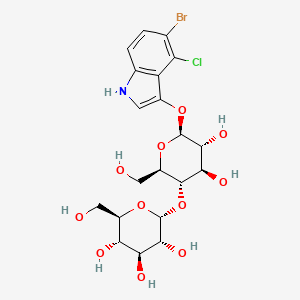
X‑α‑D‑Maltoside (CAS 207595‑15‑1) is a synthetic α‑D‑maltosidase‑specific chromogenic substrate in which a 5‑bromo‑4‑chloro‑3‑indolyl aglycone is linked via an α‑glycosidic bond to the non‑reducing end of α‑D‑maltopyranosyl disaccharide (maltose). When hydrolyzed by α‑D‑maltosidases, pullulanases, or other α‑maltoside‑cleaving enzymes, the glycosidic bond is cleaved to release the indole derivative and α‑D‑maltose; the indole then undergoes aerial oxidation to form a strongly colored magenta‑ or blue‑colored precipitate at the site of enzyme activity. This reaction makes X‑α‑D‑Maltoside particularly useful for histochemical staining of α‑D‑maltosidase activity in cells, tissues, and microbial colonies, as well as for high‑throughput screening of enzyme‑expressing clones or recombinant amylase‑type enzymes. The compound is typically supplied as a high‑purity, lyophilized or crystalline solid, compatible with standard aqueous or buffer‑based incubation systems and inclusion in agar‑based media. X‑α‑D‑Maltoside is widely used in glycobiology, food‑microbiology, and industrial‑enzyme research to visualize α‑maltosidase‑dependent processing of starch‑derived maltooligosaccharides, including studies of α‑amylase, pullulanase, and maltase‑type systems.
Appearance
- Off‑white to pale yellow crystalline or lyophilized powder.
- Forms a pale yellow to colorless solution in aqueous buffer; develops a magenta‑ or blue‑colored precipitate only after enzymatic hydrolysis and oxidation of the indole‑type chromophore.
Source / synthesis
- Synthetically prepared by glycosylation of 5‑bromo‑4‑chloro‑3‑indole with α‑D‑maltopyranose or a protected α‑D‑maltoside, followed by deprotection and crystallization from water or mixed solvents.
Molecular weight and structure
- Molecular formula: C20H25BrClNO11.
- Molecular weight: 570.77 g/mol.
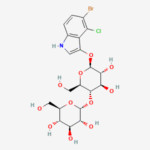
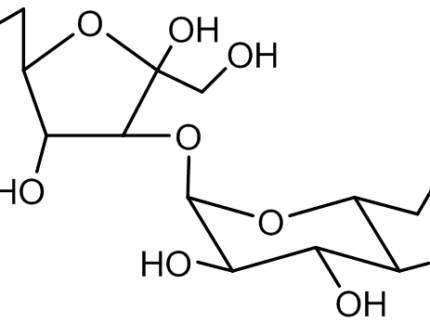
- Structure: 5‑bromo‑4‑chloro‑3‑indolyl‑α‑D‑maltopyranoside, with an α‑glycosidic linkage between the indole‑type aglycone and the non‑reducing glucose unit of α‑D‑maltose (i.e., an indolyl‑α‑(1→4)‑linked glucosyl disaccharide).
Sugar specificity
- Specifically hydrolyzed by α‑D‑maltosidases and other α‑maltoside‑cleaving glycosidases, including pullulanases and certain α‑amylase‑related enzymes active on maltosyl linkages.
- Frequently used in chromogenic panels and agar‑based media to distinguish α‑maltosidase or α‑1,4‑glycosidase activity from other glycosidases in microbial and industrial systems.
Biological activity
- Serves as a chromogenic reporter whose rate of indole‑derivative release under defined pH and temperature conditions reflects α‑D‑maltosidase activity.
- Enables localization and relative quantification of α‑D‑maltosidase activity in tissue sections, cell cultures, and microbial colonies, supporting studies on starch‑ and maltose‑processing enzymes.
Purity and microbial contamination
- Typically described as a “high‑purity raw material” (e.g., “high‑purity raw material suitable for scientific research”), with purity often ≥95% by HPLC‑type methods.
- Described as a non‑sterile, research‑grade solid suitable for use under standard clean‑laboratory or sterile‑handling conditions, depending on the assay (e.g., microbiological vs. histochemical).
Identity and quality control
- Identity based on CAS 207595‑15‑1, molecular formula C20H25BrClNO11C20H25BrClNO11, and molecular weight 570.77 g/mol, with the systematic name 5‑bromo‑4‑chloro‑3‑indolyl‑α‑D‑maltopyranoside.
- Quality‑control includes checks for appearance, solubility, spectral properties, and performance in defined α‑D‑maltosidase or maltase‑type activity assays (e.g., agar‑based colony‑screening or enzyme‑kinetic assays).
Shelf life and storage
- Shelf life is typically 12–24 months when stored at −20 °C in a tightly sealed, light‑protected container, as the indole‑type chromophore is sensitive to light and oxidation.
- Aqueous working solutions or agar media containing the substrate are best used fresh or shortly after preparation to avoid nonspecific color development.
Application
- Histochemical and chromogenic staining of α‑D‑maltosidase activity in tissue sections, cell cultures, and microbial colonies.
- Use in agar‑based chromogenic media for differentiation and detection of α‑maltosidase‑expressing microorganisms.
- Enzyme‑activity and substrate‑specificity studies of α‑amylase‑, pullulanase‑, and maltase‑type systems.
Key characteristics
- Chromogenic readout: release of an indole derivative that oxidizes to a magenta‑ or blue‑colored precipitate, enabling straightforward visual detection of α‑D‑maltosidase activity.
- Defined α‑D‑maltopyranoside linkage providing selectivity for α‑D‑maltosidases and other α‑maltoside‑cleaving enzymes over many β‑glycosidases.
- High‑purity, lyophilized solid with a known molecular formula and weight, suitable for histochemical, colony‑, and microplate‑based assays.
Citations
- Hepattack – X‑α‑D‑Maltoside product page (CAS 207595‑15‑1, MF C₂₀H₂₅BrClNO₁₁, MW 570.77): https://www.hepattack.com/en/product03_cid_212_pid_503.html
- Hepattack – X‑substrate series listing (X‑α‑D‑Maltoside at CAS 207595‑15‑1 in product catalog): https://www.hepattack.com/en/product02_page_2.html
- Chemical‑data‑aggregator (e.g., ChemicalBook‑style overview) for 5‑bromo‑4‑chloro‑3‑indolyl‑α‑D‑maltoside (core X‑substrate concept): https://amp.chemicalbook.com/ChemicalProductProperty_EN_CB9198621.htm (search for “5‑bromo‑4‑chloro‑3‑indolyl‑α‑D‑maltoside”).
- Maltooligosaccharide‑review (PMC) on chromogenic/fluorogenic derivatives of maltooligosaccharides for enzyme‑activity assays: https://pmc.ncbi.nlm.nih.gov/articles/PMC10097025/
- Chromogenic‑substrate overview (DC Fine Chemicals, X‑substrate‑type indolyl‑glycosides): https://www.dcfinechemicals.com/en/blog/chromogenic-substrates-overview/
- GoldBio chromogenic‑substrates guide (context for indolyl‑glycoside‑based enzyme detection): https://www.goldbio.com/blogs/articles/chromogenic-substrates-overview
- ZELLX – X‑α‑Glc product‑description (method‑analog for indolyl‑glucoside‑type enzyme detection): https://zellx.de/product/5-bromo-4-chloro-3-indolyl-%CE%B1-d-glucopyranoside-x-%CE%B1-glc/
- General glycosidase‑substrate catalog (X‑α‑D‑Maltoside and related X‑substrates overview): https://www.chemicalbook.com/ (search for “207595‑15‑1”).
- Inalcopharm‑style technical‑sheet (for X‑α‑Glc, X‑α‑Gal‑type indolyl‑glycoside‑use in microbiology and histochemistry, analogous to X‑α‑D‑Maltoside): https://www.inalcopharm.com/download_files/10_12215032040.pdf
- N‑dodecyl‑α‑D‑maltoside product page (for α‑D‑maltoside‑chemistry context, same maltooligosaccharide core): https://www.sigmaaldrich.com/IN/en/product/apolloscientificltd/apoh93d9319







Reviews
There are no reviews yet.