About this product
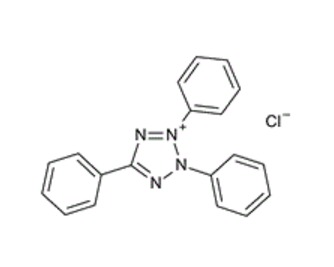
2,3,5-Triphenyltetrazolium chloride
TTC; Tetrazolium red; TPTZ; Tetrazole red
Tetrazolium Red is used to visualise dehydrogenase enzyme activity. Initially the tetrazolium solution is colorless but changes to red when it comes into contact with hydrogen. Tetrazolium red is used in a biochemical viability test for seeds. The test relies on dehydrogenase enzymes to release hydrogen ions which subsequently reduce the colorless tetrazolium salt solution to a red compound called formazan. Living cells turn red, while dead cells remain colorless.
Redox indicator used to detect cellular respiration. Primarily reduced by Complex I in mitochondria and, under anaerobic conditions, is completely reduced to an insoluble red 1,3,5-triphenylformazan. Typically used as a mitochondrial redox potential indicator for cell death.
TTC is a redox indicator used to detect cellular respiration. It is primarily reduced by Complex I in mitochondria and, under anaerobic conditions, is completely reduced to an insoluble red 1,3,5-triphenylformazan. TTC assays are typically used as a mitochondrial redox potential indicator for cell death.
Title: Triphenyltetrazolium Chloride
CAS Registry Number: 298-96-4
Additional Names: 2,3,5-Triphenyl-2H-tetrazolium chloride; red tetrazolium; TPTZ; TTC; RT
Trademarks: VitaStain (Arapahoe)
Molecular Formula: C19H15ClN4
Molecular Weight: 334.80
Percent Composition: C 68.16%, H 4.52%, Cl 10.59%, N 16.73%
Literature References: Prepn: H. v. Pechmann, P. Runge, Ber. 27, 2920 (1894); Atkinson et al., Science 111, 385 (1950); R. Kuhn, D. Jerchel, Ber. 74, 945 (1941); R. Price, J. Chem. Soc. A 1971, 3379. Review of prepn and use of tetrazolium salts as indicators in biochemical and biological oxidation-reduction processes: W. Ried, Angew. Chem. 14, 391 (1952).
Properties: Solvated nearly colorless needles from alcohol or chloroform, dry at 105?. Turns yellow on exposure to light. Dec 243?. Sol in water, alcohol, acetone. Insol in ether. Oxidizes aldoses and ketoses, as well as other a-ketols, and is thereby reduced to a water-insoluble, deep red pigment, a triphenylformazan.
Use: In analytical chemistry as a sensitive reagent for reducing sugars, and to distinguish between a-ketols and simple aldehydes. For staining plant and animal tissue. Germination indicator in testing the ability of seeds to germinate: G. Lakon, Ber. Dtsch. Bot. Ges. 60, 299, 434 (1942). In histochemical studies. In determination of antibiotics; of dehydrogenases.
CAS Number 298-96-4
Product Name 2,3,5-Triphenyltetrazolium chloride
IUPAC Name 2,3,5-triphenyltetrazol-2-ium;chloride
Molecular Formula C19H15ClN4
Molecular Weight 334.80 g/mol
InChI InChI=1S/C19H15N4.ClH/c1-4-10-16(11-5-1)19-20-22(17-12-6-2-7-13-17)23(21-19)18-14-8-3-9-15-18;/h1-15H;1H/q+1;/p-1
InChI Key PKDBCJSWQUOKDO-UHFFFAOYSA-M
SMILES C1=CC=C(C=C1)C2=NN([N+](=N2)C3=CC=CC=C3)C4=CC=CC=C4.[Cl-]
Synonyms 1,3,5-Triphenyl-2H-tetrazolium Chloride; 1,3,5-Triphenyltetrazolium Chloride; 2,3,5-Triphenyltetrazolium Chloride; PTB; RT; Red Tetrazolium; TPTZ; TT; TTC; TTC (dye); Tetrazolium Chloride; Tetrazolium Red; Triphenyltetrazolium Chloride; Urocheck; Uro
Canonical SMILES C1=CC=C(C=C1)C2=NN([N+](=N2)C3=CC=CC=C3)C4=CC=CC=C4.[Cl-]

![N-[(2S,3R,4R,5R,6R)-2-[(6-CHLORO-1H-INDOL-3-YL)OXY]-4,5-DIHYDROXY-6-(HYDROXYMETHYL)OXAN-3-YL]ACETAMIDE](https://iqqtzppqhmpvcumbzjyb.supabase.co/storage/v1/object/public/images/products/23/1782805624190_main_N-2S-3R-4R-5R-6R-2-6-CHLORO-1H-INDOL-3-YL-OXY-4-5-DIHYDROXY-6-HYDROXYMETHYL-OXAN-3-YL-ACETAMIDE.png)