About this product
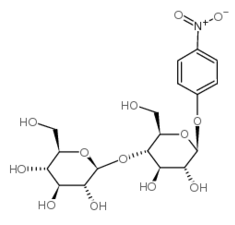
4-Nitrophenyl b-D-cellobioside
Chromogenic substrate for cellulases.
4-Nitrophenyl ?-D-cellobioside is a disaccharide and an enzyme substrate. It has been used to characterize the function of endoglucanase 1 from T. harzianum, ?-glucosidase from T. xylanolyticum, and glycoside hydrolase family 3 (GH3) aryl ?-glucosidases from A. oryzae.
4-Nitrophenyl beta-D-cellobioside (p-nitrophenyl-?-D-cellobioside or PNPC) is a synthetic substrate used to measure the activity of cellobiases, enzymes that hydrolyze cellobiose to glucose monomers. PNPC is a ?-glycoside, a molecule that contains a glycosidic bond between two sugar molecules. In this case, PNPC consists of two cellobiose units connected by this bond.
Physical and Chemical Properties
PNPC is a yellow crystalline powder that is slightly soluble in water and ethanol. Its molecular formula is C18H21NO11, and its molecular weight is 427.35 g/mol. PNPC is stable at room temperature but decomposes at temperatures above 80?C.
Synthesis and Characterization
PNPC can be synthesized via several methods, including the reaction of p-nitrophenol and cellobiose in the presence of acid or catalytic amounts of an enzyme. The synthesis of PNPC can also be achieved using in vitro enzymatic synthesis. The purity and identity of PNPC can be confirmed via techniques like thin-layer chromatography (TLC), high-performance liquid chromatography (HPLC), and nuclear magnetic resonance (NMR) spectroscopy.
Analytical Methods
PNPC can be analyzed through enzymatic assays that monitor the rate of cellobiose hydrolysis using spectrophotometric techniques. Enzymatic assays can also be coupled with additional techniques like liquid chromatography-mass spectrometry (LC-MS) and capillary electrophoresis (CE) to obtain more detailed information about cellobiase activity.
Biological Properties
As a cellobiose-mimicking substrate, PNPC can be used to study the activity of cellobiases and other enzymes that hydrolyze ?-glycosides. There is limited information about the biological properties of PNPC itself, as it is primarily used as a research tool.
Toxicity and Safety in Scientific Experiments
PNPC is not known to be significantly toxic or hazardous when used in scientific experiments, although it may be harmful if ingested or inhaled. Researchers should take appropriate safety precautions when handling PNPC, including wearing gloves, lab coats, and eye protection.
Applications in Scientific Experiments
PNPC has several important applications in scientific experiments, including:
? Measuring the activity of cellobiases and related enzymes
? Studying the mechanisms and kinetics of cellobiose hydrolysis
? Developing and optimizing cellobiase assays
Current State of Research
PNPC has been widely used as a substrate for measuring cellobiase activity and studying the mechanisms of cellobiose hydrolysis. Recent research has focused on the development of more sensitive and specific cellobiase assays using PNPC, as well as the synthesis of modified PNPC derivatives that can be used to study other ?-glycosidases.
Potential Implications in Various Fields of Research and Industry
The use of PNPC and related substrates has important implications in several fields of research and industry, including:
? Bioenergy: Cellobiases are critical enzymes in the production of biofuels from lignocellulosic biomass, and PNPC can be used to develop and optimize cellobiase assays for this purpose.
? Glycoscience: ?-glycosides like PNPC are important tools for studying the structure and function of complex carbohydrates in biological systems.
Limitations and Future Directions
While PNPC is a valuable research tool, there are some limitations to its use. For example, PNPC is not an ideal substrate for all cellobiases and may not accurately reflect in vivo cellobiose hydrolysis. Future research directions for PNPC and related substrates may include:
? The synthesis and characterization of modified PNPC derivatives that can be used to study other ?-glycosidases
? The development of more sensitive and specific cellobiase assays for bioenergy and glycoscience applications
? The use of PNPC and related substrates to study the roles of cellobiases and ?-glycosides in biological systems beyond cellobiose hydrolysis.
CAS Number 3482-57-3
Product Name 4-Nitrophenyl beta-D-cellobioside
IUPAC Name (2S,3R,4S,5S,6R)-2-[(2R,3S,4R,5R,6S)-4,5-dihydroxy-2-(hydroxymethyl)-6-(4-nitrophenoxy)oxan-3-yl]oxy-6-(hydroxymethyl)oxane-3,4,5-triol
Molecular Formula C18H25NO13
Molecular Weight 463.4 g/mol
InChI InChI=1S/C18H25NO13/c20-5-9-11(22)12(23)14(25)18(30-9)32-16-10(6-21)31-17(15(26)13(16)24)29-8-3-1-7(2-4-8)19(27)28/h1-4,9-18,20-26H,5-6H2/t9-,10-,11-,12+,13-,14-,15-,16-,17-,18+/m1/s1
InChI Key IAYJZWFYUSNIPN-KFRZSCGFSA-N
SMILES C1=CC(=CC=C1[N+](=O)[O-])OC2C(C(C(C(O2)CO)OC3C(C(C(C(O3)CO)O)O)O)O)O
Synonyms 4-nitrophenyl beta-cellobioside, p-nitrophenyl beta-D-cellobioside, para-nitrophenyl beta-D-cellobioside, PNPC
Canonical SMILES C1=CC(=CC=C1[N+](=O)[O-])OC2C(C(C(C(O2)CO)OC3C(C(C(C(O3)CO)O)O)O)O)O
Isomeric SMILES C1=CC(=CC=C1[N+](=O)[O-])O[C@H]2[C@@H]([C@H]([C@@H]([C@H](O2)CO)O[C@H]3[C@@H]([C@H]([C@@H]([C@H](O3)CO)O)O)O)O)O
CAS No: 3482-57-3
Synonyms: PNP-cellobioside
MDL No: MFCD00069845
Chemical Formula: C18H25NO13
Molecular Weight: 463.39
COA:
Name : 4-Nitrophenyl beta-D-cellobioside; PNPC
CAS: 3482-57-3 M.F.: C 18 H 25 NO 13 M .W.: 463.39
Items
Standards
Results
Appearance
White crystal powder
Complies
Solubility
Easily soluble in water, insoluble in ether
Complies
Identification
IR and HPLC
Complies
Appearance of solution
Dissolve0.5gin 10mL water,
and the solution should be clear
Complies
Loss weight on drying
Max.0.5%
0.1%
Heavy metal
Max. 20ppm
Complies
Residue on ignition
Max. 0.5%
0.1%
TLC
One spot
One spot
p-Nitrophenol
Max. 20ppm
Complies
Any other impurity
Max. 0.5%
Complies
Assay by HPLC
Min. 98%
99.2%
*Chromogenic cellobiohydralase (e.g. cellobiosidase) substrate used in histochemistry
References:
1. Eckert K, Zielinski F, Lo Leggio L, Schneider E, Appl. Microbiol. Biotechnol. 2002, Vol60, Pt4, p428-436

![N-[(2S,3R,4R,5R,6R)-2-[(6-CHLORO-1H-INDOL-3-YL)OXY]-4,5-DIHYDROXY-6-(HYDROXYMETHYL)OXAN-3-YL]ACETAMIDE](https://iqqtzppqhmpvcumbzjyb.supabase.co/storage/v1/object/public/images/products/23/1782805624190_main_N-2S-3R-4R-5R-6R-2-6-CHLORO-1H-INDOL-3-YL-OXY-4-5-DIHYDROXY-6-HYDROXYMETHYL-OXAN-3-YL-ACETAMIDE.png)