About this product
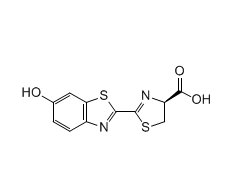
D-Luciferin Firefly,(S)-4,5-Dihydro-2-(6-hydroxy-2-benzothiazolyl)-4-thiazolecarboxylic acid
D-Luciferin is a chemiluminescent substrate of firefly luciferase. It produces light upon oxidative decarboxylation by luciferase in the presence of ATP. D-Luciferin can be employed to assay the expression of the luciferase gene linked to a promoter of interest. Alternatively, D-luciferin and luciferase can be used to assess ATP availability in cellular or biochemical assays.
D-Luciferin, also known as Firefly Luciferin, is a light-emitting compound, found in many firefly (Lampyridae) species. It is the substrate of luciferase (EC 1.13.12.7), which is responsible for the characteristic yellow light emission from many firefly species. As with all other luciferins, oxygen is required to elicit light; however, it has also been found that adenosine triphosphate (ATP) and magnesium are required for light emission.
Bioluminescent substrate for luciferase; used to assay ATP availability
Title: Firefly Luciferin
CAS Registry Number: 2591-17-5
CAS Name: (4S)-4,5-Dihydro-2-(6-hydroxy-2-benzothiazolyl)-4-thiazolecarboxylic acid
Additional Names: 2-(6-hydroxybenzothiazol-2-yl)-2-thiazoline-4-carboxylic acid; D-(-)-luciferin
Molecular Formula: C11H8N2O3S2
Molecular Weight: 280.32
Percent Composition: C 47.13%, H 2.88%, N 9.99%, O 17.12%, S 22.88%
Literature References: Light emission in the American firefly, Photinus pyralis, has been shown to involve the interaction of magnesium ion, oxygen, ATP, the enzyme luciferase, and the oxidizable substrate luciferin. Isoln from fireflies (yield from 15,000 active fireflies about 9 mg): Bitler, McElroy, Arch. Biochem. Biophys. 72, 358 (1957); from Japanese firefly (Luciola cruciata): Kishi et al., Tetrahedron Lett. 1968, 2847. Structure and synthesis: E. H. White et al., J. Am. Chem. Soc. 83, 2402 (1961); 85, 337 (1963); J. Org. Chem. 30, 2344 (1965); S. Seto et al., Bull. Chem. Soc. Jpn. 36, 331 (1963). Configuration: G. E. Blank et al., Biochem. Biophys. Res. Commun. 42, 583 (1971). Measurement of ATP: D. M. Karl, O. Holm-Hansen, Anal. Biochem. 75, 100 (1976). Review: L. J. Bowie, Methods Enzymol. 57, 15 (1978).
Properties: Pale yellow needles from methanol, dec 189.5-190?. Recrystallizes with difficulty and sublimes with decomposition and decarboxylation. [a]D22 -36? (c = 1.2 in DMF). uv max (H2O): 268, 327 nm (log e 3.88, 4.27). Slightly sol in water at pH 6.5. Sol in alkaline aq solns, methanol, acetone, ethyl acetate, DMF. Aqueous solns are sensitive to extremes in pH, esp. in presence of light and oxygen. Racemization occurs rapidly in some solvents. Should be stored for extended periods dry, under nitrogen atmosphere in light-tight containers.
Optical Rotation: [a]D22 -36? (c = 1.2 in DMF)
Absorption maximum: uv max (H2O): 268, 327 nm (log e 3.88, 4.27)
Use: In the assay of ATP.
CAS Number 2591-17-5
Product Name Firefly luciferin
IUPAC Name (4S)-2-(6-hydroxy-1,3-benzothiazol-2-yl)-4,5-dihydro-1,3-thiazole-4-carboxylic acid
Molecular Formula C11H8N2O3S2
Molecular Weight 280.3 g/mol
InChI InChI=1S/C11H8N2O3S2/c14-5-1-2-6-8(3-5)18-10(12-6)9-13-7(4-17-9)11(15)16/h1-3,7,14H,4H2,(H,15,16)/t7-/m1/s1
InChI Key BJGNCJDXODQBOB-SSDOTTSWSA-N
SMILES C1C(N=C(S1)C2=NC3=C(S2)C=C(C=C3)O)C(=O)O
Solubility Soluble in DMSO, not in water
Synonyms D-Luciferin; Firefly Luciferin.
Canonical SMILES C1C(N=C(S1)C2=NC3=C(S2)C=C(C=C3)O)C(=O)O
Isomeric SMILES C1[C@@H](N=C(S1)C2=NC3=C(S2)C=C(C=C3)O)C(=O)O

![N-[(2S,3R,4R,5R,6R)-2-[(6-CHLORO-1H-INDOL-3-YL)OXY]-4,5-DIHYDROXY-6-(HYDROXYMETHYL)OXAN-3-YL]ACETAMIDE](https://iqqtzppqhmpvcumbzjyb.supabase.co/storage/v1/object/public/images/products/23/1782805624190_main_N-2S-3R-4R-5R-6R-2-6-CHLORO-1H-INDOL-3-YL-OXY-4-5-DIHYDROXY-6-HYDROXYMETHYL-OXAN-3-YL-ACETAMIDE.png)