About this product
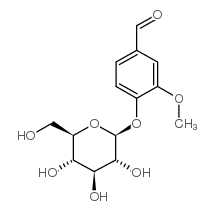
Vanilloside, also known as avenein or glucovanillin, belongs to the class of organic compounds known as phenolic glycosides. These are organic compounds containing a phenolic structure attached to a glycosyl moiety. Some examples of phenolic structures include lignans, and flavonoids. Among the sugar units found in natural glycosides are D-glucose, L-Fructose, and L rhamnose. Vanilloside exists as a solid, soluble (in water), and a very weakly acidic compound (based on its pKa). Within the cell, vanilloside is primarily located in the cytoplasm. Vanilloside is a very mild, bitter, and vanilla tasting compound that can be found in cereals and cereal products and oat. This makes vanilloside a potential biomarker for the consumption of these food products.
Glucovanillin is a natural product that is found in the papillae of various plants and in the bark of conifers. It is an inhibitor of bacterial growth, but its mechanism of action has not been determined. Glucovanillin has been shown to exhibit anti-inflammatory properties, which may be due to its inhibition of prostaglandin synthesis. In tissue culture experiments, glucovanillin inhibited the growth of Candida albicans and Helicobacter pylori. The active form, vanillin, can be produced by hydrolysis of glucovanillin with hydrochloric acid or by microbial metabolism. The optimum pH for glucovanillin production is between 5 and 6, with a maximum at about pH 4.5. The surface methodology for detecting glucovanillin involves measuring the reaction solution's absorption spectrum at 260 nm after adding hydrochloric acid and sodium hydroxide to react with the sample.
CAS Number 494-08-6
Product Name Glucovanillin
IUPAC Name 3-methoxy-4-[(2S,3R,4S,5S,6R)-3,4,5-trihydroxy-6-(hydroxymethyl)oxan-2-yl]oxybenzaldehyde
Molecular Formula C14H18O8
Molecular Weight 314.29 g/mol
InChI InChI=1S/C14H18O8/c1-20-9-4-7(5-15)2-3-8(9)21-14-13(19)12(18)11(17)10(6-16)22-14/h2-5,10-14,16-19H,6H2,1H3/t10-,11-,12+,13-,14-/m1/s1
InChI Key LPRNQMUKVDHCFX-UHFFFAOYSA-N
SMILES COC1=C(C=CC(=C1)C=O)OC2C(C(C(C(O2)CO)O)O)O
Synonyms 4-(beta-D-Glucopyranosyloxy)-3-methoxybenzaldehyde
Canonical SMILES COC1=C(C=CC(=C1)C=O)OC2C(C(C(C(O2)CO)O)O)O
Isomeric SMILES COC1=C(C=CC(=C1)C=O)O[C@H]2[C@@H]([C@H]([C@@H]([C@H](O2)CO)O)O)O
COA:
Product name: Glucovanillin, 4-(beta-D-Glucopyranosyloxy)-3-methoxybenzaldehyde
M.F.: C 14 H 18 O 8 M.W.: 314.29 CAS: 494-08-6
Items
Standards
Results
Appearance
White crystals or powder
Positive
Solubility
Easily soluble in water, insoluble in ether
Complies
Appearance of solution
Dissolve0.5gin 10mLof water,
and the solution should be clear
Complies
Identification
IR and TLC
Complies
MS and NMR
Should Comply
Complies
M.P.
180 ? ~ 190 ?
185 ? ~188 ?
Loss weight on
Dryness
Min.1%
0.2%
Residue on ignition
Max. 0.5%
0.1%
TLC
Should be one spot
one spot
Heavy metal
Max.50ppm
Complies
Any other impurity
Max. 0.5%
Complies
Assay
Min. 98%
99.2%
![N-[(2S,3R,4R,5R,6R)-2-[(6-CHLORO-1H-INDOL-3-YL)OXY]-4,5-DIHYDROXY-6-(HYDROXYMETHYL)OXAN-3-YL]ACETAMIDE](https://iqqtzppqhmpvcumbzjyb.supabase.co/storage/v1/object/public/images/products/23/1782805624190_main_N-2S-3R-4R-5R-6R-2-6-CHLORO-1H-INDOL-3-YL-OXY-4-5-DIHYDROXY-6-HYDROXYMETHYL-OXAN-3-YL-ACETAMIDE.png)