About this product
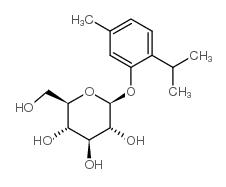
Thymol-b-D-glucopyranoside
Beta-D-Glucopyranoside, 5-methyl-2-(1-methylethyl)phenyl is a naturally occurring phenolic compound found in various fruits and vegetables such as apples, tea, and onions. It is also synthesized for many applications in research and industry. In this paper, we will provide a detailed analysis of this versatile compound including its definition and background, physical and chemical properties, synthesis and characterization, analytical methods, biological properties, toxicity and safety in scientific experiments, applications in scientific experiments, current state of research, potential implications in various fields of research and industry, limitations, and future directions.
Definition and Background
Beta-D-Glucopyranoside, 5-methyl-2-(1-methylethyl)phenyl (also known as phloretin glucoside) is a chemical compound that consists of a glucose molecule bound to a phloretin molecule. Phloretin is a dihydrochalcone that is a derivative of phloroglucinol, while glucose is a simple sugar that is essential for human metabolism. Phloretin glucoside is known for its antioxidant and anti-inflammatory properties, making it a promising candidate for various applications, including cosmetics, food industry, and pharmaceuticals.
Physical and Chemical Properties
Phloretin glucoside is a white, crystalline solid that is soluble in water and ethanol but insoluble in many organic solvents. It has a molecular weight of 436.40 g/mol and a melting point of 244-247?C. Chemically, it is classified as a glycoside, a type of molecule that consists of a carbohydrate molecule (in this case, glucose) linked to a non-sugar molecule (in this case, phloretin).
Synthesis and Characterization
Phloretin glucoside can be synthesized by enzymatic or chemical methods. One common method involves using a glucosyltransferase enzyme to catalyze the transfer of glucose from UDP-glucose to phloretin. The resulting product is then purified using chromatography techniques. Various spectroscopic and analytical techniques, including NMR, FT-IR, and LC-MS, can be used to determine the purity and identity of phloretin glucoside.
Analytical Methods
Several analytical methods have been developed to detect and quantify phloretin glucoside in different matrices. These methods include HPLC, GC-MS, and LC-MS. Additionally, various extraction techniques such as solid-phase extraction and liquid-liquid extraction have been used to isolate and purify phloretin glucoside from complex mixtures. These techniques allow the identification and quantification of phloretin glucoside in various matrices, including plant extracts, food products, and biological fluids.
Biological Properties
Phloretin glucoside has been shown to possess various biological activities, including antioxidant, anti-inflammatory, anticancer, and antimicrobial properties. Studies have demonstrated that phloretin glucoside can scavenge free radicals, inhibit oxidative stress, and reduce inflammation. In addition, it has been shown to induce apoptosis in cancer cells and inhibit the growth of pathogenic bacteria.
Toxicity and Safety in Scientific Experiments
Phloretin glucoside is generally considered safe for use in scientific experiments. However, like any other compound, it can be toxic at high concentrations. Studies have shown that phloretin glucoside has a low acute toxicity in rodents and is not mutagenic or genotoxic. Long-term studies are needed to determine the safety of phloretin glucoside in humans.
Applications in Scientific Experiments
Phloretin glucoside has numerous applications in scientific experiments, including its use as an antioxidant, anti-inflammatory agent, and anticancer agent. It has also been used as a probe to study the interaction between flavonoids and proteins. Furthermore, phloretin glucoside has potential applications in the field of food science as a natural preservative and flavoring agent.
Current State of Research
Research on phloretin glucoside is ongoing and has focused on its biological activities, synthesis, characterization, and applications. Several studies have investigated the antioxidant and anti-inflammatory properties of phloretin glucoside, with promising results. Furthermore, recent studies have shown that phloretin glucoside may have potential applications in the field of nanotechnology as a reducing agent for the synthesis of metal nanoparticles.
Potential Implications in Various Fields of Research and Industry
Phloretin glucoside has potential implications in various fields of research and industry, including cosmetics, food science, and pharmaceuticals. In the cosmetics industry, phloretin glucoside has been shown to have skin-protective effects, including the inhibition of UV-induced skin damage. It may also be used as a natural preservative and flavoring agent in the food industry. In the pharmaceutical industry, phloretin glucoside has potential as an antioxidant and anti-inflammatory agent and as a natural anticancer agent.
Limitations and Future Directions
Despite its promising properties, phloretin glucoside has some limitations that need to be addressed in future research. First, its bioavailability and pharmacokinetics in humans are not well understood. Second, its stability under different environmental conditions needs to be investigated to determine its applications in different industries. Third, its toxicity and safety in humans need to be evaluated in long-term studies. Future research should focus on addressing these limitations and exploring new applications for phloretin glucoside.
Future Directions
Possible future directions for the research on phloretin glucoside include:
- Investigating the potential of phloretin glucoside as a natural preservative in the food industry
- Evaluating the pharmacokinetics and bioavailability of phloretin glucoside in humans
- Investigating the potential of phloretin glucoside as a reducing agent for the synthesis of metal nanoparticles
- Investigating the potential of phloretin glucoside as a skin-protective agent in the cosmetics industry
- Developing new synthesis and purification methods for phloretin glucoside to improve its yield and purity
- Investigating the possibility of combining phloretin glucoside with other compounds to enhance its biological activities
- Using phloretin glucoside as a tool to study the interaction between flavonoids and proteins.
Conclusion
Phloretin glucoside is a promising compound that has various biological activities and potential applications in different fields of research and industry. Its antioxidant, anti-inflammatory, anticancer, and antimicrobial properties make it a promising candidate for various applications, including cosmetics, food industry, and pharmaceuticals. However, more research is needed to fully understand its properties, limitations, and potential applications.
CAS Number 20772-23-0
Product Name beta-D-Glucopyranoside, 5-methyl-2-(1-methylethyl)phenyl
IUPAC Name (2R,3S,4S,5R,6S)-2-(hydroxymethyl)-6-(5-methyl-2-propan-2-ylphenoxy)oxane-3,4,5-triol
Molecular Formula C16H24O6
Molecular Weight 312.36 g/mol
InChI InChI=1S/C16H24O6/c1-8(2)10-5-4-9(3)6-11(10)21-16-15(20)14(19)13(18)12(7-17)22-16/h4-6,8,12-20H,7H2,1-3H3/t12-,13-,14+,15-,16-/m1/s1
InChI Key GKQGIQVSMCHAFX-IBEHDNSVSA-N
SMILES CC1=CC(=C(C=C1)C(C)C)OC2C(C(C(C(O2)CO)O)O)O
Synonyms thymol-beta-D-glucopyranoside
Canonical SMILES CC1=CC(=C(C=C1)C(C)C)OC2C(C(C(C(O2)CO)O)O)O
Isomeric SMILES CC1=CC(=C(C=C1)C(C)C)O[C@H]2[C@@H]([C@H]([C@@H]([C@H](O2)CO)O)O)O
CAS No: 20772-23-0
MDL No: MFCD00080959
Chemical Formula: C16H24O6
Molecular Weight: 312.36
COA
: Product name : Thymol-beta-D-glucopyranoside CAS: 20772-23-0
M.F. : C 16 H 24 O 6 M .W. : 312.36 Batch No : 20140714 Quantity :28 g
Items
Standards
Results
Appearance
White crystal powder
Complies
Solubility
Soluble in hot water, insoluble in petroleun
Complies
NMR and MS
Should comply
Complies
Identification
IR and HPLC
Complies
Residue on ignition
Max. 0.5%
0.1%
Heavy metal
Max.50ppm
Complies
TLC
Should be one spot
One spot
Assay by HPLC
Min. 98%
98.8%

![N-[(2S,3R,4R,5R,6R)-2-[(6-CHLORO-1H-INDOL-3-YL)OXY]-4,5-DIHYDROXY-6-(HYDROXYMETHYL)OXAN-3-YL]ACETAMIDE](https://iqqtzppqhmpvcumbzjyb.supabase.co/storage/v1/object/public/images/products/23/1782805624190_main_N-2S-3R-4R-5R-6R-2-6-CHLORO-1H-INDOL-3-YL-OXY-4-5-DIHYDROXY-6-HYDROXYMETHYL-OXAN-3-YL-ACETAMIDE.png)