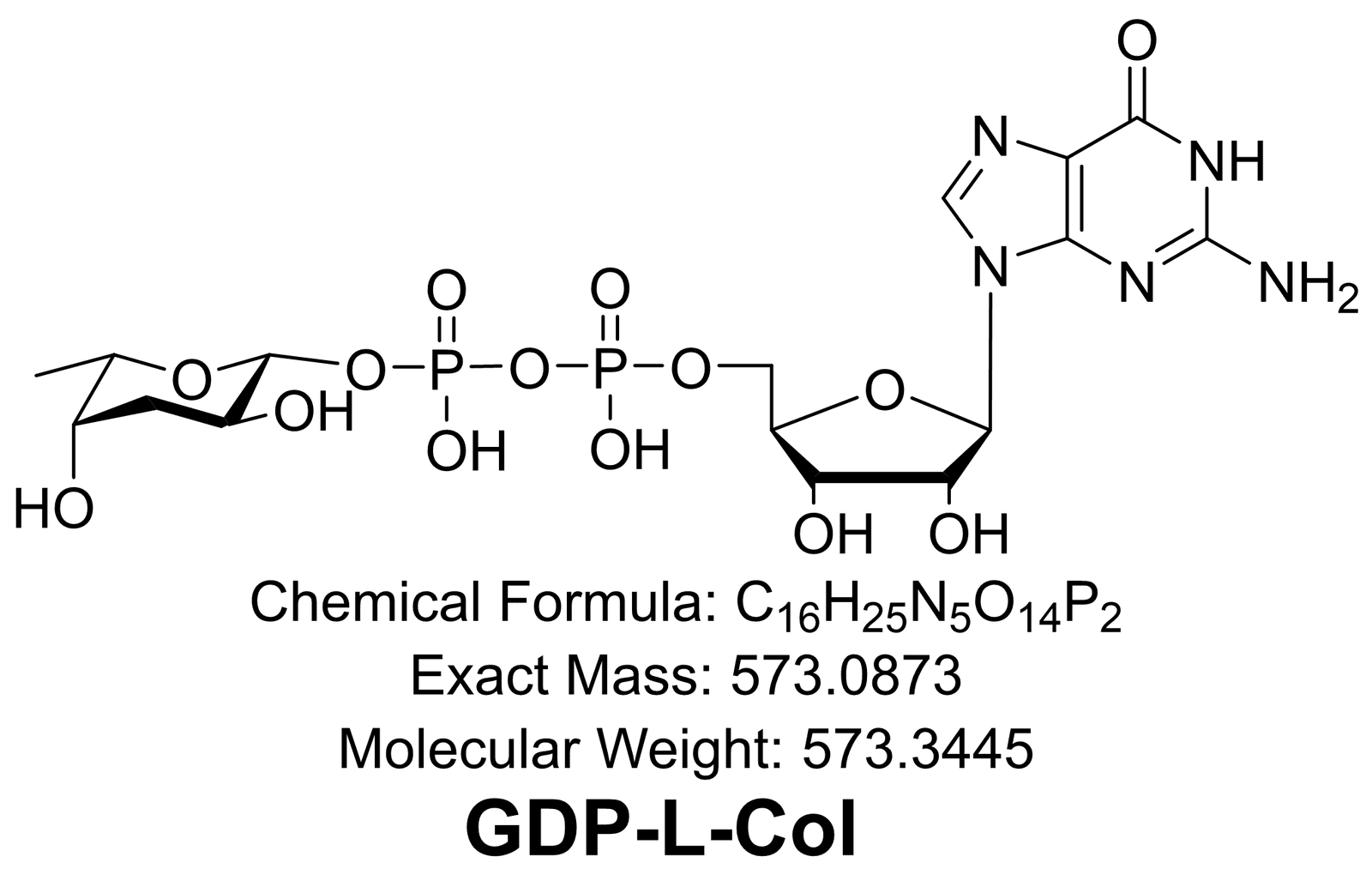
About this product
Abbreviated Name
UDP-diNAcBac
Synonyms
UDP-2,4-diacetamido-2,4,6-trideoxy-α-D-glucopyranose
SMILES
C[C@@H]3([C@H]([C@@H]([C@H]([C@@H](OP(OP(OC[C@@H]2([C@H]([C@H]([C@H](N1(\C=C/C(=O)NC1=O))O2)O)O))(=O)[O-])(=O)[O-])O3)NC(C)=O)O)NC(C)=O)
InChI
InChI=1S/C19H30N4O16P2/c1-7-12(20-8(2)24)15(28)13(21-9(3)25)18(36-7)38-41(33,34)39-40(31,32)35-6-10-14(27)16(29)17(37-10)23-5-4-11(26)22-19(23)30/h4-5,7,10,12-18,27-29H,6H2,1-3H3,(H,20,24)(H,21,25)(H,31,32)(H,33,34)(H,22,26,30)/p-2/t7-,10-,12-,13-,14-,15+,16-,17-,18-/m1/s1
InChIKey
InChIKey=KCAODEOZHCZEBC-TUHJILAWSA-L
UDP-diNAcBac (Uridine Diphosphate 2,4-diacetamido-2,4,6-trideoxy-bacillosamine) is a nucleotide sugar involved in the biosynthesis of bacterial glycans, particularly in the formation of glycoproteins and glycolipids. This molecule consists of uridine diphosphate (UDP) linked to a modified sugar, 2,4-diacetamido-2,4,6-trideoxy-bacillosamine (diNAcBac), which is a derivative of bacillosamine, a rare sugar found in bacteria.
Structure & Properties:
Molecular Weight (MW): Approximately 565 g/mol (depending on specific form and substitutions)
Chemical Formula: C19H30N4O16P2 (approximate)
Synonyms: UDP-2,4-diacetamido-2,4,6-trideoxy-bacillosamine
Functional Groups: diNAcBac is characterized by the presence of two acetamido groups (-NHCOCH3) at the 2 and 4 positions and the absence of hydroxyl groups at the 6 position, making it a unique deoxy sugar.
Biological Role:
Biosynthesis Pathway: UDP-diNAcBac is synthesized in bacterial cells through a series of enzymatic reactions, starting from UDP-glucose and involving the addition of acetamido groups and the removal of hydroxyl groups to form the trideoxy sugar.
Function: It acts as a glycosyl donor in the synthesis of bacterial glycoproteins and glycolipids, transferring the diNAcBac residue to acceptor molecules, thereby contributing to the formation of complex glycans.
Applications:
Bacterial Glycosylation: UDP-diNAcBac is essential in the glycosylation processes of bacteria, particularly in the formation of glycoproteins and glycolipids that are crucial for bacterial cell surface structures.
Synthetic Biology: It is used in synthetic biology to create engineered glycans with specific properties, particularly those mimicking bacterial glycan structures.
Significance in Research:
Bacterial Glycan Diversity: The presence of rare sugars like diNAcBac in bacterial glycans adds to the diversity of glycosylation patterns, which can influence bacterial pathogenicity and immune evasion.
Therapeutic Targeting: Understanding the biosynthesis and function of UDP-diNAcBac can lead to the development of antibacterial strategies that target glycosylation pathways in pathogenic bacteria.
Key Roles:
Pathogenic Bacteria: UDP-diNAcBac is involved in the biosynthesis of glycoproteins and glycolipids in pathogenic bacteria, contributing to their virulence and ability to evade the host immune system.
Bacterial Glycoprotein Synthesis: This molecule is a key component in the synthesis of bacterial glycoproteins, which play roles in cell adhesion, signaling, and biofilm formation.
Storage and Stability:
Storage: UDP-diNAcBac should be stored at -20°C in a moisture-free environment to maintain its stability.
Stability: The compound is stable under these conditions but can degrade if exposed to heat, moisture, or light.
Research Applications:
Glycobiology: UDP-diNAcBac is used in research to study bacterial glycosylation processes and the role of rare sugars in glycan biosynthesis.
Biotechnological Applications: It is employed in synthetic biology for engineering bacteria or other systems to produce glycoproteins and glycolipids with specific properties, useful in vaccine development and other therapeutic applications.
Potential Impact:
Antibacterial Strategies: Targeting the enzymes that synthesize UDP-diNAcBac could disrupt bacterial glycan biosynthesis, weakening bacterial defenses and making them more susceptible to immune responses or antibacterial agents.
Synthetic Glycans: Engineering synthetic glycans containing diNAcBac can have applications in developing new biomaterials and therapeutic agents.
Key Research Areas:
Bacterial Virulence: Research into UDP-diNAcBac's role in glycosylation can provide insights into the mechanisms of bacterial virulence and the development of immune evasion strategies.
Glycan Engineering: Studying UDP-diNAcBac enables the design of novel glycan structures for use in biotechnology and medicine, particularly in the development of vaccines and therapeutics targeting bacterial pathogens.
Conclusion:
UDP-diNAcBac is a crucial nucleotide sugar involved in the biosynthesis of complex bacterial glycans. Its role in glycosylation processes makes it a key molecule in research related to bacterial virulence, synthetic biology, and the development of antibacterial strategies. The ability to engineer and study glycans containing diNAcBac opens up new possibilities for therapeutic and industrial applications.