About this product
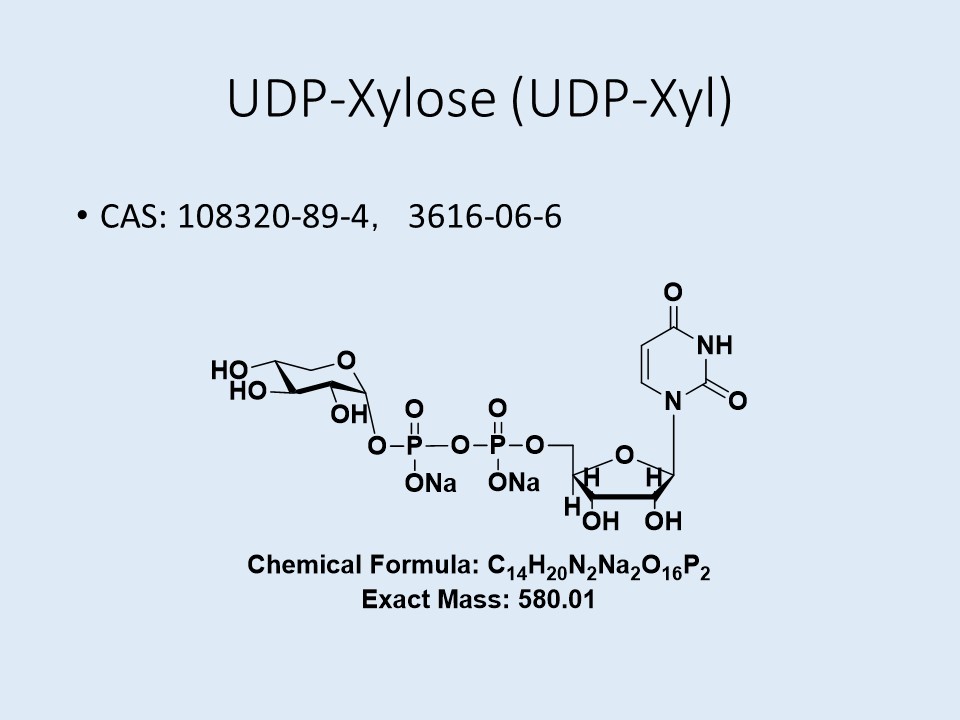
UDP-Xyl.2Na
UDP-D-Xyl, Uridine 5?-diphospho-a-D-xylopyranoside
UDP-Xyl.2Na (Uridine Diphosphate Xylose disodium salt) is a nucleotide sugar involved in the biosynthesis of various glycans, including glycosaminoglycans (GAGs) and hemicellulose in plant cell walls. Xylose is a five-carbon sugar that plays a critical role in both plant and animal glycosylation processes.
Structure & Properties:
Molecular Weight (MW): Approximately 566 g/mol (depending on specific form and substitutions)
Chemical Formula: C14H22N2Na2O17P2 (approximate)
Synonyms: UDP-xylose disodium salt, UDP-D-xylose
Functional Groups: UDP-Xyl consists of uridine diphosphate (UDP) linked to D-xylose, a pentose sugar.
Biological Role:
Biosynthesis Pathway: UDP-Xyl is synthesized from UDP-glucose through an enzymatic process that involves the decarboxylation of the glucose moiety. It serves as a sugar donor in various glycosylation processes.
Function: UDP-Xyl is crucial in transferring xylose residues to growing glycan chains. This process is essential for the formation of glycosaminoglycans in animals and hemicellulose in plant cell walls.
Applications:
Glycosaminoglycan (GAG) Biosynthesis: In animals, UDP-Xyl is a critical donor in the formation of the xylose-based linkage regions of proteoglycans, which are fundamental components of the extracellular matrix, including heparan sulfate and chondroitin sulfate.
Hemicellulose Biosynthesis: In plants, UDP-Xyl is involved in the biosynthesis of hemicellulose, which contributes to the structural stability and rigidity of plant cell walls.
Significance in Research:
Extracellular Matrix Research: Studying UDP-Xyl is important for understanding the assembly of GAGs, which are crucial for tissue integrity, cellular communication, and wound healing in animals.
Plant Cell Wall Biology: Research on UDP-Xyl contributes to understanding hemicellulose biosynthesis, which affects plant growth, biomass production, and resistance to pathogens.
Key Roles:
Proteoglycan Synthesis: UDP-Xyl initiates the formation of the linkage region in proteoglycans, vital for the structural and functional properties of the extracellular matrix in animals.
Plant Cell Wall Formation: In plants, UDP-Xyl is required for the synthesis of hemicellulose, which plays a key role in maintaining cell wall integrity and supporting plant growth.
Storage and Stability:
Storage: UDP-Xyl should be stored at -20°C in a moisture-free environment for optimal stability.
Stability: The compound is stable under these conditions but may degrade if exposed to heat, moisture, or light.
Research Applications:
Glycobiology: UDP-Xyl is used in research to study the biosynthesis of glycosaminoglycans and hemicellulose, with implications for understanding cell wall formation in plants and the extracellular matrix in animals.
Biotechnology: It is used in synthetic biology for engineering cells to produce specific glycan structures for therapeutic and industrial applications.
Potential Impact:
Agriculture and Bioenergy: Understanding and manipulating UDP-Xyl’s role in plant cell wall biosynthesis could lead to the development of crops with enhanced growth characteristics, biomass yield, and resistance to environmental stress.
Therapeutic Development: Research into UDP-Xyl’s involvement in proteoglycan biosynthesis can lead to the development of new therapies for connective tissue diseases and other conditions related to extracellular matrix dysfunction.
Conclusion:
UDP-Xyl.2Na is a key nucleotide sugar involved in the biosynthesis of proteoglycans in animals and hemicellulose in plants. Its role in these biosynthetic pathways makes it a critical molecule for research in plant biology, extracellular matrix biology, and therapeutic development.
Documents:
CoA