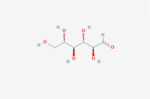

| Chemical Formula | C17H25N3O16P2 |
|
|---|---|---|
| Molecular Weight | 589.34 Daltons | |
| Monoisotopic Mass | 591.0866548559 Daltons |
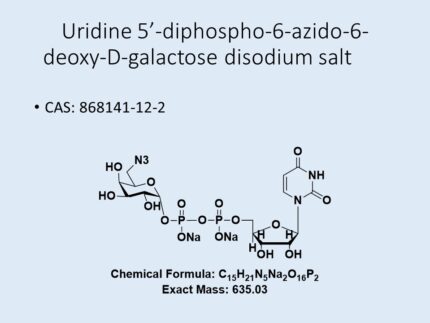
| Chemical Name | Uridine-5’-diphospho-6-azido-6-deoxy-D-galactose, Disodium Salt |
|---|---|
| Synonyms | UDP-6-N3-Gal·2Na, UDP-6-Azido-Galactose Disodium Salt, UDP-GalAz |
| Molecular Formula | C15H21N5O16P2 · 2Na |
| Molecular Weight | 635.28 g/mol (disodium salt) |
| CAS No. | 868141-12-2 (free acid) |
| Appearance | White to off-white lyophilized powder |
| Purity | ≥95% (HPLC) |
| Solubility | Soluble in water |
| Storage | −20°C, protect from moisture and light |
| Application | Azido-modified nucleotide sugar donor substrate for β-(1,4)-galactosyltransferases; the C6-azido handle enables bioorthogonal detection via strain-promoted azide–alkyne cycloaddition (SPAAC) and copper-catalyzed azide–alkyne cycloaddition (CuAAC); widely used in GlycoConnect™ antibody–drug conjugate (ADC) technology, glycan remodeling, and glycoproteomic profiling |
10 in stock
| Chemical Name | Uridine-5’-diphospho-6-azido-6-deoxy-D-glucose, Disodium Salt |
|---|---|
| Synonyms | UDP-6-N3-Glc·2Na, UDP-α-6N3-Glucose Disodium Salt, UDP-6-Azido-6-deoxy-D-Glucose Disodium Salt |
| Molecular Formula | C15H21N5O16P2 · 2Na |
| Molecular Weight | 635.28 g/mol (disodium salt) |
| CAS No. | 537039-67-1 |
| Appearance | White to off-white lyophilized powder |
| Purity | ≥95% (HPLC) |
| Solubility | Soluble in water |
| Storage | −20°C, protect from moisture and light |
| Application | Azido-modified nucleotide sugar donor substrate for glucosyltransferases; the C6-azido handle enables bioorthogonal detection via copper-catalyzed azide–alkyne cycloaddition (CuAAC) and strain-promoted azide–alkyne cycloaddition (SPAAC); used for selective labeling of 5-hydroxymethylcytosine (5-hmC) in genomic DNA, glycan imaging, and glycoproteomic profiling |
10 in stock
| Chemical Name | Uridine-5’-diphospho-α-D-glucuronic acid, Trisodium Salt |
|---|---|
| Synonyms | UDP-D-GlcA·3Na, UDP-Glucuronic Acid Trisodium Salt, UDPGA |
| Molecular Formula | C15H19N2O18P2 · 3Na |
| Molecular Weight | 646.23 g/mol (trisodium salt) |
| CAS No. | 63700-19-6 (trisodium salt); 2616-64-0 (free acid) |
| Appearance | White to off-white powder |
| Purity | ≥95% (HPLC) |
| Solubility | Soluble in water |
| Storage | −20°C, protect from moisture |
| Application | Activated nucleotide sugar donor substrate for UDP-glucuronosyltransferases (UGTs); essential for Phase II glucuronidation metabolism of xenobiotics and endogenous compounds; also serves as a donor for glycosaminoglycan (GAG) biosynthesis (heparan sulfate, chondroitin sulfate, hyaluronic acid) and plant cell-wall polysaccharide assembly |
| Chemical Formula | C17H22N3O18P2 |
|
|---|---|---|
| Molecular Weight | 618.32 Daltons | |
| Monoisotopic Mass | 621.0608340359 Daltons |
| Chemical Formula | C17H22N3O18P2 |
|
|---|---|---|
| Molecular Weight | 618.32 Daltons | |
| Monoisotopic Mass | 621.0608340359 Daltons |
| Chemical Formula | C17H25N3O16P2 |
|
|---|---|---|
| Molecular Weight | 589.34 Daltons | |
| Monoisotopic Mass | 591.0866548559 Daltons |
| Chemical Name | Uridine-5’-diphospho-α-D-xylose, Disodium Salt |
|---|---|
| Synonyms | UDP-D-Xyl·2Na, UDP-Xylose Disodium Salt, UDP-α-D-Xylose |
| Molecular Formula | C14H20N2O16P2 · 2Na |
| Molecular Weight | 580.23 g/mol (disodium salt); 536.04 g/mol (free acid) |
| CAS No. | 108320-87-2 (disodium salt); 3616-06-6 (free acid) |
| Appearance | White to off-white lyophilized powder |
| Purity | ≥95% (HPLC) |
| Solubility | Soluble in water |
| Storage | −20°C, protect from moisture |
| Application | Activated nucleotide sugar donor substrate for xylosyltransferases (XTs); essential for the biosynthesis of glycosaminoglycan (GAG) linkage regions (heparan sulfate, chondroitin sulfate, dermatan sulfate) where xylose is the first sugar attached to the core protein serine residue; also involved in plant cell-wall xylan biosynthesis and O-glucosylation pathways |
















![G81253FL, GlcNAc(b1-6)[GlcNAc(b1-2)]Man(a1-6)[GlcNAc(b1-2)Man(a1-3)]Man(b1-4)GlcNAc(b1-4)GlcNAc](https://glycodepot.com/wp-content/uploads/2024/08/G81253FL.svg)