


From: $90.00
| Chemical Name | Uridine-5’-diphospho-α-D-glucuronic acid, Trisodium Salt |
|---|---|
| Synonyms | UDP-D-GlcA·3Na, UDP-Glucuronic Acid Trisodium Salt, UDPGA |
| Molecular Formula | C15H19N2O18P2 · 3Na |
| Molecular Weight | 646.23 g/mol (trisodium salt) |
| CAS No. | 63700-19-6 (trisodium salt); 2616-64-0 (free acid) |
| Appearance | White to off-white powder |
| Purity | ≥95% (HPLC) |
| Solubility | Soluble in water |
| Storage | −20°C, protect from moisture |
| Application | Activated nucleotide sugar donor substrate for UDP-glucuronosyltransferases (UGTs); essential for Phase II glucuronidation metabolism of xenobiotics and endogenous compounds; also serves as a donor for glycosaminoglycan (GAG) biosynthesis (heparan sulfate, chondroitin sulfate, hyaluronic acid) and plant cell-wall polysaccharide assembly |
UDP-D-GlcA (Uridine Diphosphate-D-Glucuronic Acid) is a nucleotide sugar consisting of uridine diphosphate (UDP) linked to D-glucuronic acid, a carboxylated sugar. It serves as a key precursor in the biosynthesis of glycosaminoglycans, proteoglycans, and other glycan structures in both plants and animals.
Structure & Properties:
Biological Role:
Applications:
Significance in Research:
Key Roles:
Storage and Stability:
Research Applications:
Potential Impact:
Key Research Areas:
Conclusion: UDP-D-GlcA is a crucial nucleotide sugar involved in the biosynthesis of glycosaminoglycans in animals and cell wall components in plants. Its role in detoxification, tissue repair, and structural biology makes it a key focus of research in both health and plant sciences. Its applications in drug development, synthetic biology, and agricultural biotechnology highlight its broad significance across multiple fields.
| Size | 10 MG |
|---|
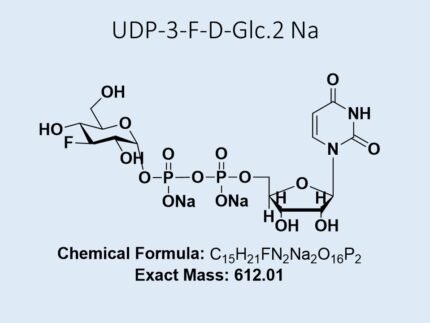
| Name | UDP-3-F-D-Glc.2Na |
| Catalog No. | GN02026 |
| CAS Number | |
| Formula | C15H21FN2Na2O16P2 |
| M.W. | 612.26 |
| Purity | min 90% by HPLC |
10 in stock
| Chemical Name | Uridine-5’-diphospho-6-azido-6-deoxy-D-glucose, Disodium Salt |
|---|---|
| Synonyms | UDP-6-N3-Glc·2Na, UDP-α-6N3-Glucose Disodium Salt, UDP-6-Azido-6-deoxy-D-Glucose Disodium Salt |
| Molecular Formula | C15H21N5O16P2 · 2Na |
| Molecular Weight | 635.28 g/mol (disodium salt) |
| CAS No. | 537039-67-1 |
| Appearance | White to off-white lyophilized powder |
| Purity | ≥95% (HPLC) |
| Solubility | Soluble in water |
| Storage | −20°C, protect from moisture and light |
| Application | Azido-modified nucleotide sugar donor substrate for glucosyltransferases; the C6-azido handle enables bioorthogonal detection via copper-catalyzed azide–alkyne cycloaddition (CuAAC) and strain-promoted azide–alkyne cycloaddition (SPAAC); used for selective labeling of 5-hydroxymethylcytosine (5-hmC) in genomic DNA, glycan imaging, and glycoproteomic profiling |
10 in stock
| Chemical Name | Uridine-5’-diphospho-N-azidoacetyl-α-D-galactosamine, Disodium Salt |
|---|---|
| Synonyms | UDP-GalNAz·2Na, UDP-N-Azidoacetylgalactosamine Disodium Salt, UDP-GalNAz Disodium |
| Molecular Formula | C17H24N6Na2O17P2 |
| Molecular Weight | 692.33 g/mol (disodium salt) |
| CAS No. | 653600-61-4 |
| Appearance | White to off-white lyophilized powder |
| Purity | ≥95% (HPLC) |
| Solubility | Soluble in water |
| Storage | −20°C, protect from moisture and light |
| Application | Azido-modified analogue of UDP-GalNAc; serves as a substrate for N-acetylgalactosaminyltransferases (ppGalNAc-Ts) enabling metabolic and chemoenzymatic glycan labeling; the azidoacetyl handle permits bioorthogonal conjugation via copper-catalyzed azide–alkyne cycloaddition (CuAAC) and strain-promoted azide–alkyne cycloaddition (SPAAC); widely used in O-GalNAc glycoproteomics, mucin-type glycan imaging, and site-specific antibody–drug conjugate (ADC) construction |
10 in stock
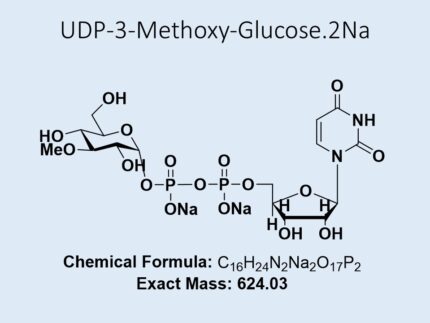
| Name | UDP-3-methyl-Glucose.2Na |
| Catalog No. | GN02024 |
| CAS Number | N/A |
| Formula | C16H24N2Na2O17P2 |
| M.W. | 624.29 |
10 in stock






Reviews
There are no reviews yet.