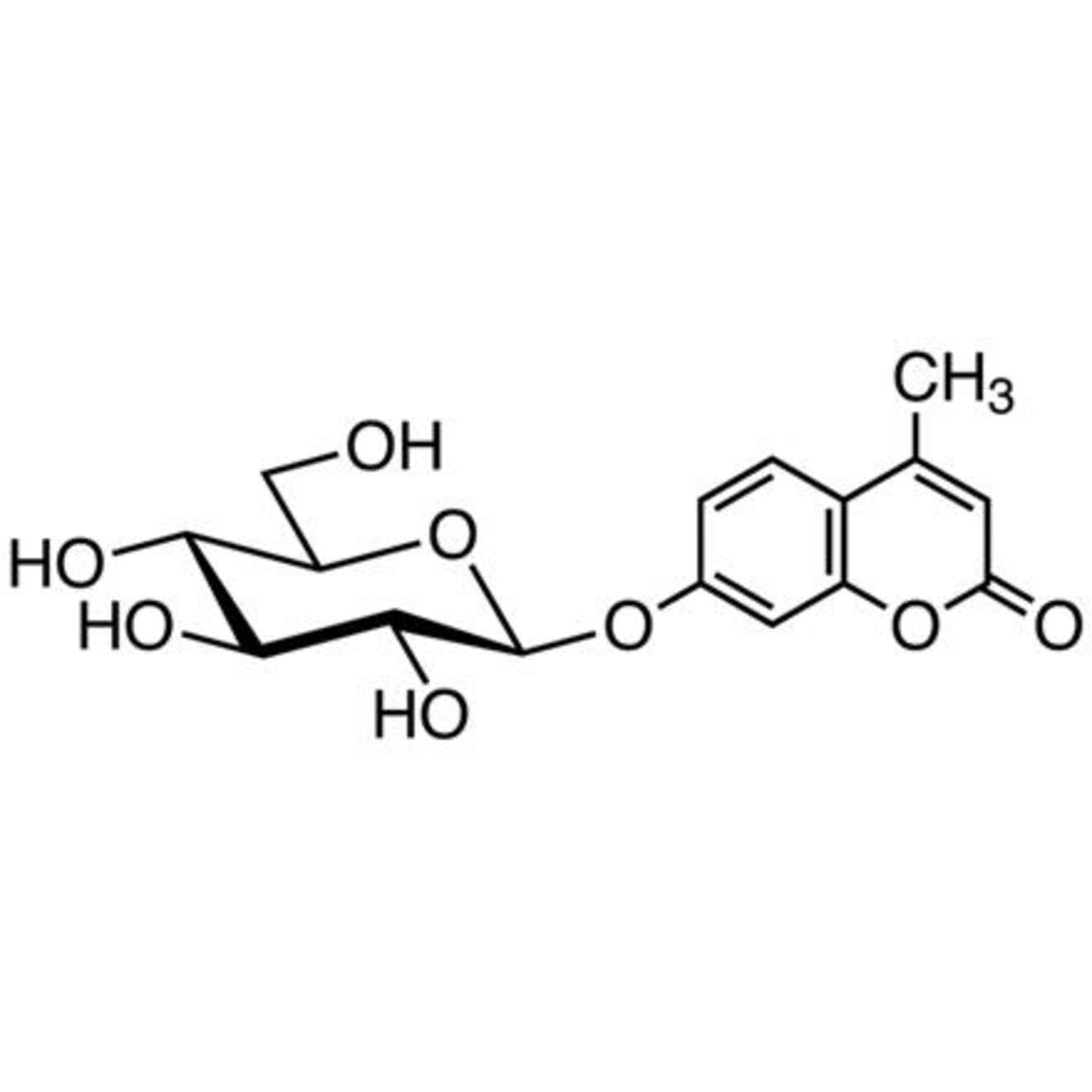
4‑MU‑Glc (CAS ) is a synthetic β‑D‑glucosidase‑specific fluorogenic substrate in which a 4‑methylumbelliferyl aglycone is linked via a β‑glycosidic bond to the anomeric carbon of β‑D‑glucopyranose. When hydrolyzed by β‑D‑glucosidase (EC 3.2.1.21) or β‑glucocerebrosidase (glucosylceramidase, GBA1), the glycosidic bond is cleaved to release 4‑methylumbelliferone (4‑MU) and β‑D‑glucose. The released 4‑MU exhibits strong blue fluorescence under UV excitation, allowing highly sensitive, continuous monitoring of enzyme activity in microplate‑based assays. 4‑MU‑Glc is used in enzyme‑kinetic studies (Km, Vmax), inhibitor‑screening campaigns, and diagnostic‑type assays for β‑glucosidase‑deficiency diseases such as Gaucher disease, where β‑glucocerebrosidase activity is measured in cell or tissue lysates. The compound is water‑soluble, typically supplied as a high‑purity, crystalline or lyophilized powder, and is suitable for routine biochemical and clinical‑research applications. Its high sensitivity and compatibility with standard microplate readers make it one of the most widely adopted fluorogenic glycosidase substrates in glycosidase and lysosomal‑enzyme research.
Appearance
- Off‑white to pale yellow crystalline or lyophilized powder.
- Forms a clear, colorless solution in aqueous buffer; develops strong blue fluorescence only after enzymatic hydrolysis.
Source / synthesis
- Synthetically prepared by glycosylation of 4‑methylumbelliferol with β‑D‑gluco‑pyranose or a protected β‑D‑glucoside, followed by deprotection and crystallization from water or mixed solvents.
- Commercially manufactured by biochemical‑reagent suppliers (e.g., Sigma‑Aldrich, G‑Biosciences, EvitaChem, VWR‑branded vendors) as a high‑purity β‑glucosidase substrate.
Molecular weight and structure
- Molecular formula: C16H18O8C16H18O8.
- Molecular weight: 338.31–338.32 g/mol.
- Structure: 4‑methylumbelliferyl‑β‑D‑glucopyranoside, with a β‑glycosidic linkage between the 4‑methylumbelliferyl group and the anomeric oxygen of the D‑glucose ring in the pyranose form.
Sugar specificity
- Specifically hydrolyzed by β‑D‑glucosidases and β‑glucocerebrosidase (GBA1), with activity also reported against other β‑glycosidases depending on the enzyme source.
- Widely used in fluorogenic panels to distinguish β‑glucosidase activity from α‑glucosidase and other β‑glycosidase activities.
Biological activity
- Serves as a fluorogenic reporter whose rate of 4‑MU release under defined pH and temperature conditions reflects β‑D‑glucosidase or β‑glucocerebrosidase activity.
- Enables determination of kinetic parameters (Km, Vmax), inhibitor‑IC₅₀, and comparative activity profiling of different glycosidases, including lysosomal β‑glucosidases linked to Gaucher disease.
Purity and microbial contamination
- Typically supplied at ≥97–99% purity (e.g., “99%” or “≥99% HPLC”) as indicated by supplier data sheets and product‑specification labels.
- Described as a non‑sterile, research‑grade solid suitable for use in standard enzymatic assays under clean‑laboratory conditions.
Identity and quality control
- Identity confirmed by molecular formula, molecular weight, melting point (~210–212 °C), and UV‑Vis/fluorescence spectra consistent with 4‑methylumbelliferyl‑β‑D‑glucopyranoside.
- Quality‑control includes checks for appearance, solubility in water or DMF, and performance in a defined β‑glucosidase or β‑glucocerebrosidase activity assay (e.g., in microplate‑based glucosidase kits).
Shelf life and storage
- Shelf life is generally 12–24 months when stored at −20 °C in a tightly sealed, light‑protected container, often as a lyophilized powder.
- Aqueous working solutions are best prepared fresh or stored at 4 °C for short periods, as elevated temperature and UV exposure can promote photodegradation or nonspecific hydrolysis.
Application
- Fluorimetric assay of β‑D‑glucosidase and β‑glucocerebrosidase activity in microbial, plant, and mammalian systems.
- Diagnostic‑type and research‑use assays for β‑glucocerebrosidase deficiency in Gaucher‑disease screening and lysosomal‑enzyme profiling.
- Inhibitor‑screening and enzyme‑mechanism‑elucidation studies for β‑glucosidases and related lysosomal glycosidases.
Key characteristics
- Fluorogenic readout based on 4‑methylumbelliferone release, enabling highly sensitive, microplate‑compatible detection of β‑glucosidase activity.
- Defined β‑D‑glucopyranoside linkage providing selectivity for β‑glucosidases and β‑glucocerebrosidase.
- High‑purity, crystalline powder with a known molecular formula and weight, suitable for quantitative enzyme assays and standardized protocols.
Citations
- ChemicalBook – 4‑Methylumbelliferyl‑β‑D‑glucopyranoside (4‑MU‑Glc, CAS 18997‑57‑4, MF C₁₆H₁₈O₈, MW 338.32): https://www.chemicalbook.com/ChemicalProductProperty_EN_CB8853266.htm
- G‑Biosciences – 4‑Methylumbelliferyl‑β‑D‑glucopyranoside product and assay‑feature sheet (CAS 18997‑57‑4): https://www.gbiosciences.com/Bioassays/Enzyme-Substrates/4-Methylumbelliferyl-beta-D-glucopyranoside
- GlpBio – 4‑Methylumbelliferyl‑β‑D‑Glucopyranoside (MUG/4‑MU‑Glc) as a fluorogenic substrate for β‑glucosidase and β‑glucocerebrosidase: https://www.glpbio.com/4-methylumbelliferyl-b-d-glucopyranoside.html
- Sigma‑Aldrich – 4‑Methylumbelliferyl‑α‑D‑glucopyranoside product‑page (for context on methylumbelliferyl‑glycoside‑technology; different linkage but analogous design): https://www.sigmaaldrich.com/US/en/product/sigma/m9766
- VWR (S.I. Chemicals) – 4‑Methylumbelliferyl‑β‑D‑glucopyranoside (99%, CAS 18997‑57‑4, physical and safety data): https://si.vwr.com/store/product/22158611/4-methylumbelliferyl-b-d-glucopyranoside-99
- PubChem – 4‑Methylumbelliferyl‑β‑D‑glucopyranoside compound entry (C₁₆H₁₈O₈, CAS 18997‑57‑4): https://pubchem.ncbi.nlm.nih.gov/compound/4-Methylumbelliferyl-beta-D-glucopyranoside
- PMC – 6‑O‑alkyl 4‑MU‑Glc derivatives used as selective β‑glucosidase substrates (e.g., for Gaucher‑disease diagnosis): https://pmc.ncbi.nlm.nih.gov/articles/PMC11585764/
- 4‑MU‑Glc‑based β‑glucocerebrosidase‑deficiency‑assay protocol (Gaucher‑disease‑diagnostic context): https://pmc.ncbi.nlm.nih.gov/ (search “4‑methylumbelliferyl‑β‑D‑glucopyranoside Gaucher”).
- General glycosidase‑substrate catalog (4‑MU‑Glc and related 4‑MU‑glycosides overview): https://www.chemicalbook.com/ (search for “18997‑57‑4”).
- Enzyme‑substrate supplier listing (e.g., MP Biomedicals, EvitaChem) for 4‑MU‑Glc‑type fluorogenic glycosides: https://www.fishersci.com and similar vendor sites (search “4‑methylumbelliferyl‑β‑D‑glucopyranoside”).




Reviews
There are no reviews yet.