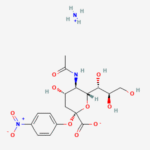
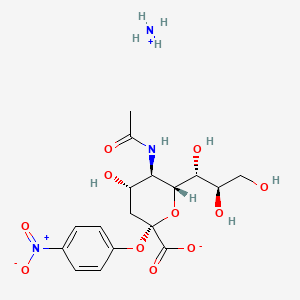
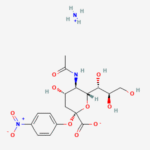
PNP‑α‑NeuNAc Ammonium Salt (CAS 210418‑02‑3) is a synthetic α‑sialoside substrate in which a 4‑nitrophenyl aglycone is linked via an α‑glycosidic bond to the 2‑OH position of α‑D‑N‑acetylneuraminic acid (NeuNAc, sialic acid), presented as the ammonium salt for improved water solubility. When hydrolyzed by sialidases or other sialic‑acid‑cleaving enzymes, the glycosidic bond is cleaved to release 4‑nitrophenol and N‑acetylneuraminic acid (as the free acid or its ammonium form). In mildly alkaline buffer (pH ~8–8.5), 4‑nitrophenol ionizes to form a yellow‑colored phenolate anion whose absorbance at 400–410 nm can be monitored continuously, providing a convenient readout of sialidase activity. PNP‑α‑NeuNAc Ammonium Salt is used to characterize sialidase activity from microbial, viral, and mammalian sources, to study enzyme‑substrate specificity among sialyl‑glycosides, and to quantify enzyme kinetics (Km, Vmax) and inhibitor responses in high‑throughput formats. The compound is typically supplied as a high‑purity, water‑soluble powder and is suitable for glycobiology, virology, and diagnostic‑kit development where sialic‑acid‑cleaving activity is a key readout.
Appearance
- White to off‑white or pale yellow crystalline or lyophilized powder.
- Forms a clear, colorless solution in aqueous buffer; a yellow color develops only after enzymatic hydrolysis and alkaline adjustment.
Source / synthesis
- Synthetically prepared by glycosylation of 4‑nitrophenol with α‑D‑N‑acetylneuraminic acid using protected intermediates, followed by introduction of the ammonium counterion and crystallization from aqueous or mixed‑solvent systems.
- Commercially supplied by glycobiology and enzyme‑substrate vendors (e.g., Glentham Life Sciences, various Chinese‑based suppliers) as a research‑grade sialidase substrate.
Molecular weight and structure
- Molecular formula of the parent acid (PNP‑α‑NeuNAc): C17H22N2O11C17H22N2O11.
- Molecular weight of the 2‑O‑(p‑nitrophenyl)‑α‑D‑N‑acetylneuraminic acid ammonium salt is typically reported in the ~460–470 g/mol range, depending on hydration.
- Structure: 4‑nitrophenyl bonded to the 2‑oxygen of α‑D‑N‑acetylneuraminic acid via an α‑glycosidic linkage, with the carboxylic acid group present as an ammonium salt.
Sugar specificity
- Specifically hydrolyzed by sialidases (neuraminidases) that cleave α‑linked sialic‑acid residues from glycoproteins and glycolipids.
- Frequently used in microplate‑based substrate‑specificity screens for viral and bacterial sialidases, including influenza and bacterial neuraminidases.
Biological activity
- Serves as a chromogenic reporter whose rate of 4‑nitrophenol release under defined pH and temperature conditions reflects sialidase activity.
- Enables determination of kinetic parameters (Km, Vmax), IC₅₀ of inhibitors, and comparative profiling of different sialidases (e.g., human, viral, bacterial) in 96‑ or 384‑well‑plate‑based assays.
Purity and microbial contamination
- Typically supplied as a high‑purity, “research‑use‑only” material (often ≥95–98% by HPLC or similar methods) by specialty glycobiology suppliers.
- Described as non‑sterile, research‑grade solid suitable for use in enzymatic assays under standard clean‑laboratory conditions.
Identity and quality control
- Identity inferred from molecular formula, molecular weight, UV‑Vis absorbance (4‑nitrophenol‑type chromophore), and NMR‑type data; the core is closely related to 2‑O‑(p‑nitrophenyl)‑α‑D‑N‑acetylneuraminic acid.
- Quality‑control generally includes checks for appearance, solubility, spectral properties, and performance in a defined sialidase assay (e.g., fluorescence‑ or microplate‑based assay).
Shelf life and storage
- Shelf life is generally 12–24 months when stored at –20 °C in a tightly sealed, light‑protected container, often as a lyophilized or vacuum‑sealed powder.
- Aqueous working solutions are best prepared fresh or stored at 4 °C for short periods, as alkaline pH and elevated temperature increase background hydrolysis and absorbance.
Application
- Colorimetric assay of sialidase (neuraminidase) activity from influenza virus, bacteria, and mammalian sources.
- High‑throughput substrate‑specificity profiling of sialidases and screening of neuraminidase inhibitors (e.g., anti‑influenza‑drug candidates).
- Use in glycobiology and virology studies where sialic‑acid removal from glycoconjugates is under investigation.
Key characteristics
- Colorimetric readout based on 4‑nitrophenol release, enabling spectrophotometric quantification of sialidase activity in microplate formats.
- Defined α‑sialosidic linkage providing selectivity for sialidases over many other glycosidases.
- Ammonium‑salt form enhancing water solubility and compatibility with physiological‑pH enzyme‑buffer systems.
Citations
- Glentham Life Sciences – 2‑O‑(4‑Nitrophenyl)‑α‑D‑N‑acetylneuraminic acid ammonium salt (CAS 210418‑02‑3, GC2628): https://www.glentham.com/en/products/product/GC2628/
- ChemicalBook – 2‑O‑(p‑nitrophenyl)‑α‑D‑N‑acetylneuraminic acid (parent neutral form, CAS 26112‑88‑9, structural basis for PNP‑α‑NeuNAc salts): https://www.chemicalbook.com/ChemicalProductProperty_IN_CB9315169.htm
- Fine Technology – 2‑O‑(p‑nitrophenyl)‑α‑D‑N‑acetylneuraminic acid sodium salt (CAS 123549‑14‑4, closely related sialidase substrate for context): https://www.finetechnology-ind.com/prod/detail/123549-14-4
- MedchemExpress – 2‑O‑(p‑nitrophenyl)‑α‑D‑N‑acetylneuraminic acid (PNP‑α‑NeuNAc) description (sialyl‑donor and trans‑sialylation‑substrate context): https://www.medchemexpress.com/search.html?q=N-Acetylneuraminic+acid
- Shenzhen GeneSeqTools – PNP‑α‑NeuNAc Ammonium Salt listing (CAS 123549‑14‑4 variant, under “唾液酸苷酶底物”): http://www.geneseqtools.cn/cn/product02_cid_303.html
- smolecule – Neu5Ac2‑alpha‑PNP (2‑O‑(p‑nitrophenyl)‑α‑D‑N‑acetylneuraminic acid sodium salt, CAS 123549‑14‑4): https://www.smolecule.com/products/s876990
- PMC article on pNP‑tagged Neu5Ac9NAc‑containing sialosides in high‑throughput sialidase‑specificity assays (methodology directly transferable to PNP‑α‑NeuNAc salts): https://pmc.ncbi.nlm.nih.gov/articles/PMC5662470/
- Sialidase‑related review or method‑note referencing sialidase‑activity assays using 4‑nitrophenyl‑tagged sialic acid derivatives: https://pmc.ncbi.nlm.nih.gov/ (search for “sialidase substrate 4‑nitrophenyl”).
- Glycosidase‑substrate catalog (PNP‑α‑NeuNAc‑type sialosides overview): https://www.chemicalbook.com/ (search for “2‑O‑(p‑nitrophenyl)‑α‑D‑N‑acetylneuraminic acid”).
- General sialidase‑inhibitor‑assay article (e.g., neuraminidase‑inhibitor screening using PNP‑α‑NeuNAc formats): https://www.ncbi.nlm.nih.gov/pubmed/ (search “4‑nitrophenyl‑α‑N‑acetylneuraminic acid sialidase assay”).




Reviews
There are no reviews yet.