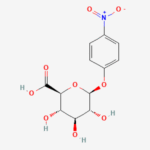
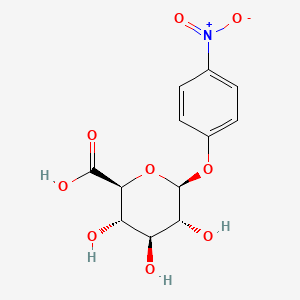
p‑Nitrophenyl‑β‑D‑glucuronide (PNP‑GlcA, CAS 10344‑94‑2) is a synthetic β‑glycoside substrate in which a 4‑nitrophenyl aglycone is linked via a β‑glycosidic bond to the anomeric carbon of β‑D‑glucuronic acid. When hydrolyzed by β‑D‑glucuronidase (GUS) or other β‑glucuronide‑cleaving enzymes, the glycosidic bond is cleaved to release 4‑nitrophenol and β‑D‑glucuronic acid. In mildly alkaline buffer (pH ~8–8.5), the released 4‑nitrophenol ionizes to form a yellow‑colored phenolate anion whose absorbance at 400–410 nm can be monitored continuously, providing a convenient readout of enzyme velocity. PNP‑GlcA is widely used to characterize β‑glucuronidase activity in bacterial, plant, and mammalian systems, to study enzyme‑substrate specificity among PNP‑glycosides, and to quantify activity in kinetic experiments (Km, Vmax). The compound is water‑soluble, supplied as a high‑purity, crystalline or lyophilized powder, and is suitable for routine biochemical and enzymatic research. It is a key reagent in cloning and reporter‑gene assays (e.g., GUS reporter systems), as well as in drug‑metabolism and toxicology studies where β‑glucuronidase activity is used as a marker enzyme.
Appearance
- White to pale yellow or light yellow crystalline solid.
- Forms a clear, colorless solution in aqueous buffer; a yellow color develops only after enzymatic hydrolysis and alkaline adjustment.
Source / synthesis
- Synthetically produced by glycosylation of 4‑nitrophenol with β‑D‑glucuronic acid or a protected β‑D‑glucuronide derivative, followed by deprotection and crystallization from water or aqueous alcohols.
- Commercially manufactured by biochemical‑reagent suppliers (e.g., Merck/Calbiochem, ChemicalBook‑linked vendors) as a high‑purity substrate for β‑glucuronidase assays.
Molecular weight and structure
- Molecular formula: C12H13NO9C12H13NO9.
- Molecular weight: 315.23 g/mol.
- Structure: p‑nitrophenyl‑β‑D‑glucopyranosiduronic acid, with a β‑glycosidic linkage between the aromatic 4‑nitrophenyl group and the anomeric oxygen of the D‑glucuronic‑acid ring.
Sugar specificity
- Specifically hydrolyzed by β‑D‑glucuronidases (GUS) and other β‑glucuronide‑cleaving enzymes.
- Widely used as a selective substrate to distinguish β‑glucuronidase activity from other glycosidases, especially in reporter‑gene and enzyme‑profiling panels.
Biological activity
- Serves as a chromogenic reporter whose rate of 4‑nitrophenol release under defined pH and temperature reflects β‑glucuronidase activity.
- Enables determination of kinetic parameters (Km, Vmax), inhibitor‑IC₅₀, and comparative activity profiling of different GUS enzymes, for example from bacterial, fungal, and mammalian sources.
Purity and microbial contamination
- Typically supplied at ≥97–99% purity (e.g., “high purity” or “≥98%” by HPLC) as indicated by supplier data sheets and MSDS‑style documents.
- Described as non‑sterile, research‑grade material suitable for use in standard enzymatic assays under clean‑laboratory conditions.
Identity and quality control
- Identity inferred from molecular formula, molecular weight, UV‑Vis spectral profile (4‑nitrophenol‑like absorbance), and NMR‑type data consistent with 4‑nitrophenyl‑β‑D‑glucuronide.
- Quality‑control includes checks for appearance, solubility, and performance in a defined β‑glucuronidase activity assay (e.g., Km ~0.22 mM reported for many GUS preparations).
Shelf life and storage
- Shelf life is generally 12–24 months when stored as a dry powder at −20 °C in a tightly sealed, light‑protected container, shielded from moisture.
- Aqueous working solutions are best prepared fresh or stored at 4 °C for short periods, as alkaline pH and elevated temperature can increase background hydrolysis and absorbance.
Application
- Colorimetric assay of β‑glucuronidase activity in bacterial, plant, and mammalian systems (e.g., GUS reporter‑gene assays).
- Enzyme‑kinetic studies, inhibitor‑screening, and enzyme‑mechanism‑elucidation experiments for GUS‑type enzymes.
- Use in drug‑metabolism and toxicology studies where β‑glucuronidase activity is used as a marker for exposure or enzyme‑induction.
Key characteristics
- Colorimetric readout based on 4‑nitrophenol release, enabling spectrophotometric quantification of β‑glucuronidase activity.
- Defined β‑D‑glucuronide linkage providing selectivity for β‑glucuronidases over many α‑glycosidases.
- Crystalline, stable powder with a known molecular formula and weight, suitable for quantitative enzyme assays and standardized protocols.
Citations
- ChemicalBook – 4‑Nitrophenyl‑β‑D‑glucuronide (PNP‑GlcA, CAS 10344‑94‑2, MF C₁₂H₁₃NO₉, MW 315.23): https://www.chemicalbook.com/ChemicalProductProperty_EN_CB2251352.htm
- Merck/Calbiochem – p‑Nitrophenyl‑β‑D‑glucuronide (chromogenic substrate for β‑glucuronidase, CAS 10344‑94‑2): https://www.merckmillipore.com/INTL/en/product/p-Nitrophenyl-D-glucuronide-CAS-10344-94-2-Calbiochem,EMD_BIO-487500
- Procure‑Net – p‑Nitrophenyl‑β‑D‑glucuronide (pNPG, high‑purity chromogenic substrate, CAS 10344‑94‑2): https://procure-net.com/product/p-nitrophenyl-ce-b2-d-glucuronide-pnpg/
- ChemSynlab – 4‑Nitrophenyl‑β‑D‑glucuronide (PNP‑β‑D‑GlcA, CAS 10344‑94‑2, sugar‑chemistry product): http://chemsynlab.com/en/product/10344-94-2.html
- Megazyme – 4‑Nitrophenyl‑β‑D‑glucuronide (discontinued but with assay‑method and substrate‑role description): https://www.megazyme.com/4-nitrophenyl-beta-d-glucuronide
- Duchefa Biochemie – p‑Nitrophenyl‑β‑D‑glucuronide (NPG) substrate for β‑glucuronidase detection: https://www.duchefa-biochemie.com/product/details/number/N1408
- PubMed – Novel β‑glucuronidase from Talaromyces pinophilus Li‑93 characterized using glycyrrhetinic glycoside and glucuronide‑type substrates (context for PNP‑GlcA use): https://pmc.ncbi.nlm.nih.gov/articles/PMC6146983/
- PubChem – α‑D‑GlcNS6S‑(1→4)‑β‑D‑GlcA‑pNP‑type conjugate (for extended glucuronide‑substrate context): https://pubchem.ncbi.nlm.nih.gov/compound/118796898
- Organic‑chemistry and biochemical‑use database (quick‑lookup for PNP‑GlcA CAS and formula): https://webbook.nist.gov/ (search for “10344‑94‑2”)
- General glycosidase‑substrate catalog (PNP‑GlcA and related PNP‑glycosides overview): https://www.chemicalbook.com/ (search for “10344‑94‑2”)




Reviews
There are no reviews yet.