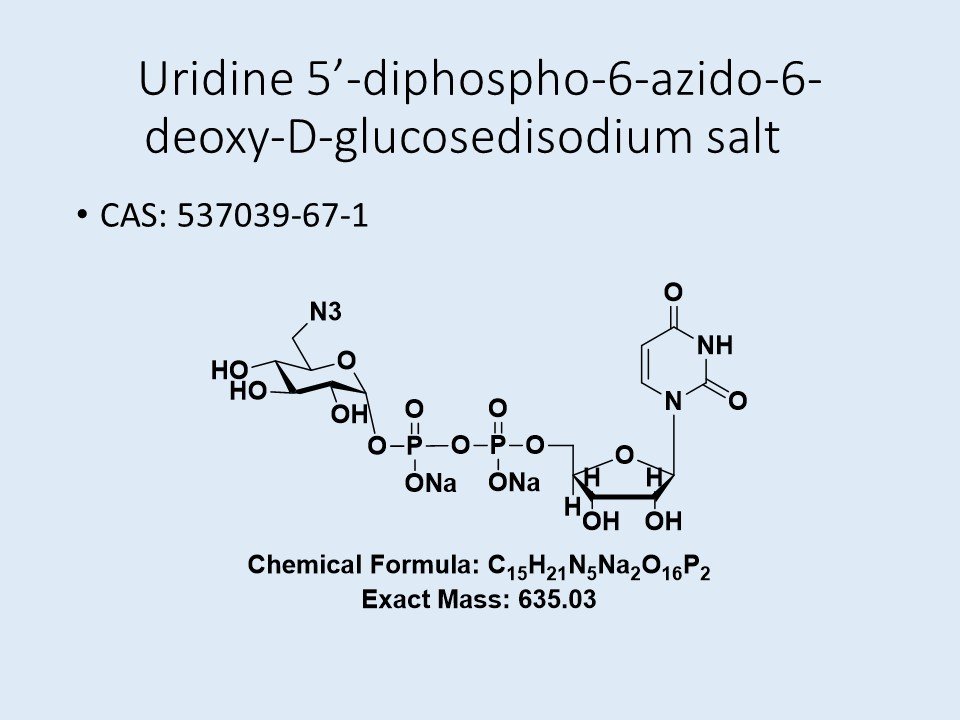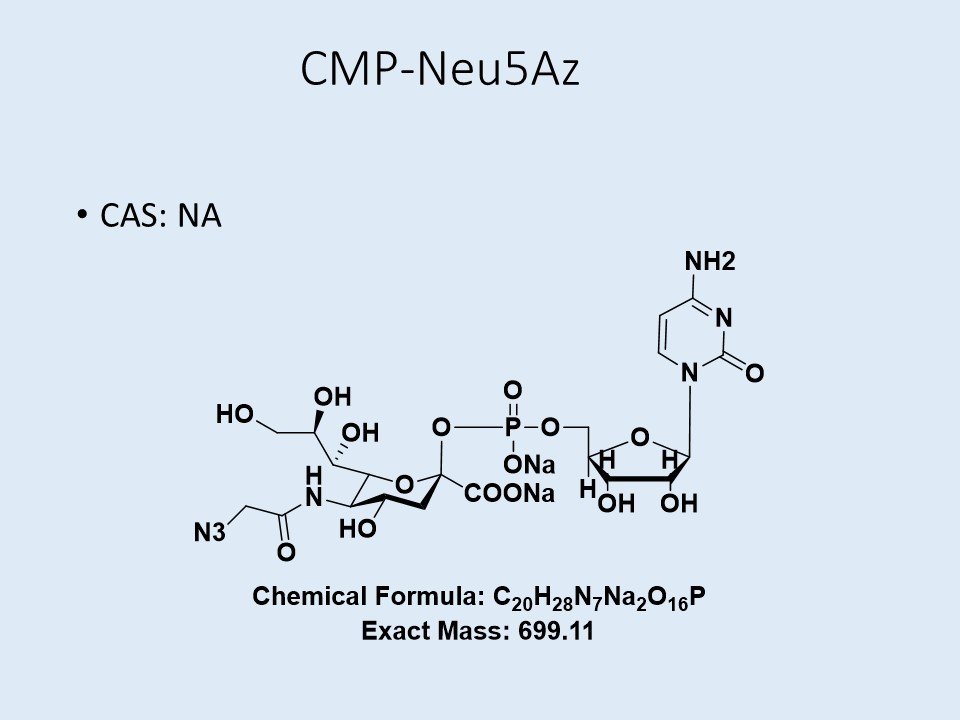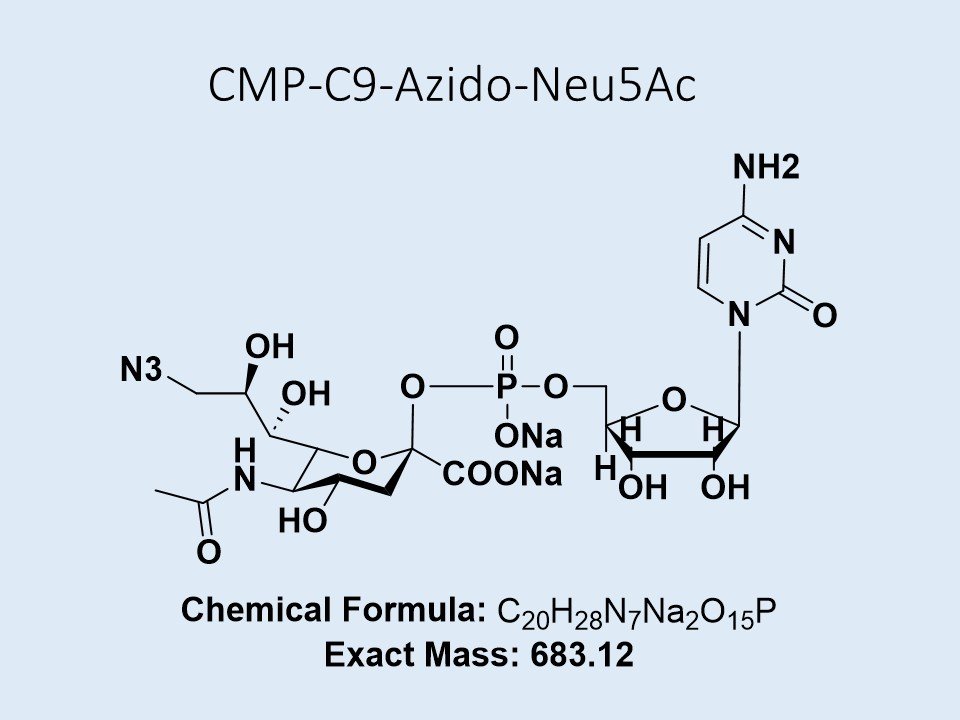
CMP-C9-Azido-Neu5Ac (CMP-C9-Azido-Sialic acid)
$100.10 – $560.00
| Chemical Name | Cytidine-5’-monophospho-9-azido-9-deoxy-N-acetylneuraminic acid (Ammonium Salt) |
|---|---|
| Synonyms | CMP-9-AzNeu5Ac, CMP-C9-Azido-Sialic Acid |
| Molecular Formula | C20H29N7O15P · NH4 |
| Molecular Weight | 656.51 g/mol (ammonium salt) |
| Related CAS No. | 112037-53-3 (free acid) |
| Appearance | Lyophilized white powder |
| Purity | ≥95% (HPLC) |
| Solubility | Soluble in water |
| Storage | −20°C, protect from moisture |
| Application | Activated sugar nucleotide donor substrate for sialyltransferases; enables bioorthogonal click chemistry labeling of sialylated glycoconjugates via azide–alkyne cycloaddition (CuAAC/SPAAC) |
CMP-C9-Azido-Neu5Ac (Cytidine Monophosphate 9-Azido-9-deoxy-Neu5Ac) is a modified sialic acid nucleotide used in glycosylation research, particularly for bioorthogonal labeling techniques. It features an azido group (-N3) at the 9th carbon of the sialic acid (Neu5Ac) molecule, making it suitable for selective tagging and visualization of sialylated glycans.
Structure & Properties:
- Molecular Weight (MW): Approximately 677 g/mol (depending on the specific form)
- Chemical Formula: C20H30N6O16P2 (approximate)
- Synonyms: CMP-9-N3-Neu5Ac, CMP-9-azido-9-deoxy-Neu5Ac
- Functional Groups: Contains an azido group (-N3) at the 9-position of Neu5Ac, which is critical for bioorthogonal reactions.
Biological Role:
- Modified Sialic Acid Donor: CMP-C9-Azido-Neu5Ac acts as a donor of azido-modified sialic acid in sialylation reactions, incorporating the azido-modified Neu5Ac into glycoconjugates, such as glycoproteins and glycolipids.
- Role in Glycosylation: This molecule participates in the sialylation of glycans, where it is transferred by sialyltransferases to glycan structures, enabling the study of sialylated glycoproteins and glycolipids.
Applications:
- Bioorthogonal Chemistry: The azido group on CMP-C9-Azido-Neu5Ac allows for specific labeling of sialylated glycans via click chemistry, enabling researchers to tag and track these molecules in various biological contexts.
- Glycan Labeling: It is used to label sialic acid-containing glycans in cells or tissues, which can then be detected with fluorescent or other reporter molecules.
Significance in Research:
- Glycan Visualization: CMP-C9-Azido-Neu5Ac is valuable in tracking sialylated glycans, which play essential roles in cell-cell communication, pathogen-host interactions, and immune response.
- Sialylation Studies: The compound is useful for studying the dynamics of sialylation in biological processes, including cancer progression, immune modulation, and infectious diseases.
Key Roles:
- Sialylation Tracking: CMP-C9-Azido-Neu5Ac facilitates the labeling and visualization of sialylated glycans, helping researchers investigate the roles of sialylation in cellular processes.
- Cellular Imaging: It is widely used in live-cell imaging studies to observe the distribution and function of sialylated glycans in real-time.
Storage and Stability:
- Storage: Store at -20°C in a moisture-free environment for optimal stability.
- Stability: The compound is stable under these storage conditions but may degrade if exposed to heat, moisture, or light.
Research Applications:
- Glycobiology: CMP-C9-Azido-Neu5Ac is employed in studies of glycan structure and function, particularly focusing on the role of sialic acids in glycosylation.
- Synthetic Biology: It is used in synthetic biology to generate modified sialylated glycans for various research and therapeutic applications.
Potential Impact:
- Therapeutic Development: CMP-C9-Azido-Neu5Ac could be leveraged in the development of therapies targeting sialylation pathways, which are involved in cancer metastasis, immune evasion, and viral infections.
- Bioorthogonal Labeling: Its use in click chemistry enables precise labeling of sialylated glycans, facilitating research in cell biology, disease mechanisms, and therapeutic interventions.
Key Research Areas:
- Cancer Biology: Sialylation plays a key role in cancer cell survival and immune evasion, making CMP-C9-Azido-Neu5Ac a useful tool in studying these processes.
- Immunology: This compound is valuable in research on immune responses, particularly those involving sialylated glycoproteins and glycolipids.
Conclusion:
CMP-C9-Azido-Neu5Ac is a critical tool in glycosylation research, enabling the selective labeling and tracking of sialylated glycans in biological systems. Its bioorthogonal properties make it invaluable for studying sialic acid biology, with potential applications in therapeutic development and synthetic biology
| Size | 10 MG, 5 MG |
|---|
SKU: GN02032
Category: Sugar Nucleotides
Tags: Activated Sugar Donors, cell surface modification, Click chemistry, CMP-Sialic acid, glycan engineering
Related Products
UDP-4-F-D-Glc.2 Na
$100.10 – $10,000.10
| Name | UDP-4-F-6-D-Glc.2Na |
| Catalog No. | GN02025 |
| CAS Number | N/A |
| Formula | C15H21FN2Na2O16P2 |
| M.W. | 612.26 |
10 in stock
CMP-Neu5Gc.2Na, Cytidine-5-monophospho-N-glycolylneuraminic acid (98396-76-0)
$400.00 – $900.00
| Chemical Name | Cytidine-5’-monophospho-N-glycolylneuraminic acid, Disodium Salt |
|---|---|
| Synonyms | CMP-Neu5Gc·2Na, CMP-NeuGc Disodium Salt, CMP-N-Glycolylneuraminic Acid Disodium Salt |
| Molecular Formula | C20H29N4O17P · 2Na |
| Molecular Weight | 674.41 g/mol |
| CAS No. | 98396-76-0 |
| Appearance | White lyophilized powder |
| Purity | ≥95% (HPLC) |
| Source | Enzymatic synthesis |
| Solubility | Soluble in water |
| Storage | −20°C, protect from moisture |
| Application | Activated sugar nucleotide donor substrate for sialyltransferases; used in enzymatic glycolyl-sialylation of glycoproteins, glycolipids, and oligosaccharides; key tool for studying non-human Neu5Gc expression and anti-Neu5Gc immune responses |
10 in stock
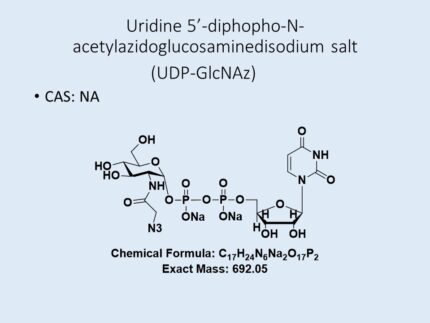
UDP-GlcNAz.2Na
$180.00 – $1,800.00
| Chemical Name | Uridine-5’-diphospho-N-azidoacetyl-α-D-glucosamine, Disodium Salt |
|---|---|
| Synonyms | UDP-GlcNAz·2Na, UDP-N-Azidoacetylglucosamine Disodium Salt, UDP-GlcNAz Disodium |
| Molecular Formula | C17H24N6Na2O17P2 |
| Molecular Weight | 692.33 g/mol (disodium salt) |
| CAS No. | 608514-41-6 (free acid) |
| Appearance | White to off-white lyophilized powder |
| Purity | ≥95% (HPLC) |
| Solubility | Soluble in water |
| Storage | −20°C, protect from moisture and light |
| Application | Azido-modified analogue of UDP-GlcNAc; serves as a substrate for O-GlcNAc transferase (OGT) and N-acetylglucosaminyltransferases enabling metabolic and chemoenzymatic glycan labeling; the azidoacetyl handle permits bioorthogonal conjugation via copper-catalyzed azide–alkyne cycloaddition (CuAAC) and strain-promoted azide–alkyne cycloaddition (SPAAC); can be epimerized to UDP-GalNAz by UDP-galactose-4-epimerase (GALE); widely used in O-GlcNAc proteomics, glycan imaging, and selective probing of intracellular O-GlcNAcylation |
10 in stock
UDP-a-L-Rha.2Na
$400.00 – $1,080.00
| Name | UDP-a-L-Rha Sodium Salt |
| Catalog No. | GN02020 |
| CAS Number | 1526988-33-9 |
| Formula | C15H22N2Na2O16P2 |
| M.W. | 594.27 |
10 in stock