


Request a quote
| Chemical Name | Uridine-5’-diphospho-N-acetyl-α-D-glucosamine, Disodium Salt |
|---|---|
| Synonyms | UDP-GlcNAc·2Na, UDP-N-Acetylglucosamine Disodium Salt, UDP-α-D-N-Acetylglucosamine |
| Molecular Formula | C17H25N3Na2O17P2 |
| Molecular Weight | 651.32 g/mol (disodium salt) |
| CAS No. | 91183-98-1 (disodium salt); 4578-31-8 (free acid) |
| Appearance | White to off-white powder |
| Purity | ≥95% (HPLC) |
| Solubility | Soluble in water |
| Storage | −20°C, protect from moisture |
| Application | Activated nucleotide sugar donor substrate for N-acetylglucosaminyltransferases (GnTs / OGT); end product of the hexosamine biosynthetic pathway (HBP) and a key metabolic sensor linking nutrient status to glycosylation; essential for N-glycan branching (GnT-I through GnT-V), O-GlcNAc modification of nuclear and cytoplasmic proteins, chitin biosynthesis, and peptidoglycan assembly; widely used in in vitro glycosylation assays, glycoengineering, and metabolic studies |
UDP-GlcNAc (Uridine Diphosphate N-Acetylglucosamine) is a nucleotide sugar that plays a vital role in various glycosylation processes. It serves as a donor of N-acetylglucosamine (GlcNAc) in the biosynthesis of glycans, glycoproteins, and glycosaminoglycans (GAGs).
UDP-GlcNAc is a critical nucleotide sugar involved in glycosylation processes essential for the synthesis of glycoproteins and GAGs. Its role in O-GlcNAcylation and its involvement in cellular communication and disease make it a vital molecule for research in glycobiology, cell signaling, and therapeutic development.
| Size | 100 MG, 25 MG, 50 MG |
|---|
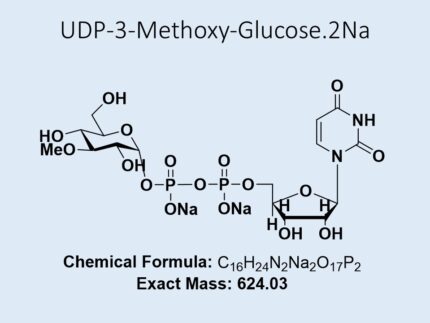
| Name | UDP-3-methyl-Glucose.2Na |
| Catalog No. | GN02024 |
| CAS Number | N/A |
| Formula | C16H24N2Na2O17P2 |
| M.W. | 624.29 |
10 in stock
| Chemical Name | Uridine-5’-diphospho-N-azidoacetyl-α-D-galactosamine, Disodium Salt |
|---|---|
| Synonyms | UDP-GalNAz·2Na, UDP-N-Azidoacetylgalactosamine Disodium Salt, UDP-GalNAz Disodium |
| Molecular Formula | C17H24N6Na2O17P2 |
| Molecular Weight | 692.33 g/mol (disodium salt) |
| CAS No. | 653600-61-4 |
| Appearance | White to off-white lyophilized powder |
| Purity | ≥95% (HPLC) |
| Solubility | Soluble in water |
| Storage | −20°C, protect from moisture and light |
| Application | Azido-modified analogue of UDP-GalNAc; serves as a substrate for N-acetylgalactosaminyltransferases (ppGalNAc-Ts) enabling metabolic and chemoenzymatic glycan labeling; the azidoacetyl handle permits bioorthogonal conjugation via copper-catalyzed azide–alkyne cycloaddition (CuAAC) and strain-promoted azide–alkyne cycloaddition (SPAAC); widely used in O-GalNAc glycoproteomics, mucin-type glycan imaging, and site-specific antibody–drug conjugate (ADC) construction |
10 in stock
| Name | UDP-2-deo-Glucose.2Na |
| Catalog No. | GN02022 |
| CAS Number | N/A |
| Formula | C15H22N2Na2O16P2 |
| M.W. | 594.27 |
10 in stock
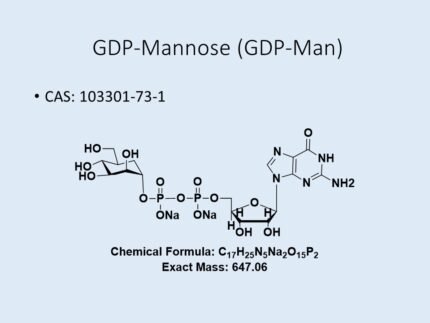
| Chemical Name | Guanosine-5’-diphospho-α-D-mannose, Disodium Salt |
|---|---|
| Synonyms | GDP-D-Man·2Na, GDP-Mannose Disodium Salt, GDP-α-D-Mannose Disodium Salt |
| Molecular Formula | C16H23N5O16P2 · 2Na |
| Molecular Weight | 649.30 g/mol (disodium salt) |
| CAS No. | 103301-73-1 (disodium salt); 3123-67-9 (free acid) |
| Appearance | White powder |
| Purity | ≥95% (HPLC) |
| Source | Enzymatic synthesis |
| Solubility | Soluble in water |
| Storage | −20°C, protect from moisture |
| Application | Activated sugar nucleotide donor substrate for mannosyltransferases; essential for N-linked glycoprotein biosynthesis, GPI-anchor assembly, and ascorbic acid (vitamin C) biosynthesis in plants |
10 in stock





Reviews
There are no reviews yet.