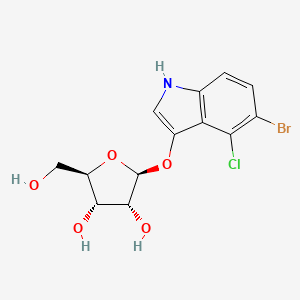
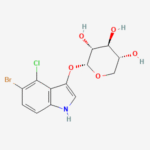
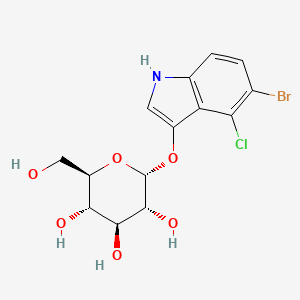
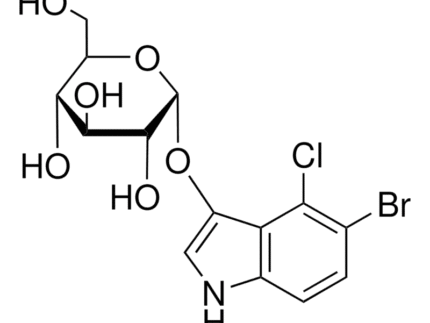
X‑β‑D‑Riboside (CAS 518033‑33‑5) is a synthetic β‑D‑ribosidase‑specific chromogenic substrate in which a 5‑bromo‑4‑chloro‑3‑indolyl aglycone is linked via a β‑glycosidic bond to β‑D‑ribofuranose. When hydrolyzed by β‑D‑ribosidases or other β‑riboside‑cleaving glycosidases, the glycosidic bond is cleaved to release the indole derivative and β‑D‑ribose; the indole then undergoes aerial oxidation to form a strongly colored magenta‑ or blue‑colored precipitate at the site of enzyme activity. This reaction makes X‑β‑D‑Riboside especially useful for chromogenic detection of β‑ribosidase activity in Gram‑negative bacteria grown on solid media, enabling differentiation and identification of ribosidase‑expressing strains. The compound is supplied as a high‑purity, lyophilized or crystalline solid, compatible with standard aqueous buffer or buffer‑agar systems. X‑β‑D‑Riboside has been evaluated as a novel chromogenic substrate for β‑ribosidase‑based detection in agar‑based microbiological media, and shows effectiveness in differentiating certain Gram‑negative bacteria, including Escherichia and Pseudomonas species, based on colony color. Its design follows the X‑substrate paradigm, where indolyl‑glycosides provide a simple, color‑based readout of glycosidase activity in situ.
Appearance
- Off‑white to pale yellow crystalline or lyophilized powder.
- Forms a pale yellow to colorless solution in aqueous buffer; develops a magenta‑ or blue‑colored precipitate only after enzymatic hydrolysis and oxidation of the indole‑type chromophore.
Source / synthesis
- Synthetically prepared by glycosylation of 5‑bromo‑4‑chloro‑3‑indole with β‑D‑ribofuranose or a protected β‑D‑ribofuranoside, followed by deprotection and crystallization from water or mixed solvents.
- Commercially supplied by specialty‑carbohydrate‑and‑enzyme‑substrate manufacturers (e.g., GlycoSynth, Sigma‑Aldrich, SCR BIO) as a high‑purity, research‑grade β‑ribosidase substrate.
Molecular weight and structure
- Molecular formula: C13H13BrClNO5C13H13BrClNO5.
- Molecular weight: 378.60 g/mol.
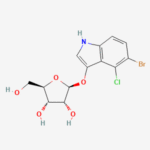
- Structure: 5‑bromo‑4‑chloro‑3‑indolyl‑β‑D‑ribofuranoside, with a β‑glycosidic linkage between the indole‑type aglycone and the anomeric carbon of β‑D‑ribofuranose.
Sugar specificity
- Specifically hydrolyzed by β‑D‑ribosidases and β‑riboside‑cleaving glycosidases, typically used to detect β‑ribosidase activity in Gram‑negative bacteria.
- Frequently used in chromogenic media and agar‑based plates to distinguish β‑ribosidase‑positive colonies from negative ones by color development.
Biological activity
- Serves as a chromogenic reporter whose rate of indole‑derivative release under defined pH and temperature conditions reflects β‑D‑ribosidase activity.
- Enables colony‑level differentiation and identification of β‑ribosidase‑expressing bacteria on agar, supporting microbial‑differentiation and diagnostic‑type workflows.
Purity and microbial contamination
- Typically supplied at ≥95–99% purity (e.g., “high‑purity” or “≥95% HPLC”) as indicated by vendor data sheets.
- Described as a non‑sterile, research‑grade solid suitable for use in microbiological and enzymatic assays under standard clean‑laboratory conditions.
Identity and quality control
- Identity based on CAS 518033‑33‑5, molecular formula C13H13BrClNO5C13H13BrClNO5, and molecular weight 378.60 g/mol, with the systematic name 5‑bromo‑4‑chloro‑3‑indolyl‑β‑D‑ribofuranoside.
- Quality‑control includes checks for appearance, solubility, spectral properties, and performance in defined β‑ribosidase or agar‑based microbial‑differentiation assays.
Shelf life and storage
- Shelf life is typically 12–24 months when stored at −20 °C in a tightly sealed, light‑protected container, as the indole‑type chromophore is sensitive to light and oxidation.
- Aqueous working solutions or agar media containing the substrate are best used fresh or shortly after preparation to avoid nonspecific color development.
Application
- Chromogenic detection of β‑D‑ribosidase activity in bacterial cultures, particularly Gram‑negative species such as E. coli and Pseudomonas spp.
- Use in agar‑based chromogenic media for bacterial differentiation and presumptive identification.
- Enzyme‑activity and substrate‑specificity studies of β‑ribosidases and related glycosidases.
Key characteristics
- Chromogenic readout: release of an indole derivative that oxidizes to a magenta‑ or blue‑colored precipitate, enabling straightforward visual detection of β‑D‑ribosidase activity.
- Defined β‑D‑ribofuranoside linkage providing selectivity for β‑D‑ribosidases over many α‑glycosidases and other β‑glycosidase activities.
- High‑purity, lyophilized solid with the same molecular formula and weight as other X‑substrates, adapted for β‑ribosidase‑specific microbial detection.
Citations
- GlycoSynth – 5‑Bromo‑4‑chloro‑3‑indolyl‑β‑D‑ribofuranoside (X‑β‑D‑Riboside, CAS 518033‑33‑5, product code 70180): https://www.glycosynth.co.uk/det/152/5-Bromo-4-chloro-3-indolyl-beta-D-ribofuranoside/
- Sigma‑Aldrich (Mexico) – Technical paper evaluating novel β‑ribosidase substrates, including X‑β‑D‑Riboside (X‑riboside) and DHF‑riboside, for bacterial differentiation: https://www.sigmaaldrich.com/MX/es/tech-docs/paper/96517
- Sigma‑Aldrich (global product search) – CAS 518033‑33‑5 listing (5‑Bromo‑4‑chloro‑3‑indolyl‑β‑D‑ribofuranoside, X‑β‑D‑riboside, X‑riboside, MF C₁₃H₁₃BrClNO₅, MW 378.60): https://www.sigmaaldrich.com/US/en/search/518033-33-5
- Sigma‑Aldrich (Bahrain) – Same CAS‑entry mirror page: https://www.sigmaaldrich.com/BH/en/search/518033-33-5
- SCR BIO product page – 5‑Bromo‑4‑chloro‑3‑indoxyl‑β‑D‑ribofuranoside (CAS 518033‑33‑5, X‑β‑D‑ribofuranoside, X‑riboside): http://www.scrbio.com/product/SCGC-100644
- Peer‑reviewed article on novel chromogenic substrates for β‑ribosidase detection and Gram‑negative‑bacteria differentiation (mentions X‑riboside and DHF‑riboside): https://pubmed.ncbi.nlm.nih.gov/30170924/
- NIST‑style database entry for β‑D‑ribofuranose derivatives (context for D‑ribo‑glycoside chemistry): https://webbook.nist.gov/cgi/cbook.cgi?ID=R441011
- PubChem‑type entry for Ethyl‑β‑D‑riboside (D‑ribose derivative, general riboside‑structure context): https://pubchem.ncbi.nlm.nih.gov/compound/Ethyl-beta-d-riboside
- D‑Ribose (PubChem) – Background on ribose and riboside‑type substrates: https://pubchem.ncbi.nlm.nih.gov/compound/D-Ribose-d
- Chromogenic‑substrates overview (X‑substrate paradigm and indolyl‑glycoside‑use in detection): https://www.dcfinechemicals.com/en/blog/chromogenic-substrates-overview/





Reviews
There are no reviews yet.