About this product
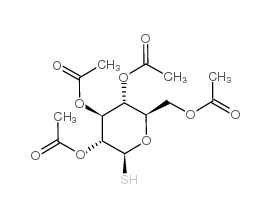
Tetra-O-acetyl-?-D-thioglucopyranose
1-Thio-beta-D-glucose 2,3,4,6-tetraacetate, also known as pentaacetyl-1-thio-beta-D-glucose, is a synthetic molecule synthesized by the selective acetylation of the hydroxyl groups in glucose and replacement of one oxygen atom with a sulfur atom, leading to the formation of a disaccharide structure. This molecule exhibits various biological activities that have attracted attention, particularly in medicinal chemistry and biotechnology fields.
Physical and Chemical Properties
The molecular formula of 1-Thio-beta-D-glucose 2,3,4,6-tetraacetate is C14H20O9S, and its molecular weight is 364.37 g/mol. The compound is a white to off-white crystalline powder that is soluble in various organic solvents, such as methanol, ethanol, chloroform, and acetone, but is insoluble in water. Interestingly, the compound has an odor that has been described as resembling that of freshly cut hay.
Synthesis and Characterization
The synthesis of 1-Thio-beta-D-glucose 2,3,4,6-tetraacetate involves the acetylation of glucose using acetic anhydride in the presence of a catalyst, such as pyridine or triethylamine, at a moderate temperature. The selective introduction of a thiol group instead of a hydroxyl group can be achieved by using a sulfur source, such as thiourea, in the presence of a weak acid, such as acetic acid.
The characterization of the synthesized compound is usually performed using various analytical techniques, including nuclear magnetic resonance spectroscopy (NMR), Fourier transform infrared spectroscopy (FT-IR), and mass spectrometry (MS). These techniques can provide invaluable information regarding the structure and purity of the compound.
Analytical Methods
Several analytical methods have been developed for the determination of 1-Thio-beta-D-glucose 2,3,4,6-tetraacetate in various matrices, such as biological fluids, food products, and environmental samples. These methods include high-performance liquid chromatography (HPLC), gas chromatography (GC), and capillary electrophoresis (CE). The sensitivity, specificity, and selectivity of these methods vary depending on the sample type and the analytical technique used.
Biological Properties
1-Thio-beta-D-glucose 2,3,4,6-tetraacetate exhibits various biological activities, including anticancer, antioxidant, and antiviral activities. Studies have shown that the compound can induce apoptosis in cancer cells by inhibiting the PI3K/Akt/mTOR signaling pathway, which is a critical pathway for cancer cell survival and proliferation. Moreover, the compound has been shown to scavenge free radicals and reduce oxidative stress in vitro and in vivo models. Additionally, the compound has demonstrated antiviral activity against human immunodeficiency virus (HIV) and hepatitis C virus (HCV) by inhibiting viral replication and entry.
Toxicity and Safety in Scientific Experiments
Studies have shown that 1-Thio-beta-D-glucose 2,3,4,6-tetraacetate exhibits low toxicity in vitro and in vivo models. However, the compound's safety in human trials is still unknown and requires further investigation.
Applications in Scientific Experiments
The unique properties of 1-Thio-beta-D-glucose 2,3,4,6-tetraacetate have led to its use in various scientific experiments, including drug discovery, biocatalysis, and material science. The compound has been studied as a lead compound for the development of novel anticancer agents, and its chiral structure has been utilized in biocatalytic reactions. The compound has also been used as a starting material for the synthesis of novel materials, such as hydrogels and nanoparticles.
Current State of Research
Recent studies have focused on elucidating the molecular mechanisms underlying the compound's biological activities and optimizing its synthesis. Additionally, efforts are being made to develop methods for the targeted delivery of the compound to cancer cells, which would increase its therapeutic efficacy and reduce its toxicity.
Potential Implications in Various Fields of Research and Industry
The unique properties of 1-Thio-beta-D-glucose 2,3,4,6-tetraacetate have significant implications in various fields of research and industry, including drug discovery, biocatalysis, and material science. The compound's anticancer, antioxidant, and antiviral activities have promising potential for the development of novel therapeutics. Moreover, the compound's chiral structure has significant implications in drug discovery and biocatalysis, as it can serve as a scaffold for the synthesis of novel compounds with enhanced properties. The compound's synthetic versatility has also attracted attention in material science, as it can be used as a starting material for the synthesis of novel materials with a wide range of applications.
Limitations and Future Directions
Despite the promising potential of 1-Thio-beta-D-glucose 2,3,4,6-tetraacetate, limitations and challenges exist that require further investigation. These include the compound's toxicity and safety in human trials, optimization of its synthesis, and challenges in the targeted delivery of the compound to cancer cells. Future studies should focus on optimizing the methods for the synthesis and purification of the compound, the development of methods for the targeted delivery of the compound, and the investigation of its safety and efficacy in clinical trials.
Future Directions:
1. Investigation of the synergistic effects of 1-Thio-beta-D-glucose 2,3,4,6-tetraacetate with other anticancer agents
2. Development of methods for the targeted delivery of 1-Thio-beta-D-glucose 2,3,4,6-tetraacetate to cancer cells
3. Exploration of the potential applications of 1-Thio-beta-D-glucose 2,3,4,6-tetraacetate in biocatalysis and material science
4. Investigation of the mechanisms underlying the antiviral activity of 1-Thio-beta-D-glucose 2,3,4,6-tetraacetate
5. Optimization of the methods for the synthesis and purification of 1-Thio-beta-D-glucose 2,3,4,6-tetraacetate
6. Investigation of the safety and efficacy of 1-Thio-beta-D-glucose 2,3,4,6-tetraacetate in clinical trials
7. Development of novel analogs of 1-Thio-beta-D-glucose 2,3,4,6-tetraacetate with enhanced properties for various applications
8. Exploration of the potential applications of 1-Thio-beta-D-glucose 2,3,4,6-tetraacetate in agriculture and food industry
9. Investigation of the effects of 1-Thio-beta-D-glucose 2,3,4,6-tetraacetate on the immune system and its potential applications in immunotherapy
10. Development of novel methods for the large-scale production of 1-Thio-beta-D-glucose 2,3,4,6-tetraacetate for various applications.
CAS Number 19879-84-6
Product Name 1-Thio-beta-D-glucose 2,3,4,6-tetraacetate
IUPAC Name (3,4,5-triacetyloxy-6-sulfanyloxan-2-yl)methyl acetate
Molecular Formula C14H20O9S
Molecular Weight 364.37 g/mol
InChI InChI=1S/C14H20O9S/c1-6(15)19-5-10-11(20-7(2)16)12(21-8(3)17)13(14(24)23-10)22-9(4)18/h10-14,24H,5H2,1-4H3
InChI Key SFOZKJGZNOBSHF-RGDJUOJXSA-N
SMILES CC(=O)OCC1C(C(C(C(O1)S)OC(=O)C)OC(=O)C)OC(=O)C
Synonyms 1-Thio-?-D-glucopyranose Tetraacetate; 1-Thio-?-D-glucose Tetraacetate; 2,3,4,6-Tetra-O-acetyl-1-thio-?-D-glucopyranose; 2,3,4,6-Tetra-O-acetyl-1-thio-?-D-glucopyranoside; 2,3,4,6-Tetra-O-acetyl-1-thio-?-D-glycopyranose; NSC 97032; SKF 83940D; Tetra-
Canonical SMILES CC(=O)OCC1C(C(C(C(O1)S)OC(=O)C)OC(=O)C)OC(=O)C
Isomeric SMILES CC(=O)OC[C@@H]1[C@H]([C@@H]([C@H]([C@@H](O1)S)OC(=O)C)OC(=O)C)OC(=O)C
COA:
Name: 1-Thio-beta-D-glucose Tetraacetate; 2,3,4,6-Tetra-O-acetyl-1-thio-?-D-glucopyranose
CAS: 19879-84-6 M .F. : C 14 H 20 O 9 S M.W. : 364.37
Items
Standards
Results
Appearance
White or off-white powder
Complies
Solubility
Insoluble in water, easily soluble in CHCl 3
Complies
Identification
IR and HPLC
Complies
NMR
Should comply
Complies
[a] 20 D
(c,1.07 inCH 2 Cl 2 )
+3 o ? +4 o
+3.6 o
Water
Max. 0.5%
0.2%
TLC
Should be one spot
one spot
Assay by HPLC
Min. 97%
98.4%
References:
1. Fleet GW, et al., Biochemistry 1994, 33, 5745-5758