About this product
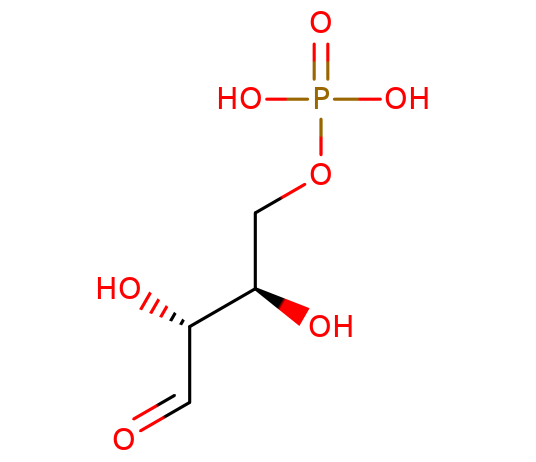
D-Erythrose 4-phosphate
D-Erythrose 4-phosphate, also known as D-erythrose-4-p or 4-O-phosphono-D-erythrose, belongs to the class of organic compounds known as monosaccharide phosphates. These are monosaccharides comprising a phosphated group linked to the carbohydrate unit. D-Erythrose 4-phosphate is soluble (in water) and a moderately acidic compound (based on its pKa). Within the cell, D-erythrose 4-phosphate is primarily located in the cytoplasm. D-Erythrose 4-phosphate exists in all eukaryotes, ranging from yeast to humans. D-Erythrose 4-phosphate participates in a number of enzymatic reactions. In particular, D-Erythrose 4-phosphate and fructose 6-phosphate can be converted into D-glyceraldehyde 3-phosphate and D-sedoheptulose 7-phosphate; which is mediated by the enzyme transaldolase. In addition, D-Erythrose 4-phosphate and xylulose 5-phosphate can be converted into fructose 6-phosphate and D-glyceraldehyde 3-phosphate; which is catalyzed by the enzyme transketolase. In humans, D-erythrose 4-phosphate is involved in the pentose phosphate pathway. D-Erythrose 4-phosphate is also involved in several metabolic disorders, some of which include glucose-6-phosphate dehydrogenase deficiency, ribose-5-phosphate isomerase deficiency, transaldolase deficiency, and cancer (via the Warburg effect).
D-erythrose 4-phosphate is an erythrose phosphate that is D-erythrose carrying a phosphate group at position 4. It is an intermediate in the pentose phosphate pathway and Calvin cycle. It has a role as a human metabolite, an Escherichia coli metabolite and a mouse metabolite. It derives from a D-erythrose.
D-erythrose 4-phosphate is a potent antitumor agent that inhibits the production of proteins by inhibiting the transcription and translation of genetic information. D-Erythrose 4-phosphate has been shown to bind to RNA polymerase, thereby inhibiting transcriptional activity. The reaction mechanism is not well understood, but it can be assumed that the inhibition is due to an interaction with one or more of the nucleotides in the active site of RNA polymerase. D-Erythrose 4-phosphate has also been shown to inhibit protein synthesis by binding to ribosomes, preventing amino acid incorporation into polypeptides. This drug also has antimicrobial properties against bacteria, fungi, and protozoa.
Title: D -Erythrose 4-Phosphate
CAS Registry Number: 585-18-2
CAS Name: (2 R ,3 R )-2,3-Dihydroxy-4-(phosphonooxy)butanal
Additional Names: 4- D -erythrosephosphoric acid
Molecular Formula: C 4 H 9 O 7 P
Molecular Weight: 200.08
Percent Composition: C 24.01%, H 4.53%, O 55.98%, P 15.48%
Literature References: Occurs in minute amounts in muscle flesh of all animals. Important natural intermediate in the Embden-Meyerhof scheme of alcoholic fermentation and glycolysis. Prepn by chemical synthesis: Ballou et al., J. Am. Chem. Soc. 77, 2658, 5967 (1955). Outline: Chem. Eng. News 34, 2506 (1956).
Properties: Obtained in aq soln only. Shows no observable optical rotation. Is condensed with phosphoenolpyruvate by a cell-free extract from an E. coli mutant to give a 90% yield. Best stored and transported as the cyclohexylammonium salt of 4-phosphoryl- D -erythrose dimethyl acetal from which it can be prepared readily when needed.
CAS Number 585-18-2
Product Name D-Erythrose 4-phosphate
IUPAC Name [(2R,3R)-2,3-dihydroxy-4-oxobutyl] dihydrogen phosphate
Molecular Formula C4H9O7P
Molecular Weight 200.08 g/mol
InChI InChI=1S/C4H9O7P/c5-1-3(6)4(7)2-11-12(8,9)10/h1,3-4,6-7H,2H2,(H2,8,9,10)/t3-,4+/m0/s1
InChI Key NGHMDNPXVRFFGS-IUYQGCFVSA-N
SMILES C(C(C(C=O)O)O)OP(=O)(O)O
Synonyms erythrose 4-phosphate, erythrose 4-phosphate, ((R*,R*)-(+-))-isomer, erythrose 4-phosphate, ((R*,S*)-(+-))-isomer, erythrose 4-phosphate, (R*,R*)-isomer, erythrose 4-phosphate, 14C4-labeled, (R*,R*)-isomer, threose 4-phosphate
Canonical SMILES C(C(C(C=O)O)O)OP(=O)(O)O
Isomeric SMILES C([C@H]([C@H](C=O)O)O)OP(=O)(O)O