About this product
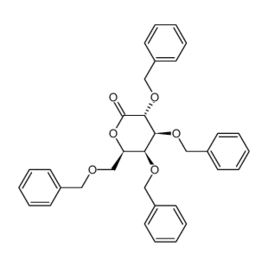
2,3,4,6-Tetra-O-benzyl-D-galactono-1,5-lactone
2,3,4,6-Tetra-O-benzyl-D-galactono-1,5-lactone, commonly known as TBG, is a lactone derivative of galacturonic acid. Lactones are cyclic esters that possess a carbonyl group as part of the ring. TBG is a white, odorless powder that is soluble in most organic solvents but insoluble in water. TBG has been studied extensively for its potential applications in chemical synthesis, polymer chemistry, and material science.
Physical and Chemical Properties:
TBG has a molecular formula of C29H28O8 and a molecular weight of 500.54 g/mol. It has a melting point of 154-156?C and a boiling point of 930?C at 760 mmHg. TBG is stable at room temperature but is sensitive to light and moisture. The compound exhibits strong nucleophilic properties and can be easily hydrolyzed to its corresponding acid form.
Synthesis and Characterization:
The synthesis of TBG can be achieved through several methods, including esterification, ketalization, and lactonization. It is usually obtained by benzylating galactaric acid and then treating the benzylated derivative with acid. The characterization of TBG involves several analytical techniques such as nuclear magnetic resonance spectroscopy (NMR), mass spectrometry (MS), and infrared (IR) spectroscopy.
Analytical Methods:
Several analytical methods have been employed to study the properties of TBG. NMR spectroscopy is commonly used to reveal the molecular structure of the compound. MS is used to determine the molecular weight of the compound. IR spectroscopy provides information about the functional groups present in the compound. High-performance liquid chromatography (HPLC) is used to determine the purity of the compound.
Biological Properties:
Although TBG has not been extensively studied for its biological activity, it has been shown to exhibit antioxidant and anti-inflammatory properties. It has also been suggested that TBG may have potential anticancer properties.
Toxicity and Safety in Scientific Experiments:
There is limited information available on the toxicity of TBG. However, the compound is considered to be safe in scientific experiments at concentrations commonly used in research.
Applications in Scientific Experiments:
TBG has been used in a variety of scientific experiments. It is commonly used as a protecting group for hydroxyl groups in organic synthesis. It has also been used to prepare chiral ligands for catalysis and as a building block for the synthesis of new materials.
Current State of Research:
Current research on TBG is focused on the development of new synthetic methods, the study of its biological properties, and the investigation of its potential applications in various fields of research.
Potential Implications in Various Fields of Research and Industry:
TBG has potential implications in several fields of research and industry. It can be used in the development of new drugs, materials, and catalysts. It may also have potential applications in the food industry as a food additive.
Limitations and Future Directions:
One of the limitations of TBG is its sensitivity to light and moisture, which affects its stability. Future research could focus on developing more stable derivatives of the compound. Other future directions could include studying the toxicity and safety of TBG in greater detail and exploring its potential applications in fields such as biomedicine and energy storage.
List of Future Directions:
- Development of more stable derivatives of TBG
- Investigation of the toxicity and safety of TBG in greater detail
- Exploration of the potential applications of TBG in biomedicine and energy storage
- Development of new synthetic methods for TBG
- Study of the biological properties of TBG
- Investigation of the potential applications of TBG in the food industry
- Development of TBG-based catalysts for chemical reactions
- Optimization of the synthesis and characterization of TBG
- Study of the mechanism of action of TBG in potential anticancer activity
- Exploration of the potential applications of TBG in the field of materials science
CAS Number 82598-84-3
Product Name 2,3,4,6-Tetra-O-benzyl-D-galactono-1,5-lactone
IUPAC Name (3R,4S,5S,6R)-3,4,5-tris(phenylmethoxy)-6-(phenylmethoxymethyl)oxan-2-one
Molecular Formula C34H34O6
Molecular Weight 538.6 g/mol
InChI InChI=1S/C34H34O6/c35-34-33(39-24-29-19-11-4-12-20-29)32(38-23-28-17-9-3-10-18-28)31(37-22-27-15-7-2-8-16-27)30(40-34)25-36-21-26-13-5-1-6-14-26/h1-20,30-33H,21-25H2/t30-,31+,32+,33-/m1/s1
InChI Key BUBVLQDEIIUIQG-JDIHBLRXSA-N
SMILES C1=CC=C(C=C1)COCC2C(C(C(C(=O)O2)OCC3=CC=CC=C3)OCC4=CC=CC=C4)OCC5=CC=CC=C5
Synonyms 2,3,4,6-Tetrakis-O-(phenylmethyl)-D-galactonic Acid ?-Lactone;
Canonical SMILES C1=CC=C(C=C1)COCC2C(C(C(C(=O)O2)OCC3=CC=CC=C3)OCC4=CC=CC=C4)OCC5=CC=CC=C5
Isomeric SMILES C1=CC=C(C=C1)COC[C@@H]2[C@@H]([C@@H]([C@H](C(=O)O2)OCC3=CC=CC=C3)OCC4=CC=CC=C4)OCC5=CC=CC=C5
CAS No: 82598-84-3
MDL No: MFCD15145121
Chemical Formula: C34H34O6
Molecular Weight: 538.63