About this product
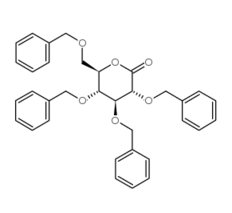
Tetra-O-benzyl-D-glucono-1,5-lactone
2,3,4,6-Tetra-O-benzyl-D-glucono-1,5-lactone is a compound that belongs to the family of gluconolactones. It is a colorless to off-white powder that is soluble in methanol and ethanol. It is commonly used in organic synthesis as an intermediate in the preparation of various chemicals. This compound is also known by the name benzyl D-gluconolactone. It was first synthesized by Martindale et al. in 1953.
Synthesis and Characterization:
2,3,4,6-Tetra-O-benzyl-D-glucono-1,5-lactone can be synthesized through the reaction of D-glucono-?-lactone with benzyl alcohol in the presence of a Lewis acid catalyst such as zinc chloride. The reaction is carried out under reflux conditions in anhydrous toluene. After completion of the reaction, the product is purified by recrystallization.
The compound can be characterized by various analytical techniques such as nuclear magnetic resonance (NMR), Fourier-transform infrared spectroscopy (FTIR), and mass spectrometry (MS).
Analytical Methods:
The purity of 2,3,4,6-Tetra-O-benzyl-D-glucono-1,5-lactone can be determined by high-performance liquid chromatography (HPLC) or gas chromatography (GC). The compound can also be analyzed by NMR spectroscopy to determine its structure and purity.
Biological Properties:
2,3,4,6-Tetra-O-benzyl-D-glucono-1,5-lactone has been reported to have antitumor and antiviral activity. It has also been found to inhibit the growth of certain bacteria and fungi. The compound is believed to act by inhibiting the activity of enzymes involved in the biosynthesis of nucleic acids.
Toxicity and Safety in Scientific Experiments:
Despite its biological activity, 2,3,4,6-Tetra-O-benzyl-D-glucono-1,5-lactone has been found to be relatively non-toxic in preliminary toxicology studies. However, further studies are required to determine its toxicity and safety profile.
Applications in Scientific Experiments:
2,3,4,6-Tetra-O-benzyl-D-glucono-1,5-lactone has a wide range of applications in scientific experiments. It can be used as an intermediate in the synthesis of various chemicals, including antiviral and antitumor agents. It can also be used as a reagent in organic synthesis.
Current State of Research:
Currently, research into the biological activity and potential therapeutic applications of 2,3,4,6-Tetra-O-benzyl-D-glucono-1,5-lactone is ongoing. Several studies have been conducted to explore its antitumor and antiviral activity. However, further research is required to fully elucidate its mechanism of action and potential therapeutic applications.
Potential Implications in Various Fields of Research and Industry:
2,3,4,6-Tetra-O-benzyl-D-glucono-1,5-lactone has potential implications in various fields of research and industry. In the pharmaceutical industry, it could be used as an intermediate in the synthesis of novel antitumor and antiviral agents. It could also have applications in the food industry as a preservative or as an ingredient in functional foods.
Limitations and Future Directions:
Despite its potential, there are several limitations to the use of 2,3,4,6-Tetra-O-benzyl-D-glucono-1,5-lactone in research and industry. For one, it is relatively expensive to synthesize. Additionally, its low solubility in water can make it difficult to work with.
Future directions for research include further exploration of its biological activity and potential therapeutic applications. Studies could also focus on developing more efficient and cost-effective synthesis methods for the compound.
In conclusion, 2,3,4,6-Tetra-O-benzyl-D-glucono-1,5-lactone is a useful compound with a wide range of applications in scientific research and industry. While there are limitations to its use, ongoing research holds promise for uncovering its full potential.
CAS Number 13096-62-3
Product Name 2,3,4,6-Tetra-O-benzyl-D-glucono-1,5-lactone
IUPAC Name (3R,4S,5R,6R)-3,4,5-tris(phenylmethoxy)-6-(phenylmethoxymethyl)oxan-2-one
Molecular Formula C34H34O6
Molecular Weight 538.63 g/mol
InChI InChI=1S/C34H34O6/c35-34-33(39-24-29-19-11-4-12-20-29)32(38-23-28-17-9-3-10-18-28)31(37-22-27-15-7-2-8-16-27)30(40-34)25-36-21-26-13-5-1-6-14-26/h1-20,30-33H,21-25H2/t30-,31-,32+,33-/m1/s1
InChI Key BUBVLQDEIIUIQG-NXVJRICRSA-N
SMILES C1=CC=C(C=C1)COCC2C(C(C(C(=O)O2)OCC3=CC=CC=C3)OCC4=CC=CC=C4)OCC5=CC=CC=C5
Synonyms 2,3,4,6-Tetrakis-O-(phenylmethyl)-D-gluconic acid ?-Lactone;D-2,3,4,6-Tetra-O-benzyl-gluconic acid ?-Lactone; (3R,4S,5R,6R)-3,4,5-Tris(benzyloxy)-6-[(benzyloxy)methyl]tetrahydropyran-2-one; 2,3,4,6-Tetra-O-benzyl-D-glucono-1,5-O-lactone; 2,3,4,6-Tet
Canonical SMILES C1=CC=C(C=C1)COCC2C(C(C(C(=O)O2)OCC3=CC=CC=C3)OCC4=CC=CC=C4)OCC5=CC=CC=C5
Isomeric SMILES C1=CC=C(C=C1)COC[C@@H]2[C@H]([C@@H]([C@H](C(=O)O2)OCC3=CC=CC=C3)OCC4=CC=CC=C4)OCC5=CC=CC=C5
COA:
Product name : 2,3,4,6-Tetra-O-benzyl-D-glucono-1,5-lactone CAS : 13096-62-3
F.M. : C 34 H 34 O 6 Batch No : 20140118 Quantity : 405g
Items
Standards
Results
Appearance
Pale yellow syrup
Positive
Solubility
Soluble in chloroform, insoluble in water
Complies
Appearance of solution
Dissolve0.5gin 10mL of chloroform,
and the solution is clear
Complies
Identification
HPLC and TLC
Positive
MS and NMR
Should Comply
Complies
Water content
Max. 0.5%
Complies
TLC
One spot
Complies
Assay by HPLC
Min. 95%
96.7%