About this product
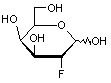
2-fluoro-D-galactoseFDGal, also known as 2-fluoro-2-deoxy-D-galactose, is a fluorinated carbohydrate molecule with the chemical formula C6H11FO5. It is a fluorinated derivative of galactose, a common monosaccharide found in many biologically important carbohydrates. FDGal is an important tool for researchers studying carbohydrate biochemistry, as it can be used to investigate the processes of carbohydrate metabolism and cell signaling.Synthesis and Characterization
FDGal can be synthesized using a variety of methods, including the classic Leuckart-Wallach reaction, which involves the reaction of galactose with hydrofluoric acid and formic acid. Other methods include the use of protecting groups to selectively modify the hydroxyl groups of galactose, followed by fluorination reactions. Once synthesized, FDGal can be characterized using a variety of analytical techniques, including nuclear magnetic resonance spectroscopy (NMR), mass spectrometry, and X-ray crystallography.Analytical Methods
Several analytical methods are used to detect FDGal in biological samples and quantify its levels. These methods include high-performance liquid chromatography (HPLC), gas chromatography-mass spectrometry (GC-MS), and capillary electrophoresis.Biological Properties
FDGal has been shown to be a useful tool in studying carbohydrate metabolism and cell signaling. It is rapidly taken up by cells and microorganisms, and can be incorporated into various cellular components such as lipids and glycans. FDGal can also be used in the study of carbohydrate-protein interactions, including lectin-carbohydrate interactions.Toxicity and Safety in Scientific Experiments
Although FDGal has not been extensively studied for toxicity, it is generally considered to be safe for use in scientific experiments at the concentrations typically used. However, caution should always be exercised when working with any hazardous chemical.Applications in Scientific Experiments
FDGal has numerous applications in scientific research, including:- Studying carbohydrate metabolism and cell signaling- Investigating carbohydrate-protein interactions- Characterizing glycans in biological samplesCurrent State of Research
Research on FDGal is ongoing, with new applications and methods being developed regularly. Some recent studies have focused on the use of FDGal in the imaging of carbohydrate metabolism and on its potential use as a diagnostic tool for certain types of cancer.Potential Implications in Various Fields of Research and Industry
FDGal has potential implications in several fields of research and industry, including:- Biotechnology: FDGal can be used to create fluorinated analogs of biologically important carbohydrates, which could have improved properties over their non-fluorinated counterparts.- Pharmaceuticals: FDGal has potential applications in drug discovery and development, particularly in the study of carbohydrate-based drugs and drug delivery systems.- Diagnostics: FDGal could have potential applications in the diagnosis and monitoring of certain types of cancer.Limitations and Future Directions
One limitation of FDGal is that it is only one of many possible fluorinated carbohydrate molecules, and its properties may not be ideal for all applications. Future research may focus on the synthesis and characterization of new fluorinated analogs of galactose and other carbohydrates.Additionally, future research could explore the potential of FDGal in:- The study of other aspects of carbohydrate biochemistry and metabolism- The development of new diagnostic tools and methods for cancer and other diseases- The creation of new carbohydrate-based drugs and drug delivery systems- The development of new methods for imaging carbohydrate metabolism in vivo.In conclusion, FDGal is an important tool for researchers studying carbohydrate biochemistry, with potential applications in biotechnology, pharmaceuticals, and diagnostics. Further research is needed to fully understand its properties and potential uses.CAS Number51146-53-3Product NameFDGalIUPAC Name(2R,3S,4S,5R)-2-fluoro-3,4,5,6-tetrahydroxyhexanalMolecular FormulaC?H??FO?Molecular Weight182.15 g/molInChIInChI=1S/C6H11FO5/c7-3(1-8)5(11)6(12)4(10)2-9/h1,3-6,9-12H,2H2/t3-,4+,5+,6-/m0/s1InChI KeyAOYNUTHNTBLRMT-KCDKBNATSA-NSMILESC(C(C(C(C(C=O)F)O)O)O)OSynonyms2-deoxy-2-(18F)fluoro-D-galactose, 2-deoxy-2-fluoro-galactose, 2-deoxy-2-fluorogalactose, 2-deoxy-2-fluorogalactose F-18, 2-deoxy-2-fluorogalactose, 18F-labeled, FDGalCanonical SMILESC(C(C(C(C(C=O)F)O)O)O)OIsomeric SMILESC([C@H]([C@@H]([C@@H]([C@H](C=O)F)O)O)O)OCAS No: 7226-39-3,51146-53-3 Synonyms: 3-Fluoro-6-hydroxymethyl-tetrahydro-pyran-2,4,5-triol MDL No: MFCD00061625 Chemical Formula: C6H11FO5 Molecular Weight: 182.15References: 1. Gross V, Hull WE, Berger U, Andus T, Kreisel W, Biochem. J. 1992, August 1, 285(Pt 3), 821?8262. Barlow J, et.al.,, Carbohydr. Res., 2000, 328, p4733. Geilen C, et.al.,, Tetrahedron Lett., 1992, 33, p2435