About this product
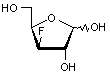
3-Deoxy-3-fluoro-D-xylofuranose, 3-??-D-??3-Deoxy-3-fluoro-D-xylofuranose - Aqueous solution is a substrate for the enzyme glucose isomerase. This enzyme catalyses the isomerisation of 3-deoxy-3-fluoro-D-xylofuranose to D-ribose in aqueous solution. The immobilised glucose isomerase can be used as an alternative to the free form, which has been shown to have low yields and high levels of product inhibition.
3-Fluoro-3-deoxy-D-xylofuranose (FX) is a fluorinated sugar that exhibits unique physical and chemical properties. It is a derivative of xylose, which is a natural sugar found in plants. FX is commonly used in synthetic chemistry, specifically in the synthesis of nucleosides, which are used in the production of antiviral drugs. FX is also useful in the synthesis of other fluorinated compounds, which have various applications in the fields of organic chemistry, materials science, and biochemistry.Physical and Chemical Properties:
FX has a molecular formula of C5H9FO4 and a molar mass of 150.12 g/mol. It is a white crystalline solid at room temperature and has a sweet taste. It is soluble in water and has a melting point of 121-125?C. The compound is stable under normal conditions, but it can decompose at high temperatures, and it is sensitive to light. FX is known for its unique physical and chemical properties, particularly its ability to form hydrogen bonds and its reactivity towards nucleophilic and electrophilic reagents.Synthesis and Characterization:
FX can be synthesized from several precursors, such as xylose, 3-deoxy-2-keto-D-xylo-hexos-2-ulose, and D-ribulose. The most common method of synthesis involves the reaction of xylose or 3-deoxy-2-keto-D-xylo-hexos-2-ulose with hydrofluoric acid (HF) under controlled conditions. The resulting compound is then purified using various techniques, such as column chromatography, crystallization, and recrystallization.The characterization of FX can be done using various spectroscopic and analytical methods, such as nuclear magnetic resonance (NMR), infrared (IR) spectroscopy, and mass spectrometry. These techniques provide detailed information about the structure and purity of the compound.Analytical Methods:
Analytical methods, such as high-performance liquid chromatography (HPLC), gas chromatography (GC), and capillary electrophoresis (CE), are commonly used to analyze the purity and concentration of FX. These methods provide accurate and precise measurements of the compound, which are necessary for its use in various scientific experiments.
Biological Properties:
FX has been shown to exhibit antiviral and antitumor properties in various studies. It has been evaluated in vitro and in vivo for its antiviral activity against several viruses, such as herpes simplex virus (HSV), hepatitis B virus (HBV), and human immunodeficiency virus (HIV). FX has also been found to have cytotoxic effects on several tumor cell lines.Toxicity and Safety in Scientific Experiments:
FX is considered to be safe for use in scientific experiments, as it is not known to exhibit any significant toxic effects. However, caution should be exercised when handling the compound, as it is sensitive to light and can decompose at high temperatures.Applications in Scientific Experiments:
FX has several applications in scientific experiments, particularly in the synthesis of nucleosides and other fluorinated compounds. It has been used in the production of various antiviral drugs, such as acyclovir and ganciclovir. FX has also been used in the synthesis of fluorinated polymers, which have applications in materials science and engineering.Current State of Research:
FX continues to be an active area of research in various fields, including organic chemistry, medicinal chemistry, and materials science. Researchers are exploring new synthetic methods for the compound, as well as its potential applications in various fields.Potential Implications in Various Fields of Research and Industry:
FX has the potential to have significant implications in various fields of research and industry. Its unique physical and chemical properties make it useful in the synthesis of various compounds, which have applications in medicine, materials science, and engineering. The antiviral and antitumor properties of FX also make it a promising candidate for the development of new drugs.Limitations and Future Directions:
While FX has several useful properties, it also has some limitations. For example, it is relatively expensive to synthesize, which limits its widespread use. In addition, the toxicity of the compound under certain conditions is not well understood and requires further investigation. Future directions for research include the development of new synthetic methods for the compound, exploration of its biological properties, and investigation into its potential applications in various fields.Some possible future directions are:- Investigation of the use of FX in the synthesis of new fluorinated polymers and materials.- Evaluation of the effectiveness of FX in the treatment of various viral infections and tumors.- Development of new synthetic methods for FX that are more cost-effective and efficient.- Investigation of the toxicological properties of FX under different conditions and exposure scenarios.- Exploration of the use of FX in the synthesis of other fluorinated compounds with unique properties.- Study of the stability of FX under different conditions, such as high temperatures and exposure to light.- Investigation of the use of FX in the modification of biomolecules, such as proteins and nucleic acids.CAS Number14537-01-0Product Name3-Fluoro-3-deoxy-D-xylofuranoseIUPAC Name(3S,4R,5R)-4-fluoro-5-(hydroxymethyl)oxolane-2,3-diolMolecular FormulaC5H9FO4Molecular Weight152.12 g/molInChIInChI=1S/C5H9FO4/c6-3-2(1-7)10-5(9)4(3)8/h2-5,7-9H,1H2/t2-,3+,4-,5?/m1/s1InChI KeyNZBLAOXQXYQYNW-IOVATXLUSA-NSMILESC(C1C(C(C(O1)O)O)F)OCanonical SMILESC(C1C(C(C(O1)O)O)F)OIsomeric SMILESC([C@@H]1[C@@H]([C@H](C(O1)O)O)F)OReferences: 1. Gosselin G, Puech F, Genu-Dellac C, Imbach JL, Carbohydr. Res. 1993, Oct 18, p1-17