About this product
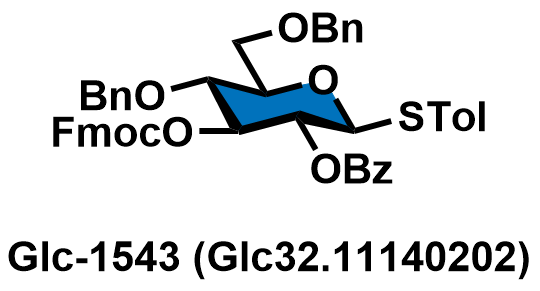
4-Methylphenyl 2-O-benzoyl-4,6-di-O-benzyl-3-O-(9-fluorenylmethoxycarbonyl)-1-thio-β-D-glucopyranoside
4-Methylphenyl 2-O-benzoyl-4,6-di-O-benzyl-3-O-(9-fluorenylmethoxycarbonyl)-1-thio-β-D-glucopyranoside is a thioglycoside building block engineered for controlled oligosaccharide synthesis, featuring a strategic combination of orthogonal protecting groups to enable selective deprotection during carbohydrate assembly.
Core Structure
Backbone : β-D-glucopyranose ring with a 4-methylphenylthio group at the anomeric position (C1), serving as a glycosyl donor activated by thiophilic promoters (e.g., NIS/TfOH).
Orthogonal Protecting Groups
Position
Group
Stability & Deprotection
C2
Benzoyl ester
Base-labile (removed via NaOH/MeOH)
C3
Fmoc (9-fluorenylmethoxycarbonyl)
Base-sensitive (cleaved with 20% piperidine/DMF)
C4/C6
Benzyl ethers
Acid-stable; removed via hydrogenolysis (H₂/Pd-C)
Key Properties
Molecular formula : C₄₉H₄₅NO₈S (estimated)
Molecular weight : ~832.0 g/mol
Reactivity :
Benzoyl at C2 moderates donor reactivity via electron withdrawal.
Fmoc at C3 enables compatibility with solid-phase synthesis workflows.
Synthetic Utility
Sequential Deprotection :
Step 1 : Fmoc removal (C3) under mild basic conditions.
Step 2 : Benzoyl cleavage (C2) via alkaline hydrolysis.
Step 3 : Benzyl deprotection (C4/C6) via hydrogenolysis.
Glycosylation Control :
The 4-methylphenylthio group ensures efficient activation for glycosidic bond formation.
Benzyl groups at C4/C6 provide steric shielding to direct regioselective coupling.
Branching Flexibility :
Exposed C3-OH after Fmoc removal allows site-specific modifications (e.g., phosphorylation, conjugation).
Applications
Glycoconjugate vaccines : Selective C3 functionalization for antigen attachment.
Dendrimer synthesis : Iterative branching via orthogonal deprotection.
Glycosidase inhibitor design : Protected glucose scaffold for analog development.
Stability Profile
Condition
Stability
Acidic (pH > 3)
Stable (benzyl/benzoyl intact)
Basic (pH < 9)
Stable except during Fmoc/benzoyl cleavage
Hydrogenation
Tolerated until final benzyl removal
This compound exemplifies advanced carbohydrate engineering, integrating traditional protecting groups (benzyl, benzoyl) with modern orthogonal motifs (Fmoc) for precision synthesis of complex glycans. Its design supports both solution-phase and automated solid-phase methodologies.
Citations:
https://patents.google.com/patent/WO2000042057A1/en
https://www.frontiersin.org/journals/chemistry/articles/10.3389/fchem.2023.1332837/full
https://pubmed.ncbi.nlm.nih.gov/31895493/
https://europepmc.org/article/pmc/6531329
https://pubs.rsc.org/en/content/getauthorversionpdf/c9ob00573k
https://pmc.ncbi.nlm.nih.gov/articles/PMC6259426/
https://pmc.ncbi.nlm.nih.gov/articles/PMC2952681/
https://onlinelibrary.wiley.com/doi/full/10.1002/asia.201901621