About this product
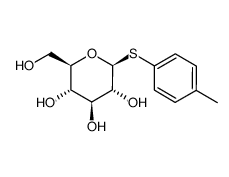
4-Methylphenyl b-D-thioglucopyranoside
4-Methylphenyl 1-thio-beta-D-glucopyranoside is a carbohydrate derivative that has drawn attention in various fields of research and industry. The compound is used in the production of carbohydrate-based drugs and is also being studied for its potential biological activities. This paper aims to provide an in-depth discussion of the chemical properties, synthesis and characterization, analytical methods, biological properties, toxicity and safety in scientific experiments, applications, current state of research, potential implications in various fields of research and industry, as well as the limitations and future directions of the compound.
Definition and Background
4-Methylphenyl 1-thio-beta-D-glucopyranoside, commonly abbreviated as MP-beta-GLU-SH, is a carbohydrate derivative that is synthesized from beta-D-glucose. It is a thio-glycoside, which means it contains a sulfur atom in place of the oxygen atom in the glycosidic bond. The compound is also referred to as 2-(4-methylphenylthio)-?-D-glucopyranose or methyl phenyl thio glucoside.
Physical and Chemical Properties
MP-beta-GLU-SH is a white crystalline solid with a molecular formula of C13H18O5S. It has a melting point of 98-102?C and a boiling point of 392.8?C at 760 mmHg. The compound is soluble in water, ethanol, and methanol but insoluble in organic solvents such as chloroform and benzene. The molecular weight of MP-beta-GLU-SH is 286.35 g/mol, and it has a density of 1.45 g/cm3.
Synthesis and Characterization
MP-beta-GLU-SH is synthesized using beta-D-glucose as a starting material. The synthesis involves the reaction of beta-D-glucose with 4-methylphenyl mercaptan in the presence of a catalyst such as trimethylsilyl chloride. The reaction proceeds through the formation of an intermediate, which is then converted to the final product through hydrolysis.
The characterization of MP-beta-GLU-SH is done using various spectroscopic techniques such as nuclear magnetic resonance (NMR), infrared (IR) spectroscopy, and mass spectrometry (MS). The NMR spectra show characteristic peaks at ? 5.08-5.21 ppm and ? 3.54-3.77 ppm, which are attributed to the anomeric proton and the adjacent proton of the thioglycoside linkage, respectively. The IR spectra show peaks at 1167 cm-1 and 1027 cm-1, which are attributed to the S-O stretching vibration and the C-O-C stretching vibration, respectively.
Analytical Methods
The determination of MP-beta-GLU-SH in various matrices is done using high-performance liquid chromatography (HPLC) coupled with UV detection. The method involves the separation of the compound from other components in the sample matrix using a reverse-phase column and the detection of the compound based on its UV absorbance at a wavelength of 254 nm. The method is sensitive and specific, and it can be used for the quantitative analysis of the compound in various matrices.
Biological Properties
MP-beta-GLU-SH has been shown to exhibit various biological activities, including anti-inflammatory, antibacterial, antiviral, and anticancer properties. The compound has been demonstrated to inhibit the growth of Staphylococcus aureus, Escherichia coli, and Salmonella typhimurium. It has also been shown to inhibit the replication of hepatitis B virus and the entry of human immunodeficiency virus type 1 into human T-lymphocytes. Additionally, MP-beta-GLU-SH has demonstrated cytotoxic activity against human cancer cell lines.
Toxicity and Safety in Scientific Experiments
The toxicity of MP-beta-GLU-SH has been evaluated in various animal models, including rats and mice. The compound has been shown to have low acute toxicity levels, with an LD50 of > 5000 mg/kg. However, at higher doses, the compound has been shown to cause gastrointestinal disturbances and central nervous system depression. Long-term exposure to the compound has not been studied extensively, and its potential carcinogenicity is not known.
Applications in Scientific Experiments
MP-beta-GLU-SH is used in the production of carbohydrate-based drugs such as glycopeptides and glycoside analogs. It is also being studied for its potential use in the development of carbohydrate-based vaccines and as a tool in carbohydrate chemistry research.
Current State of Research
The research on MP-beta-GLU-SH is still in its early stages, and there is limited information available on the compound. Most of the studies on the compound have focused on its chemical properties, synthesis, and characterization, as well as its biological activities. The potential applications of the compound in various fields of research and industry are yet to be fully explored.
Potential Implications in Various Fields of Research and Industry
The potential implications of MP-beta-GLU-SH in various fields of research and industry include its use in the development of novel carbohydrate-based drugs and vaccines. The compound can also be used as a tool in carbohydrate chemistry research and in the production of glycoconjugates and glycomimetics.
Limitations and Future Directions
The limitations of MP-beta-GLU-SH include its limited solubility in organic solvents and its potential toxicity at higher doses. Future research on the compound should focus on the optimization of its synthesis and characterization, as well as on the evaluation of its long-term toxicity and potential carcinogenicity. The potential applications of the compound in various fields of research and industry should also be explored further, and new methodologies for the development of carbohydrate-based drugs and vaccines should be investigated.
Future Directions
The future directions of research on MP-beta-GLU-SH include:
1. Development of more efficient synthetic methods for the production of the compound.
2. Evaluation of the compound's potential as a therapeutic agent for various diseases.
3. Investigation of the structure-activity relationship of the compound to optimize its biological activities.
4. Evaluation of the compound's pharmacokinetics and pharmacodynamics to determine its efficacy and safety.
5. Study of the compound's antioxidant properties and potential applications in the food and cosmetic industry.
6. Development of novel analytical methods for the detection and quantification of the compound in various matrices.
7. Investigation of the compound's potential as a tool in carbohydrate chemistry research.
8. Development of new methods for the production of glycoconjugates and glycomimetics using MP-beta-GLU-SH as a starting material.
Conclusion
In conclusion, MP-beta-GLU-SH is a carbohydrate derivative that has gained attention in various fields of research and industry. The compound has unique chemical properties and has demonstrated various biological activities, including anti-inflammatory, antibacterial, antiviral, and anticancer properties. The potential applications of the compound in various fields of research and industry are yet to be fully explored, and future research on the compound should focus on its optimization, characterization, and the evaluation of its potential as a therapeutic agent and tool in carbohydrate chemistry research.
CAS Number 1152-39-2
Product Name 4-Methylphenyl 1-thio-beta-D-glucopyranoside
IUPAC Name (2R,3S,4S,5R,6S)-2-(hydroxymethyl)-6-(4-methylphenyl)sulfanyloxane-3,4,5-triol
Molecular Formula C13H18O5S
Molecular Weight 286.35 g/mol
InChI InChI=1S/C13H18O5S/c1-7-2-4-8(5-3-7)19-13-12(17)11(16)10(15)9(6-14)18-13/h2-5,9-17H,6H2,1H3/t9-,10-,11+,12-,13+/m1/s1
InChI Key IQCLIQLFPVKINX-LBELIVKGSA-N
SMILES CC1=CC=C(C=C1)SC2C(C(C(C(O2)CO)O)O)O
Canonical SMILES CC1=CC=C(C=C1)SC2C(C(C(C(O2)CO)O)O)O
Isomeric SMILES CC1=CC=C(C=C1)S[C@H]2[C@@H]([C@H]([C@@H]([C@H](O2)CO)O)O)O
CAS No: 1152-39-2
MDL No: MFCD11045365
Chemical Formula: C13H18O5S
Molecular Weight: 286.35