About this product
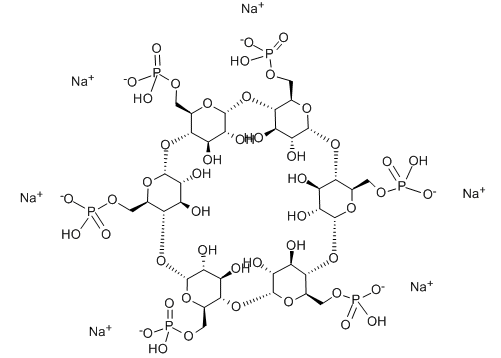
a-Cyclodextrin dihydrogen phosphate sodium salt , PACD.NaAlpha-Cyclodextrin Phosphate Sodium Salt: Definition and BackgroundAlpha-cyclodextrin phosphate sodium salt (?-CDS) is a modified version of ?-cyclodextrin, which is a cyclic sugar molecule composed of six glucose units connected by ?-1,4 glycosidic bonds. The ?-CDS molecule contains a phosphate group on one of its glucose units, which enhances its solubility in water and provides unique properties that are not present in other cyclodextrins. ?-CDS has been widely studied in various fields, including medicine, biotechnology, and material science, due to its ability to form inclusion complexes with a variety of guest molecules and its potential applications as a drug delivery vehicle, chelating agent, and chemical sensor.Physical and Chemical Properties
?-CDS is a white or off-white powder, soluble in water, slightly soluble in methanol, ethanol, and acetone, and insoluble in ether and chloroform. It has a molecular weight of 1125.3 g/mol, a melting point of approximately 260?C, and a decomposition temperature of around 300?C. The phosphate group on ?-CDS provides a negative charge, which affects its interactions with other molecules, such as cations and anions. In addition, ?-CDS has a hydrophobic cavity in the center of the molecule, which can accommodate guest molecules, such as drugs and organic compounds.Synthesis and Characterization
?-CDS can be synthesized by several methods, including phosphorylation of ?-cyclodextrin with phosphorous oxychloride, phosphoryl chloride, or phosphorous pentoxide, or by using a phosphate-containing reagent, such as diethylphosphorochloridite. The resulting ?-CDS can be further purified by recrystallization or chromatography. The purity and structure of ?-CDS can be analyzed by various techniques, including nuclear magnetic resonance (NMR), mass spectrometry (MS), infrared (IR) spectroscopy, and X-ray diffraction (XRD).Analytical Methods
Several analytical methods can be used to detect and quantify ?-CDS, including high-performance liquid chromatography (HPLC), capillary electrophoresis (CE), and enzyme-linked immunosorbent assay (ELISA). These methods can also be used to analyze the stability, solubility, and release behavior of ?-CDS and its inclusion complexes with guest molecules.Biological Properties
?-CDS has been shown to have low toxicity and good biocompatibility in vitro and in vivo. It has also been reported to have antioxidant, antimicrobial, and anti-inflammatory effects, and to enhance the stability and bioavailability of drugs. The mechanism of action of ?-CDS is thought to be related to its ability to form inclusion complexes with enzymes and proteins, as well as its interactions with cell membranes and signaling pathways.Toxicity and Safety in Scientific Experiments
Several studies have investigated the safety and toxicity of ?-CDS in animals and humans. Acute toxicity studies in rats have shown that ?-CDS has a low toxicity profile, with no significant adverse effects observed at high doses. Subacute and chronic toxicity studies have also shown no significant toxic effects of ?-CDS on organ function or histology, hematological parameters, and serum biochemistry. However, long-term safety studies are needed to evaluate the potential toxicity and safety of ?-CDS in humans.Applications in Scientific Experiments
?-CDS has a wide range of applications in various fields of research, including medicine, biotechnology, and material science. In medicine, ?-CDS has been suggested as a potential drug delivery vehicle for various drugs, including anticancer agents, antibiotics, and insulin. Furthermore, ?-CDS can be used as a chelating agent for metal ions, such as iron, copper, and nickel, which may be toxic to living organisms. In biotechnology, ?-CDS has been used as a model compound in studying the inclusion complexation behavior of cyclodextrins with various guest molecules. In material science, ?-CDS has been used as a building block in the synthesis of supramolecular materials with enhanced mechanical and optical properties.Current State of Research
The current research on ?-CDS is focused on developing new methods for synthesizing and characterizing ?-CDS and its inclusion complexes with guest molecules. Furthermore, the potential applications of ?-CDS in various scientific fields are being explored in depth, particularly in drug delivery, biotechnology, and material science. As research in these areas advances, it is likely that new applications of ?-CDS will emerge.Potential Implications in Various Fields of Research and Industry
The potential implications of ?-CDS in various fields of research and industry are significant. In medicine, ?-CDS has the potential to improve the efficacy and safety of drug delivery by enhancing the solubility and stability of drugs and targeting specific tissues or organs. Furthermore, ?-CDS can be used as a diagnostic tool for detecting and monitoring diseases, such as cancer and cardiovascular disease. In biotechnology, ?-CDS can be used as a model compound for designing novel cyclodextrin-based materials with useful properties, such as enhanced host-guest chemical sensing and catalysis. In material science, ?-CDS can be used as a building block for synthesizing supramolecular materials with unique mechanical, electrical, and optical properties. These materials could have applications in the development of electronic devices, sensors, and nanomaterials.Limitations and Future Directions
Despite its potential applications in various fields, there are several limitations of ?-CDS that need to be addressed in future research. For example, the low stability of ?-CDS in aqueous solutions and the limited solubility of its inclusion complexes with some guest molecules may limit its applicability in drug delivery and material science. Furthermore, the potential toxic effects of ?-CDS in vivo and its interactions with other biomolecules need to be investigated further. Future directions of research on ?-CDS include (1) developing new methods for synthesizing and purifying ?-CDS and its inclusion complexes with guest molecules; (2) evaluating the stability, solubility, and release behavior of ?-CDS and its inclusion complexes; (3) investigating the mechanism of action of ?-CDS in vivo and its potential toxic effects; (4) exploring new applications of ?-CDS in various scientific fields; and (5) designing novel cyclodextrin-based materials with improved properties and functionality.CAS Number199684-60-1Product Namealpha-Cyclodextrin phosphate sodium saltIUPAC Namehexasodium;[(1S,3R,5R,6S,8R,10R,11S,13R,15R,16S,18R,20R,21S,23R,25R,26S,28R,30R,31R,32R,33R,34R,35R,36R,37R,38R,39R,40R,41R,42R)-31,32,33,34,35,36,37,38,39,40,41,42-dodecahydroxy-10,15,20,25,30-pentakis[[hydroxy(oxido)phosphoryl]oxymethyl]-2,4,7,9,12,14,17,19,22,24,27,29-dodecaoxaheptacyclo[26.2.2.23,6.28,11.213,16.218,21.223,26]dotetracontan-5-yl]methyl hydrogen phosphateMolecular FormulaC36H60Na6O48P6Molecular Weight1584.6 g/molInChIInChI=1S/C36H66O48P6.6Na/c37-13-19(43)31-73-7(1-67-85(49,50)51)25(13)79-32-20(44)14(38)27(9(74-32)3-69-87(55,56)57)81-34-22(46)16(40)29(11(76-34)5-71-89(61,62)63)83-36-24(48)18(42)30(12(78-36)6-72-90(64,65)66)84-35-23(47)17(41)28(10(77-35)4-70-88(58,59)60)82-33-21(45)15(39)26(80-31)8(75-33)2-68-86(52,53)54;;;;;;/h7-48H,1-6H2,(H2,49,50,51)(H2,52,53,54)(H2,55,56,57)(H2,58,59,60)(H2,61,62,63)(H2,64,65,66);;;;;;/q;6*+1/p-6/t7-,8-,9-,10-,11-,12-,13-,14-,15-,16-,17-,18-,19-,20-,21-,22-,23-,24-,25-,26-,27-,28-,29-,30-,31-,32-,33-,34-,35-,36-;;;;;;/m1....../s1InChI KeyUVXCHNWIGVNOSW-WWKXUIADSA-HSMILESC(C1C2C(C(C(O1)OC3C(OC(C(C3O)O)OC4C(OC(C(C4O)O)OC5C(OC(C(C5O)O)OC6C(OC(C(C6O)O)OC7C(OC(O2)C(C7O)O)COP(=O)(O)[O-])COP(=O)(O)[O-])COP(=O)(O)[O-])COP(=O)(O)[O-])COP(=O)(O)[O-])O)O)OP(=O)(O)[O-].[Na+].[Na+].[Na+].[Na+].[Na+].[Na+]Canonical SMILESC(C1C2C(C(C(O1)OC3C(OC(C(C3O)O)OC4C(OC(C(C4O)O)OC5C(OC(C(C5O)O)OC6C(OC(C(C6O)O)OC7C(OC(O2)C(C7O)O)COP(=O)(O)[O-])COP(=O)(O)[O-])COP(=O)(O)[O-])COP(=O)(O)[O-])COP(=O)(O)[O-])O)O)OP(=O)(O)[O-].[Na+].[Na+].[Na+].[Na+].[Na+].[Na+]Isomeric SMILESC([C@@H]1[C@@H]2[C@@H]([C@H]([C@H](O1)O[C@@H]3[C@H](O[C@@H]([C@@H]([C@H]3O)O)O[C@@H]4[C@H](O[C@@H]([C@@H]([C@H]4O)O)O[C@@H]5[C@H](O[C@@H]([C@@H]([C@H]5O)O)O[C@@H]6[C@H](O[C@@H]([C@@H]([C@H]6O)O)O[C@@H]7[C@H](O[C@H](O2)[C@@H]([C@H]7O)O)COP(=O)(O)[O-])COP(=O)(O)[O-])COP(=O)(O)[O-])COP(=O)(O)[O-])COP(=O)(O)[O-])O)O)OP(=O)(O)[O-].[Na+].[Na+].[Na+].[Na+].[Na+].[Na+]