About this product
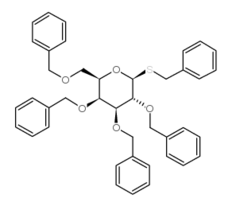
1,2,3,4,6-Penta-O-benzyl-b-D-thiogalactopyranoside
Benzyl 2,3,4,6-tetra-O-benzyl-1-thio-beta-D-galactopyranoside (BTBG) is a chemical compound that belongs to the class of thio-glycosides. Glycosides are compounds that consist of a carbohydrate molecule bonded with another molecule. In the case of BTBG, the carbohydrate is galactose, and the other molecule is a thiol with a benzyl substituent. BTBG has gained attention due to its biological and chemical properties, making it a promising molecule in several fields of research, such as medicinal chemistry, biochemistry, and material science.
Synthesis and Characterization
The synthesis of BTBG involves several steps, starting from the protection of the galactose moiety, followed by the thiolation of the galactose, and finally, the removal of the protective groups. The synthesis of BTBG is challenging but can be accomplished through established methods. Advanced techniques, such as click chemistry, have also been applied to synthesize BTBG, reducing the number of steps involved and providing high yields.
Analytical Methods
Various analytical methods can be employed to characterize the physical and chemical properties of BTBG. Common techniques include, but are not limited to, nuclear magnetic resonance (NMR) spectroscopy, infrared (IR) spectroscopy, mass spectroscopy (MS), and high-performance liquid chromatography (HPLC). These methods gather valuable information that contributes to a better understanding of BTBG's structure and properties.
Biological Properties
BTBG has gained attention due to its potential biological properties, such as antiviral, antimicrobial, and anticancer activities. Several studies have reported that BTBG exhibits antiviral activity against simian immunodeficiency virus, human immunodeficiency virus, and influenza virus. Additionally, BTBG has shown promising antimicrobial properties against various strains of bacteria and fungi. Several studies have reported BTBG to have potential anticancer activity against several cancer cell lines, making it a promising candidate in the search for new cancer therapies.
Toxicity and Safety in Scientific Experiments
Investigating the toxicity and safety of BTBG is essential when considering its potential applications in scientific experiments. Several studies have been conducted to determine the cytotoxicity of BTBG in vitro and in vivo. Results from these studies suggest that BTBG has negligible cytotoxicity, making it a safe compound to use in scientific experiments.
Applications in Scientific Experiments
BTBG's promising biological and chemical properties have opened doors for its potential applications in several scientific experiments. It can be utilized as a chemical probe to investigate the glycobiology of cells, viruses, and bacteria. BTBG can be used as a drug delivery system due to its ability to form nanoparticles. It can be functionalized to target specific cells, making it suitable for targeted drug delivery. Moreover, BTBG can be applied in material science, where it can be utilized as a building block to produce novel materials with unique properties.
Current State of Research
Research on BTBG shows promising results, but there is still much to learn about its potential applications. Studies conducted so far suggest that BTBG has antiviral, antimicrobial, anticancer, and drug delivery properties. However, more research is required to fully understand the mechanisms of these properties and to determine the most effective applications of BTBG.
Potential Implications in Various Fields of Research and Industry
The potential implications of BTBG in various fields of research and industry are numerous due to its promising biological and chemical properties. For example, BTBG can be incorporated into new antiviral, antimicrobial, and anticancer therapies. It can also be used in material science as a building block to produce new materials with unique properties. Furthermore, BTBG can be utilized in drug delivery systems, making it a promising candidate for targeted drug delivery.
Limitations and Future Directions
Despite promising results, there are limitations to the use of BTBG in scientific experiments. For example, the synthesis of BTBG is challenging and requires several steps, making it time-consuming and costly. Additionally, the potential toxicity and safety of BTBG in vivo require further investigation to determine its effectiveness and safety in living organisms. Future research should focus on developing more efficient synthetic methods, characterizing BTBG's biological properties and mechanisms of action, and investigating its potential applications in medicine, material science, and drug delivery.
Future Directions
- Developing efficient synthetic methods to reduce the time and cost involved in synthesizing BTBG
- Studying the mechanisms of action of BTBG to fully understand its biological and chemical properties
- Investigating the potential of BTBG in the development of targeted drug delivery systems
- Exploring the use of BTBG in material science to produce new materials with unique properties
- Conducting further in vivo studies to determine the safety and effectiveness of BTBG in living organisms
- Expanding the scope of BTBG research to investigate its potential in other fields, such as agriculture and environmental applications.
CAS Number 210358-01-3
Product Name Benzyl 2,3,4,6-tetra-O-benzyl-1-thio-beta-D-galactopyranoside
IUPAC Name (2S,3R,4S,5S,6R)-2-benzylsulfanyl-3,4,5-tris(phenylmethoxy)-6-(phenylmethoxymethyl)oxane
Molecular Formula C41H42O5S
Molecular Weight 646.84 g/mol
InChI InChI=1S/C41H42O5S/c1-6-16-32(17-7-1)26-42-30-37-38(43-27-33-18-8-2-9-19-33)39(44-28-34-20-10-3-11-21-34)40(45-29-35-22-12-4-13-23-35)41(46-37)47-31-36-24-14-5-15-25-36/h1-25,37-41H,26-31H2/t37-,38+,39+,40-,41+/m1/s1
InChI Key LPGXUYMYRDMAFA-RSGFCBGISA-N
SMILES C1=CC=C(C=C1)COCC2C(C(C(C(O2)SCC3=CC=CC=C3)OCC4=CC=CC=C4)OCC5=CC=CC=C5)OCC6=CC=CC=C6
Canonical SMILES C1=CC=C(C=C1)COCC2C(C(C(C(O2)SCC3=CC=CC=C3)OCC4=CC=CC=C4)OCC5=CC=CC=C5)OCC6=CC=CC=C6
Isomeric SMILES C1=CC=C(C=C1)COC[C@@H]2[C@@H]([C@@H]([C@H]([C@@H](O2)SCC3=CC=CC=C3)OCC4=CC=CC=C4)OCC5=CC=CC=C5)OCC6=CC=CC=C6
CAS No: 210358-01-3
MDL No: MFCD07367500
Chemical Formula: C41H42O5S
Molecular Weight: 646.84