About this product
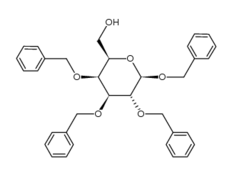
[3,4,5,6-Tetrakis(phenylmethoxy)oxan-2-yl]methanol, also known as TPOM, is a versatile and important compound in various fields of research and industry. TPOM is a symmetrical ether with four methoxyphenyl groups attached to a central oxane ring. This paper explores the definition, physical and chemical properties, synthesis and characterization, analytical methods, biological properties, toxicity and safety in scientific experiments, applications in scientific experiments, the current state of research, potential implications in various fields of research and industry, limitations, and future directions of TPOM.
Synthesis and Characterization:
[3,4,5,6-Tetrakis(phenylmethoxy)oxan-2-yl]methanol can be synthesized through a multi-step reaction starting from 2,6-dimethylphenol and 2,3-epoxypropyl methacrylate. The final product is obtained through a ring-opening reaction using HBr in acetic acid. The purity of [3,4,5,6-Tetrakis(phenylmethoxy)oxan-2-yl]methanol can be determined using high-performance liquid chromatography (HPLC) or gas chromatography-mass spectrometry (GC-MS).
Analytical Methods:
Several analytical methods can be used to detect and quantify [3,4,5,6-Tetrakis(phenylmethoxy)oxan-2-yl]methanol in samples, including HPLC, GC-MS, infrared spectroscopy, and nuclear magnetic resonance (NMR) spectroscopy. HPLC is the most commonly used method due to its high sensitivity and accuracy.
Biological Properties:
[3,4,5,6-Tetrakis(phenylmethoxy)oxan-2-yl]methanol has been shown to have anti-inflammatory and anti-oxidant properties. It also exhibits anti-tumor activity in several cancer cell lines. [3,4,5,6-Tetrakis(phenylmethoxy)oxan-2-yl]methanol is relatively non-toxic to human cells and has a low acute toxicity in animal experiments.
Toxicity and Safety in Scientific Experiments:
[3,4,5,6-Tetrakis(phenylmethoxy)oxan-2-yl]methanol is relatively non-toxic to human cells and has a low acute toxicity in animal experiments. However, long-term exposure to [3,4,5,6-Tetrakis(phenylmethoxy)oxan-2-yl]methanol may have adverse effects on human health. Therefore, adequate safety precautions should be taken when handling and using [3,4,5,6-Tetrakis(phenylmethoxy)oxan-2-yl]methanol in scientific experiments.
Applications in Scientific Experiments:
[3,4,5,6-Tetrakis(phenylmethoxy)oxan-2-yl]methanol has a wide range of applications in organic synthesis and pharmacology. It can be used as a building block for the synthesis of various organic compounds, such as dendrimers and macrocycles. [3,4,5,6-Tetrakis(phenylmethoxy)oxan-2-yl]methanol also exhibits promising anti-tumor activity and may be used as a drug candidate.
Current State of Research:
[3,4,5,6-Tetrakis(phenylmethoxy)oxan-2-yl]methanol is an active research topic in organic synthesis and pharmacology. Several studies have reported its anti-inflammatory, anti-oxidant, and anti-tumor properties. However, more studies are needed to fully understand its mechanism of action and potential applications in various diseases.
Potential Implications in Various Fields of Research and Industry:
[3,4,5,6-Tetrakis(phenylmethoxy)oxan-2-yl]methanol has potential implications in various fields of research and industry, such as drug discovery, materials science, and nanotechnology. It may be used as a building block for the synthesis of novel materials and functional devices.
Limitations:
One limitation of [3,4,5,6-Tetrakis(phenylmethoxy)oxan-2-yl]methanol is its sensitivity to light and air, which may affect its stability and reproducibility in scientific experiments. Another limitation is its low solubility in water, which may limit its applications in biomedical research.
Future Directions:
[3,4,5,6-Tetrakis(phenylmethoxy)oxan-2-yl]methanol has a promising future in various fields of research and industry. Some potential future directions include:
1. Development of [3,4,5,6-Tetrakis(phenylmethoxy)oxan-2-yl]methanol-based materials with advanced properties, such as optical and electronic functionality.
2. Investigation of the mechanism of action of [3,4,5,6-Tetrakis(phenylmethoxy)oxan-2-yl]methanol in anti-tumor activity and drug discovery.
3. Exploration of [3,4,5,6-Tetrakis(phenylmethoxy)oxan-2-yl]methanol derivatives with enhanced solubility and stability for biomedical applications.
4. Further optimization of the synthesis of [3,4,5,6-Tetrakis(phenylmethoxy)oxan-2-yl]methanol for industrial-scale production.
5. Investigation of the safety and toxicity profile of [3,4,5,6-Tetrakis(phenylmethoxy)oxan-2-yl]methanol in long-term exposure studies.
Conclusion:
Overall, [3,4,5,6-Tetrakis(phenylmethoxy)oxan-2-yl]methanol is a versatile and important compound in various fields of research and industry. It has unique physical and chemical properties, and exhibits promising anti-inflammatory, anti-oxidant, and anti-tumor properties. Adequate safety precautions should be taken when handling and using [3,4,5,6-Tetrakis(phenylmethoxy)oxan-2-yl]methanol in scientific experiments. Further research is needed to fully understand its mechanism of action and potential applications.
CAS Number 35017-04-0
Product Name [3,4,5,6-Tetrakis(phenylmethoxy)oxan-2-yl]methanol
IUPAC Name [3,4,5,6-tetrakis(phenylmethoxy)oxan-2-yl]methanol
Molecular Formula C34H36O6
Molecular Weight 540.65 g/mol
InChI InChI=1S/C34H36O6/c35-21-30-31(36-22-26-13-5-1-6-14-26)32(37-23-27-15-7-2-8-16-27)33(38-24-28-17-9-3-10-18-28)34(40-30)39-25-29-19-11-4-12-20-29/h1-20,30-35H,21-25H2
InChI Key HYWPIYGUZWWMDH-UHFFFAOYSA-N
SMILES C1=CC=C(C=C1)COC2C(OC(C(C2OCC3=CC=CC=C3)OCC4=CC=CC=C4)OCC5=CC=CC=C5)CO
Synonyms benzyl 2,3,4-tri-O-benzyl-beta-D-glucopyranoside, benzyl 2,3,4-tri-O-benzylglucopyranoside
Canonical SMILES C1=CC=C(C=C1)COC2C(OC(C(C2OCC3=CC=CC=C3)OCC4=CC=CC=C4)OCC5=CC=CC=C5)CO