About this product
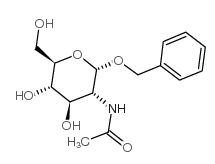
Benzyl 2-acetamido-2-deoxy-alpha-D-glucopyranoside, also known as BADG, is a chemical compound derived from glucose. BADG is primarily used as a glycosyl donor in the synthesis of various glycoconjugates. It is soluble in most organic solvents such as DMF, DMSO, and MeOH. BADG is stable at room temperature but may degrade upon exposure to high temperature and acidic conditions.
Synthesis and Characterization
BADG can be synthesized via a one-pot procedure involving the reaction between benzyl glycoside and N-acetylated glucosamine. The product is then purified using column chromatography. The structure and purity of BADG can be characterized using various methods such as NMR spectroscopy, mass spectrometry, and IR spectroscopy.
Analytical Methods
BADG can be quantified using high-performance liquid chromatography (HPLC) and thin-layer chromatography (TLC). The purity of BADG can also be assessed using HPLC and NMR spectroscopy.
Biological Properties
Studies have shown that BADG has inhibitory effects on bacterial toxins such as cholera and heat-labile enterotoxins. It has also been reported to have antiviral activity against the herpes simplex virus type 1. In addition, BADG has been shown to possess potential anti-cancer properties.
Toxicity and Safety in Scientific Experiments
Experimental studies have shown that BADG has low toxicity, making it a safe compound for use in scientific research. However, further toxicity testing is required to assess the safety of BADG in humans.
Applications in Scientific Experiments
BADG has several applications in scientific research, specifically in the synthesis of glycoconjugates. Glycoconjugates are molecules that consist of a carbohydrate attached to a protein or lipid. These molecules play essential roles in various biological processes such as cell signaling and immunity.
Current State of Research
The current research on BADG is focused on its applications in the synthesis of glycoconjugates and its potential biomedical applications. Several studies have reported the use of BADG in the synthesis of glycoconjugate vaccines and as a potential therapeutic for cancer treatment.
Potential Implications in Various Fields of Research and Industry
BADG has several potential implications in various fields of research and industry, specifically in the development of glycoconjugate vaccines and cancer therapeutics. Glycoconjugate vaccines are effective against bacterial infections and have shown promising results in the treatment of cancer. BADG can also be used in the synthesis of glycoconjugate therapeutics, which have shown potential in the treatment of various diseases.
Limitations and Future Directions
Despite its potential applications in scientific research and industry, there are limitations to the use of BADG. One of the major limitations is the high cost of synthesis. Future research should focus on improving the synthesis of BADG and developing cost-effective methods for its production. Moreover, the potential toxicity of BADG in humans should be further evaluated to ensure its safety in medical applications.
Future Directions
1. Investigate the potential of BADG in the development of glycoconjugate therapeutics for the treatment of infectious diseases and cancer
2. Explore the use of BADG in the synthesis of vaccines for infectious diseases
3. Develop efficient and cost-effective methods for the synthesis of BADG
4. Evaluate the potential of BADG in drug delivery systems
5. Investigate the potential of BADG in the development of materials for tissue engineering applications
6. Explore the use of BADG in the synthesis of glycoconjugate drugs for the treatment of autoimmune diseases
7. Study the potential of BADG in the development of biomaterials for drug delivery applications
8. Investigate the potential of BADG in the development of anti-tumor agents
9. Evaluate the potential of BADG in the synthesis of glycoconjugate vaccines for the prevention of infectious diseases.
10. Study the potential of BADG in the development of glycoconjugate drugs for the treatment of neurological disorders.
CAS Number 13343-62-9
Product Name Benzyl 2-acetamido-2-deoxy-alpha-D-glucopyranoside
IUPAC Name N-[(2S,3R,4R,5S,6R)-4,5-dihydroxy-6-(hydroxymethyl)-2-phenylmethoxyoxan-3-yl]acetamide
Molecular Formula C15H21NO6
Molecular Weight 311.33 g/mol
InChI InChI=1S/C15H21NO6/c1-9(18)16-12-14(20)13(19)11(7-17)22-15(12)21-8-10-5-3-2-4-6-10/h2-6,11-15,17,19-20H,7-8H2,1H3,(H,16,18)/t11-,12-,13-,14-,15+/m1/s1
InChI Key SKOZFDIGKDPQBO-RYPNDVFKSA-N
SMILES CC(=O)NC1C(C(C(OC1OCC2=CC=CC=C2)CO)O)O
Synonyms Phenylmethyl 2-(Acetylamino)-2-deoxy-?-D-glucopyranoside;
Canonical SMILES CC(=O)NC1C(C(C(OC1OCC2=CC=CC=C2)CO)O)O
Isomeric SMILES CC(=O)N[C@@H]1[C@H]([C@@H]([C@H](O[C@@H]1OCC2=CC=CC=C2)CO)O)O
CAS No: 13343-62-9 Synonyms: Benzyl D-GlcNAc MDL No: MFCD00070371 Chemical Formula: C15H21NO6 Molecular Weight: 311.33
References: 1. Altenbach M, Schnyder N, Zimmermann C, Imanidis G,, International Journal of Pharmaceutics, 2006, 307, 2, p308