About this product
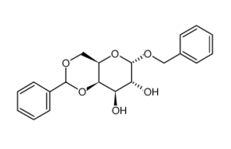
Benzyl 4,6-O-benzylidene-a-D-galactopyranoside (BBG) is a complex carbohydrate that is composed of galactose, benzyl alcohol, and benzylidene. This compound has gained scientific interest due to its potential applications in biological and chemical research.
Synthesis and Characterization:
BBG is synthesized by the reaction of benzyl alcohol with galactose in the presence of acidic catalysts. The resulting product is purified by recrystallization from ethanol. The chemical structure of BBG is determined by various spectroscopic methods, such as nuclear magnetic resonance (NMR), infrared, and mass spectrometry.
Analytical Methods:
The most common analytical methods for BBG are high-performance liquid chromatography (HPLC) and thin-layer chromatography (TLC). These methods are used to determine the purity of BBG and its concentration in samples.
Biological Properties:
BBG has been found to have various biological properties, including anti-tumor, anti-inflammatory, and anti-viral effects. Studies have shown that BBG inhibits the growth of cancer cells and induces cell death in vitro. BBG has also been found to reduce inflammation in animal models of inflammatory bowel disease. Additionally, BBG has been shown to inhibit the replication of herpes simplex virus.
Toxicity and Safety in Scientific Experiments:
BBG is considered to be a safe compound, with low toxicity reported in animal studies. However, toxicity and safety in humans have not been investigated thoroughly. Further studies are needed to determine the safety of BBG use in humans.
Applications in Scientific Experiments:
BBG has several applications in scientific experiments. It is commonly used as a substrate for the detection of glycoside hydrolases, which are enzymes that break down complex carbohydrates. BBG is also used as a chiral ligand in asymmetric catalysis, as it has a rigid structure due to its benzylidene group. Furthermore, BBG is used as a potential therapeutic agent in cancer and viral infections.
Current State of Research:
Research on BBG has mainly focused on its biological activities and potential therapeutic applications. Several studies have investigated the anti-tumor and anti-inflammatory effects of BBG, as well as its ability to inhibit viral replication. Additionally, BBG has been used as a chiral ligand in asymmetric catalysis.
Potential Implications in Various Fields of Research and Industry:
BBG has potential implications in various fields of research and industry. In the pharmaceutical industry, BBG could be used as a potential therapeutic agent in cancer and viral infections. In the chemical industry, BBG could be used as a chiral ligand in asymmetric catalysis. Additionally, BBG could be used as a substrate for the detection of glycoside hydrolases in the food industry.
Limitations and Future Directions:
Despite its potential applications, several limitations exist for BBG. As a complex carbohydrate, BBG is difficult to synthesize and purify. This makes it challenging to produce large quantities of BBG for industrial applications. Furthermore, its poor solubility in water limits its applications in aqueous environments. Future research should focus on developing more efficient methods for BBG synthesis and purification, as well as finding ways to improve its solubility in water.
Future Directions:
1. Investigate the effect of BBG on other viral infections besides herpes simplex virus.
2. Develop more efficient methods for BBG synthesis and purification.
3. Investigate the potential of BBG as a substrate for other glycoside hydrolases besides beta-galactosidase.
4. Evaluate the potential of BBG as a chiral ligand in other areas of chemistry beyond asymmetric catalysis.
5. Investigate the potential of BBG as a therapeutic agent in other diseases besides cancer and viral infections.
6. Investigate the potential of BBG in the food industry as a substrate for glycoside hydrolase detection.
7. Improve BBG's solubility in water to expand its applications in aqueous environments.
8. Conduct more safety studies on BBG in humans to determine its safety as a potential therapeutic agent.
CAS Number 57783-86-5
Product Name Benzyl 4,6-O-benzylidene-a-D-galactopyranoside
IUPAC Name (4aR,6S,7R,8R,8aR)-2-phenyl-6-phenylmethoxy-4,4a,6,7,8,8a-hexahydropyrano[3,2-d][1,3]dioxine-7,8-diol
Molecular Formula C20H22O6
Molecular Weight 358.39 g/mol
InChI InChI=1S/C20H22O6/c21-16-17(22)20(23-11-13-7-3-1-4-8-13)25-15-12-24-19(26-18(15)16)14-9-5-2-6-10-14/h1-10,15-22H,11-12H2/t15-,16-,17-,18+,19?,20+/m1/s1
InChI Key LEJLVYJUXVHIJN-AKDAEUIJSA-N
SMILES C1C2C(C(C(C(O2)OCC3=CC=CC=C3)O)O)OC(O1)C4=CC=CC=C4
Canonical SMILES C1C2C(C(C(C(O2)OCC3=CC=CC=C3)O)O)OC(O1)C4=CC=CC=C4
Isomeric SMILES C1[C@@H]2[C@@H]([C@@H]([C@H]([C@H](O2)OCC3=CC=CC=C3)O)O)OC(O1)C4=CC=CC=C4
CAS No: 57783-86-5 MDL No: MFCD09750726 Chemical Formula: C20H22O6 Molecular Weight: 358.39