About this product
Chitosan oligosaccharide; Chitooligosaccharide ;Chitosan oligomer
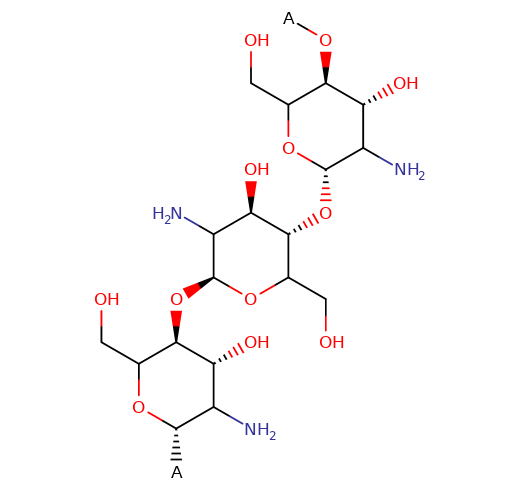
Chitosan, also known as poliglusam or chicol, belongs to the class of organic compounds known as oligosaccharides. These are carbohydrates made up of 3 to 10 monosaccharide units linked to each other through glycosidic bonds. Chitosan is soluble (in water) and a very strong basic compound (based on its pKa). Chitosan has been found throughout most human tissues. Within the cell, chitosan is primarily located in the cytoplasm.Poliglusam is a naturally occurring polysaccharide composed of beta-1,4-linked glucosamine residues with potential antineoplastic activity. Upon administration, poliglusam may, through a not yet fully elucidated mechanism, reduce advanced glycation end product (AGE) levels. This may reduce the interaction between AGEs and the receptor for advanced glycation end products (RAGE, AGER), which is overexpressed in some tumor types and is associated with poor patient outcomes. AGE-RAGE interaction may induce the phosphorylation and subsequent degradation of retinoblastoma protein (Rb), a key cell cycle inhibitor and tumor suppressor, through the phosphoinositide 3-kinase (PI3K)/protein kinase B (PKB, Akt) signaling pathway. Hyperphosphorylation of Rb leads to the dissociation of the Rb-E2F complex, which triggers the activation of genes required for G1/S transition and tumorigenesis. Reducing AGE levels may limit AGE-RAGE interaction and normalize the G1 to S-phase transition, potentially reducing the development and progression of certain cancers. AGEs are non-enzymatic protein modifications produced during the normal aging process that have been shown to play a role in the development and progression of some cancers.Deacetylated CHITIN, a linear polysaccharide of deacetylated beta-1,4-D-glucosamine. It is used in HYDROGEL and to treat WOUNDS.CAS Number9012-76-4Product NameChitosanIUPAC Namemethyl N-[5-[3-amino-5-[3-amino-5-[3-amino-5-[3-amino-5-[3-amino-5-[3-amino-4,5-dihydroxy-6-(hydroxymethyl)oxan-2-yl]oxy-4-hydroxy-6-(hydroxymethyl)oxan-2-yl]oxy-4-hydroxy-6-(hydroxymethyl)oxan-2-yl]oxy-4-hydroxy-6-(hydroxymethyl)oxan-2-yl]oxy-4-hydroxy-6-(hydroxymethyl)oxan-2-yl]oxy-4-hydroxy-6-(hydroxymethyl)oxan-2-yl]oxy-2-[5-amino-6-[5-amino-4,6-dihydroxy-2-(hydroxymethyl)oxan-3-yl]oxy-4-hydroxy-2-(hydroxymethyl)oxan-3-yl]oxy-4-hydroxy-6-(hydroxymethyl)oxan-3-yl]carbamateMolecular FormulaC56H103N9O39Molecular Weight1526.5 g/molInChIInChI=1S/C56H103N9O39/c1-87-56(86)65-28-38(84)46(19(10-74)96-55(28)104-45-18(9-73)95-49(27(64)37(45)83)97-39-12(3-67)88-47(85)20(57)31(39)77)103-54-26(63)36(82)44(17(8-72)94-54)102-53-25(62)35(81)43(16(7-71)93-53)101-52-24(61)34(80)42(15(6-70)92-52)100-51-23(60)33(79)41(14(5-69)91-51)99-50-22(59)32(78)40(13(4-68)90-50)98-48-21(58)30(76)29(75)11(2-66)89-48/h11-55,66-85H,2-10,57-64H2,1H3,(H,65,86)InChI KeyFLASNYPZGWUPSU-FBKXNGQRSA-NSMILESCOC(=O)NC1C(C(C(OC1OC2C(OC(C(C2O)N)OC3C(OC(C(C3O)N)O)CO)CO)CO)OC4C(C(C(C(O4)CO)OC5C(C(C(C(O5)CO)OC6C(C(C(C(O6)CO)OC7C(C(C(C(O7)CO)OC8C(C(C(C(O8)CO)OC9C(C(C(C(O9)CO)O)O)N)O)N)O)N)O)N)O)N)O)N)OSolubilitySoluble in DMSOSynonymsPoliglusam; Chitosan; Dac 70; Deacetylchitin; Chitosan;Canonical SMILESCOC(=O)NC1C(C(C(OC1OC2C(OC(C(C2O)N)OC3C(OC(C(C3O)N)O)CO)CO)CO)OC4C(C(C(C(O4)CO)OC5C(C(C(C(O5)CO)OC6C(C(C(C(O6)CO)OC7C(C(C(C(O7)CO)OC8C(C(C(C(O8)CO)OC9C(C(C(C(O9)CO)O)O)N)O)N)O)N)O)N)O)N)O)N)OIsomeric SMILESCOC(=O)N[C@@H]1[C@H]([C@@H]([C@H](O[C@H]1O[C@@H]2[C@H](O[C@H]([C@@H]([C@H]2O)N)O[C@@H]3[C@H](O[C@H]([C@@H]([C@H]3O)N)O)CO)CO)CO)O[C@H]4[C@@H]([C@H]([C@@H]([C@H](O4)CO)O[C@H]5[C@@H]([C@H]([C@@H]([C@H](O5)CO)O[C@H]6[C@@H]([C@H]([C@@H]([C@H](O6)CO)O[C@H]7[C@@H]([C@H]([C@@H]([C@H](O7)CO)O[C@H]8[C@@H]([C@H]([C@@H]([C@H](O8)CO)O[C@H]9[C@@H]([C@H]([C@@H]([C@H](O9)CO)O)O)N)O)N)O)N)O)N)O)N)O)N)O