About this product
Cyanoethyl Sucrose (CAS No. 18304-13-7)
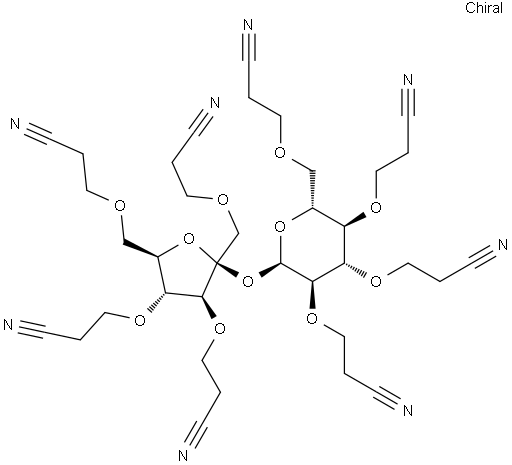
Cyanoethyl sucrose, also known as Octakis-O-(2-cyanoethyl)sucrose, is a chemically modified sucrose derivative with unique properties. Below is a comprehensive description of its characteristics:
Chemical Identity
CAS Number : 18304-13-7
Synonyms : Octakis-O-(2-cyanoethyl)sucrose, 1',2,3,3',4',6'-Octa-O-(2-cyanoethyl)sucrose
Molecular Formula : C36H46N8O11
Molecular Weight : 766.80 g/mol
EC Number : 242-187-3
Physical and Chemical Properties
Density : 1.28 g/cm³
Melting Point : -10°C
Boiling Point : 1040.5°C at 760 mmHg
Flash Point : 318.9°C
Form : Viscous liquid
Refractive Index : 1.483–1.485
Structure
Cyanoethyl sucrose is derived from sucrose through cyanoethylation, resulting in a compound with multiple cyanoethyl groups attached to the hydroxyl sites of the sucrose molecule. Its chemical structure includes glucose and fructose units joined by an acetal oxygen bridge, heavily substituted with cyanoethyl groups.
Applications
Cyanoethyl sucrose has applications in:
Film and Plastic Formulations : Used to produce water-insoluble films and plastics, contributing to compositions that can include up to 50–75% of this compound.
Chemical Research : Acts as a precursor for further chemical synthesis due to its reactivity.
Safety Information
The toxicological properties of cyanoethyl sucrose have not been fully investigated. However:
It is not classified as hazardous under most regulations.
Safety phrases include:
S24/25: Avoid contact with skin and eyes.
S28A: After contact with skin, wash immediately with plenty of water.
S37: Wear suitable gloves.
It is listed on the TSCA inventory in the US and Canada's DSL list but is not included on Canada's Ingredient Disclosure List.
Stability and Reactivity
Cyanoethyl sucrose is stable under normal temperatures and pressures but should be kept away from strong oxidizing agents. Hazardous polymerization has not been reported.
Disposal Considerations
Dispose of this substance in accordance with federal, state, and local regulations to ensure environmental safety.
This compound is available commercially with purities ranging from 95% to 98%, suitable for industrial and research purposes.
Citations:
https://www.chemsrc.com/en/cas/18304-13-7_1101449.html
https://pubchem.ncbi.nlm.nih.gov/compound/87570
https://www.chemblink.com/products/18304-13-7.htm
https://pubchem.ncbi.nlm.nih.gov/compound/2-Cyanoethyl-sucrose
https://patents.google.com/patent/US3068220A/en
https://www.chemicalbook.com/ProductChemicalPropertiesCB0297574_EN.htm
https://www.guidechem.com/trade/cyanoethyl-sucrose-id4171806.html