About this product
D-Cellotetraose, ????
Cellotetraose is a type of oligosaccharide, which is a carbohydrate molecule consisting of 2-10 monosaccharide units. In this paper, we will explore the definition and background of cellotetraose, its physical and chemical properties, synthesis, characterization, and analytical methods. We will also discuss its biological properties, toxicity, and safety in scientific experiments, as well as its applications in scientific experiments. Finally, we will explore the current state of research on cellotetraose and its potential implications in various fields of research and industry; including its limitations and future directions.Definition and Background:
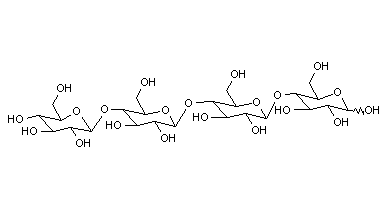
Cellotetraose is a type of cellulose oligosaccharide, which is a polymer of glucose monosaccharides. It is composed of four glucose units linked together by ?-1,4 glycosidic bonds. It is a structural component of plant cell walls and it has been widely used as a substrate for cellulase and xylanase enzymes.Synthesis and Characterization:
Cellotetraose can be synthesized through the hydrolysis of cellulose using cellulase or acid hydrolysis. It can also be produced through the enzymatic degradation of cellulose using cellulase or other glycoside hydrolases. Cellotetraose can be characterized by various techniques, including thin-layer chromatography (TLC), high-performance liquid chromatography (HPLC), electrospray ionization mass spectrometry (ESI-MS), and nuclear magnetic resonance (NMR) spectroscopy.Analytical Methods:
Various analytical methods have been developed to determine the purity and composition of cellotetraose. These methods include TLC, HPLC, ESI-MS, and NMR spectroscopy.Biological Properties:
Cellotetraose has been shown to have beneficial effects on human health. It can act as a prebiotic, stimulating the growth of beneficial bacteria in the gut. It has also been shown to have anti-inflammatory and anti-oxidant properties.Toxicity and Safety in Scientific Experiments:
Cellotetraose has been shown to be safe for consumption in humans and animals. However, it may cause gastrointestinal discomfort in some individuals.Applications in Scientific Experiments:
Cellotetraose has been widely used as a substrate for cellulase and xylanase enzymes in the production of biofuels and other industrial applications. It can also be used as a prebiotic supplement in food and feed formulations. Additionally, it can be used as an analytical tool for the characterization of cellulase and other glycoside hydrolases.Current State of Research:
Several studies have focused on the synthesis, characterization, and applications of cellotetraose. These studies have explored its potential as a prebiotic and its various industrial applications. However, further research is needed to fully understand its biological properties and potential therapeutic applications.Potential Implications in Various Fields of Research and Industry:
Cellotetraose has potential implications in various fields of research and industry. Its use as a prebiotic supplement could have significant applications in the prevention and treatment of various diseases. Additionally, its use as a substrate for cellulase and other glycoside hydrolases could greatly improve the efficiency and cost-effectiveness of biofuel production.Limitations and Future Directions:
Despite its potential applications, there are limitations to the use of cellotetraose. For example, it is difficult and expensive to produce on a large scale. Additionally, much research is needed to fully understand its biological properties and potential therapeutic applications. Future directions of research could focus on the optimization of its production methods, the exploration of its therapeutic potential,?and the development of new industrial applications.Conclusion:
In conclusion, cellotetraose is a promising molecule with potential implications in various fields of research and industry. Its physical and chemical properties, synthesis, and analytical methods have been well-characterized. Its applications as a prebiotic supplement and substrate for cellulase and other glycoside hydrolases are of particular interest, but more research is needed to fully understand its biological properties and potential therapeutic applications.Cellotetraose is a glucotetrose comprised of four D-glucose residues connected by beta(1->4) linkages.
CAS No: 38819-01-1 Synonyms: (Glc-b-1,4)3-Glc MDL No: MFCD00079079 Chemical Formula: C24H42O21 Molecular Weight: 666.58COA:Product name:?D-CellotetraoseCAS:?38819-01-1? M.F.:?C24H42O21??M.W.:?666.58? ?Batch No:?20100124? ?Quantity:?5mg from 25mgItemsStandardsResultsAppearanceWhite crystalline powderPositiveSolubilityReadily soluble in water andinsoluble in petrolumPositiveNMR and MSShould complyCompliesIdentificationIR and TLCPositiveAssayMin. 96%97.1%CAS Number38819-01-1Product NameCellotetraoseIUPAC Name(2R,3R,4R,5R)-4-[(2S,3R,4R,5S,6R)-5-[(2S,3R,4R,5S,6R)-3,4-dihydroxy-6-(hydroxymethyl)-5-[(2S,3R,4S,5S,6R)-3,4,5-trihydroxy-6-(hydroxymethyl)oxan-2-yl]oxyoxan-2-yl]oxy-3,4-dihydroxy-6-(hydroxymethyl)oxan-2-yl]oxy-2,3,5,6-tetrahydroxyhexanalMolecular FormulaC??H??O??Molecular Weight666.58 g/molInChIInChI=1S/C24H42O21/c25-1-6(30)11(32)19(7(31)2-26)43-23-17(38)14(35)21(9(4-28)41-23)45-24-18(39)15(36)20(10(5-29)42-24)44-22-16(37)13(34)12(33)8(3-27)40-22/h1,6-24,26-39H,2-5H2/t6-,7+,8+,9+,10+,11+,12+,13-,14+,15+,16+,17+,18+,19+,20+,21+,22-,23-,24-/m0/s1InChI KeyUYQJCPNSAVWAFU-ZEUIETHYSA-NSMILESC(C1C(C(C(C(O1)OC2C(OC(C(C2O)O)OC3C(OC(C(C3O)O)OC(C(CO)O)C(C(C=O)O)O)CO)CO)O)O)O)OSynonymsO-?-D-Glucopyranosyl-(1-4)-O-?-D-glucopyranosyl-(1-4)-O-?-D-glucopyranosyl-(1-4)-D-glucose; (Glc1-b-4)3-D-Glc;Canonical SMILESC(C1C(C(C(C(O1)OC2C(OC(C(C2O)O)OC3C(OC(C(C3O)O)OC(C(CO)O)C(C(C=O)O)O)CO)CO)O)O)O)OIsomeric SMILESC([C@@H]1[C@H]([C@@H]([C@H]([C@@H](O1)O[C@@H]2[C@H](O[C@H]([C@@H]([C@H]2O)O)O[C@@H]3[C@H](O[C@H]([C@@H]([C@H]3O)O)O[C@@H]4[C@H](O[C@H]([C@@H]([C@H]4O)O)O)CO)CO)CO)O)O)O)O