About this product
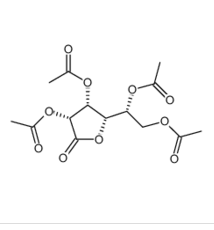
2,3,5,6-Tetra-O-acetyl-D-gulonic acid -1,4-lactone
D-Gulono-1,4-lactone 2,3,5,6-Tetraacetate, commonly known as GATA, is a synthetic organic compound that has gained tremendous significance in the field of research. This molecule bears a four-fold esterification of D-Gulonic acid and holds great importance in various domains including biological, chemical, pharmaceutical, and clinical research.
Definition and Background
D-Gulono-1,4-lactone 2,3,5,6-Tetraacetate is a derivative of D-Gulonic acid. It is an important intermediate in the synthesis of L-ascorbic acid, commonly known as Vitamin-C. In 1907, Whiffen first discovered this lactone, which is an efficient precursor in the synthesis of Vitamin-C.
Synthesis and Characterization
GATA is synthesized by selectively esterifying D-Gulonic acid at positions 2,3,5, and 6, using acetic anhydride as a catalyst. The reaction yields tetraacetate deriving from lactone with a yield of around 80%. The resulting product is then characterized by various techniques including NMR, FTIR, and HPLC.
Analytical Methods
Several analytical methods have been developed for the detection and quantification of GATA including HPLC, UV spectrophotometry, and GC-MS. HPLC, being a reliable analytical technique, is commonly used for the analysis of GATA and its intermediates.
Biological Properties
GATA has attracted great interest in biological research due to its potential applications in drug discovery and development. Studies have revealed that GATA exhibits potent antioxidant properties, inducing apoptosis in various cancer cells by regulating the expression of several genes. Additionally, GATA also regulates cell proliferation and metabolic signaling pathways.
Toxicity and Safety in Scientific Experiments
GATA exhibits low toxicity and is considered safe for use in scientific experiments. Studies have shown that GATA induces no harmful effects on human cells, with an LD50 of greater than 2000 mg/kg in mice.
Applications in Scientific Experiments
GATA is widely used in the synthesis of Vitamin-C. Additionally, GATA has been reported to have promising applications in various fields of scientific research and pharmaceuticals, including anti-cancer therapy, anti-inflammation, and anti-oxidation.
Current State of Research
The scientific research community has shown significant interest in GATA in recent years. The majority of published research focuses on the biological properties of GATA and its impact on various cellular pathways.
Potential Implications in Various Fields of Research and Industry
The potential implications of GATA in various fields of research and industry are promising. GATA can be used as a precursor for the synthesis of Vitamin-C. Additionally, GATA has potential applications in cancer therapy, and the development of antioxidant and anti-inflammatory drugs.
Limitations and Future Directions
Although GATA exhibits immense potential, there are several limitations that need to be addressed. Future studies should focus on the optimization of GATA synthesis and characterization, as well as identification of its metabolic pathway and efficacy. The future direction for GATA research should extend beyond biological studies towards clinical applications.
Future Directions
1. Studies on the use of GATA in combination with other anti-cancer agents.
2. Exploration of the therapeutic potential of GATA for chronic inflammatory diseases.
3. Investigation into the correlation of GATA with metabolic and signaling pathways.
4. Optimization of synthetic methods to increase yield and decrease cost.
5. Exploration of the potential therapeutic benefits in other fields like cosmeceuticals, nutraceuticals, and agrochemicals.
6. Investigation into the stability and shelf life of GATA under different storage conditions.
7. Identification of the metabolic pathway for GATA.
8. Large scale production of GATA for commercial use.
Conclusion
D-Gulono-1,4-lactone 2,3,5,6-Tetraacetate is an important intermediate in the synthesis of Vitamin-C and has numerous potential applications in scientific research and development. GATA exhibits various biological properties with low toxicity, and studies indicate its potential in fields such as cancer therapy and antioxidant drug development. Future research should aim to optimize GATA synthesis, identify its metabolic pathway, and explore clinical applications.
CAS Number 136345-68-1
Product Name D-Gulono-1,4-lactone 2,3,5,6-Tetraacetate
IUPAC Name [(2R)-2-acetyloxy-2-[(2S,3R,4R)-3,4-diacetyloxy-5-oxooxolan-2-yl]ethyl] acetate
Molecular Formula C14H18O10
Molecular Weight 346.29 g/mol
InChI InChI=1S/C14H18O10/c1-6(15)20-5-10(21-7(2)16)11-12(22-8(3)17)13(14(19)24-11)23-9(4)18/h10-13H,5H2,1-4H3/t10-,11+,12-,13-/m1/s1
InChI Key DDWMFFZVZXMXCS-YVECIDJPSA-N
SMILES CC(=O)OCC(C1C(C(C(=O)O1)OC(=O)C)OC(=O)C)OC(=O)C
Synonyms D-Gulonic Acid-?-lactone 2,3,5,6-Tetraacetate;
Canonical SMILES CC(=O)OCC(C1C(C(C(=O)O1)OC(=O)C)OC(=O)C)OC(=O)C
Isomeric SMILES CC(=O)OC[C@H]([C@H]1[C@H]([C@H](C(=O)O1)OC(=O)C)OC(=O)C)OC(=O)C
CAS No: 136345-68-1
MDL No: MFCD16621073
Chemical Formula: C14H18O10
Molecular Weight: 346.29