About this product
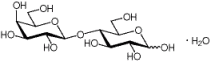
Anhydrous lactose is an excipient, filler, diluent, and bulking agent in a wide variety of pharmaceutical tablets, capsules, powders and other preparations. It also has applications as a nutrient and multi-functional ingredient in infant formulae, geriatric, dietetic and health foods and may be used as an ingredient in culture media.Title:?LactoseCAS Registry Number:?63-42-3CAS Name:?4-O-b-D-Galactopyranosyl-D-glucoseAdditional Names:?4-(b-D-galactosido)-D-glucose; milk sugarMolecular Formula:?C12H22O11Molecular Weight:?342.30Percent Composition:?C 42.11%, H 6.48%, O 51.41%Literature References:?Present in milk of mammals: human 6.7%; cow's 4.5%. Milk at body temp contains lactose as an equilibrium mixture of 2 parts of?a-lactose and 3 parts of?b-lactose. By-product of the cheese industry, produced from whey: Davis,?Can. Dairy and Ice Cream J.?19,?52 (1940);?Milk Trade Gaz.?12,?4 (1941); F. Ullmann,?Encyklop?die der Technischen Chemie,?VII,?579 (2nd ed., 1931). Structure and configuration: Zempl?n,?Ber.?59,?2402 (1926); Levene, Sobotka,?J. Biol. Chem.?71,?471 (1926); Levene, Wintersteiner,?ibid.?75,?315 (1927); Haworth, Long,?J. Chem. Soc.?1927,?544; Hudson,?J. Am. Chem. Soc.?52,?1712 (1930); Hassid, Ballou in?The Carbohydrates,?W. Pigman, Ed. (Academic Press, New York, 1957) p 495. Synthesis: Haskins?et al.,?J. Am. Chem. Soc.?64,?1852 (1942).?Reviews:?Whittier,?Chem. Rev.?2,?85-125 (1926);?J. Dairy Sci.?27,?505-537 (1944); Weisberg,?ibid.?37,?1106-1115 (1954); L. A. W. Thelwall,?Dev. Food Carbohydr.?2,?275-326 (1980). Comprehensive description: H. G. Brittain?et al.,?Anal. Profiles Drug Subs.?20,?369-398 (1991).Properties:?On hydrolysis with 2% H2SO4?or with emulsin lactose yields 1 mol?D-glucose and 1 mol?D-galactose. Reduces Fehling's soln.?Derivative Type:?a-Lactose monohydrateProperties:?Is the usual milk sugar and the lactose of pharmacy. Monoclinic sphenoidal crystals from water. Faintly sweet taste. Stable in air, but readily absorbs odors. d20?1.53. Becomes anhydrous at 120?. mp 201-202? (rapid heating). Shows mutarotation. [a]D20?+92.6????+83.5? (10 min.)???+69? (50 min)???+52.3? (22 hrs, c = 4.5). The final value is obtained instantly in the presence of a trace of NH3. U.S.P. requires +54.4? to +55.9? (c = 10). One gram dissolves in 5 ml water, in 2.6 ml boiling water; very slightly sol in alcohol. Insol in chloroform, ether. Ka at 16.5? = 6.0?10-13. d420?of aq solns calcd for the monohydrate: 5.2% = 1.018; 10.2% = 1.038; 20.0% = 1.078; 30.2% = 1.123; 50.9% = 1.226; 60.8% = 1.281; 69.1% = 1.330.Melting point:?mp 201-202? (rapid heating)Optical Rotation:?[a]D20?+92.6????+83.5? (10 min.)???+69? (50 min)???+52.3? (22 hrs, c = 4.5)Density:?d20?1.53; d420?of aq solns calcd for the monohydrate: 5.2% = 1.018; 10.2% = 1.038; 20.0% = 1.078; 30.2% = 1.123; 50.9% = 1.226; 60.8% = 1.281; 69.1% = 1.330?Derivative Type:?b-LactoseMolecular Formula:?C12H22O11Molecular Weight:?342.30Percent Composition:?C 42.11%, H 6.48%, O 51.41%Properties:?Obtained by crystallizing concd solns of?a-lactose above 93.5?. Somewhat sweeter than the?a-form. [a]D25?+34? (3 min)???+39? (6 min)???+46? (1 hr)???+52.3? (22 hrs). One gram dissolves in 2.2 ml water at 15?, in 1.1 ml boiling water. After a few days crystals of the less sol?a-monohydrate appear from satd solns.Optical Rotation:?[a]D25?+34? (3 min)???+39? (6 min)???+46? (1 hr)???+52.3? (22 hrs)?Use:?Both forms of lactose are employed, with the?a-form predominating: as a nutrient in preparing modified milk and food for infants and convalescents (Whittier). In baking mixtures. Pharmaceutic aid (tablet and capsule excipient and diluent). To produce lactic acid fermentation in ensilage and food products. As chromatographic adsorbent in analytical chemistry. In culture media. For many additional uses?see?Weisberg.Therap-Cat-Vet:?Added to cow's milk for feeding orphan foals.
References:1. Hong JH, Shim MJ, Ro BO, Ko OH, J. Org. Chem. 2002, Vol67, (19), 6837-6840