About this product
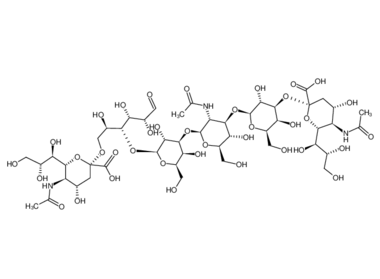
Disialyllacto-N-tetraose?a-NeuNAc-(2-3)-b-Gal-(1-3)-[a-NeuNAc-(2-6)]-b-GlcNAc-(1-3)-b-Gal-(1-4)-Glc; DSLNT; a-Neu5Ac-(2?3)-b-Gal-(1?3)-[a-Neu5Ac-(2?6)]-b-GlcNAc-(1?3)-b-Gal-(1?4)-GlcDisialyllacto-N-tetraose (DSLNT) is a trisaccharide containing two sialic acid residues that are linked to a lactose disaccharide unit. It is a member of the ganglioside family, which are glycosphingolipids that play a crucial role in cell membrane organization, cell-to-cell communication, and receptor-mediated signal transduction. DSLNT is found in various tissues, including the nervous system, where it functions as a ligand for specific proteins and lipids. DSLNT is synthesized through a series of enzymatic reactions involving glycosyltransferases and sialyltransferases.
Physical and Chemical Properties
DSLNT is a water-soluble molecule that is stable under moderate pH and temperature conditions. Its molecular weight is 1041.2 g/mol, and its chemical formula is C41H67N3O29. DSLNT contains two N-acetylneuraminic acid residues (Neu5Ac) linked to the lactose disaccharide unit through ?2-3 and ?2-6 glycosidic bonds, respectively.Synthesis and Characterization
DSLNT can be synthesized using various methods, including chemical synthesis, chemoenzymatic synthesis, and biosynthesis. Chemical synthesis involves the use of organic chemistry reactions to obtain DSLNT from its constituent monosaccharide building blocks. Chemoenzymatic synthesis utilizes recombinant glycosyltransferases and sialyltransferases to achieve regio- and stereoselective glycosidic bond formation. Biosynthesis uses living cells or organisms to produce DSLNT, either through metabolic engineering or natural biosynthetic pathways.Analytical Methods
The characterization of DSLNT requires the use of various analytical methods, including mass spectrometry, nuclear magnetic resonance spectroscopy, chromatography, and electrophoresis. These methods allow the identification and quantification of DSLNT and its related compounds, as well as the characterization of their structures and properties.Biological Properties
DSLNT has been shown to interact with various proteins and lipids in the human body, including glycan-binding proteins, immune cells, and bacterial toxins. DSLNT is known to play a role in the regulation of cell adhesion, differentiation, and signaling. It has also been shown to modulate the immune system and protect against bacterial infections.Toxicity and Safety in Scientific Experiments
There is limited information on the toxicity and safety of DSLNT in scientific experiments. However, DSLNT is considered to be safe in human consumption, as it is present in human milk and serves as a valuable nutrient for newborns. In animal studies, the oral administration of DSLNT did not cause any adverse effects.Applications in Scientific Experiments
DSLNT has various applications in scientific experiments, including its use as a molecular probe for the study of glycan-protein interactions, its use in the development of new immunotherapies and vaccines, and its use as a diagnostic marker for certain diseases.Current State of Research
Current research on DSLNT is focused on further elucidating its biological functions and molecular mechanisms of action, as well as exploring its potential therapeutic applications in various fields of medicine, including cancer, infectious diseases, and autoimmune disorders.Potential Implications in Various Fields of Research and Industry
DSLNT has potential implications in various fields of research and industry, including in the development of new drugs, biomaterials, and diagnostic tools. DSLNT may also have applications in food science and agriculture, as a potential additive in functional foods and as a bioregulator in crop production.Limitations and Future Directions
Despite the promising potential of DSLNT in scientific research and industry, there are still limitations and challenges that need to be addressed. These include the high cost and difficulty of synthesizing and purifying DSLNT, the need for more sensitive and specific analytical methods, and the need for more extensive preclinical and clinical studies to evaluate its efficacy and safety in humans. Future directions in DSLNT research include its application in personalized medicine, the development of new therapeutic strategies for neurological disorders, and the engineering of DSLNT-based biomaterials with unique properties and functions.CAS Number61278-38-4Product NameDisialyllacto-N-tetraoseIUPAC Name(2R,4S,5R,6R)-5-acetamido-2-[[(2R,3S,4R,5R,6S)-5-acetamido-4-[(2R,3R,4S,5S,6R)-4-[(2S,4S,5R,6R)-5-acetamido-2-carboxylato-4-hydroxy-6-[(1R,2R)-1,2,3-trihydroxypropyl]oxan-2-yl]oxy-3,5-dihydroxy-6-(hydroxymethyl)oxan-2-yl]oxy-6-[(2R,3S,4S,5R,6S)-3,5-dihydroxy-2-(hydroxymethyl)-6-[(2R,3S,4R,5R)-4,5,6-trihydroxy-2-(hydroxymethyl)oxan-3-yl]oxyoxan-4-yl]oxy-3-hydroxyoxan-2-yl]methoxy]-4-hydroxy-6-[(1R,2R)-1,2,3-trihydroxypropyl]oxane-2-carboxylateMolecular FormulaC48H77N3O37-2Molecular Weight1288.1 g/molInChIInChI=1S/C48H79N3O37/c1-12(57)49-23-15(60)4-47(45(74)75,86-37(23)26(64)17(62)6-52)78-11-22-30(68)36(25(51-14(3)59)42(82-22)85-39-28(66)19(8-54)80-43(33(39)71)83-35-21(10-56)79-41(73)32(70)31(35)69)84-44-34(72)40(29(67)20(9-55)81-44)88-48(46(76)77)5-16(61)24(50-13(2)58)38(87-48)27(65)18(63)7-53/h15-44,52-56,60-73H,4-11H2,1-3H3,(H,49,57)(H,50,58)(H,51,59)(H,74,75)(H,76,77)/p-2/t15-,16-,17+,18+,19+,20+,21+,22+,23+,24+,25+,26+,27+,28-,29-,30+,31+,32+,33+,34+,35+,36+,37+,38+,39-,40-,41?,42-,43-,44-,47+,48-/m0/s1InChI KeyFCIROHDMPFOSFG-LAVSNGQLSA-LSMILESCC(=O)NC1C(CC(OC1C(C(CO)O)O)(C(=O)[O-])OCC2C(C(C(C(O2)OC3C(C(OC(C3O)OC4C(OC(C(C4O)O)O)CO)CO)O)NC(=O)C)OC5C(C(C(C(O5)CO)O)OC6(CC(C(C(O6)C(C(CO)O)O)NC(=O)C)O)C(=O)[O-])O)O)OSynonymsdisialyl-N-tetraoseCanonical SMILESCC(=O)NC1C(CC(OC1C(C(CO)O)O)(C(=O)[O-])OCC2C(C(C(C(O2)OC3C(C(OC(C3O)OC4C(OC(C(C4O)O)O)CO)CO)O)NC(=O)C)OC5C(C(C(C(O5)CO)O)OC6(CC(C(C(O6)C(C(CO)O)O)NC(=O)C)O)C(=O)[O-])O)O)OIsomeric SMILESCC(=O)N[C@@H]1[C@H](C[C@@](O[C@H]1[C@@H]([C@@H](CO)O)O)(C(=O)[O-])OC[C@@H]2[C@H]([C@@H]([C@H]([C@@H](O2)O[C@H]3[C@H]([C@H](O[C@H]([C@@H]3O)O[C@@H]4[C@H](OC([C@@H]([C@H]4O)O)O)CO)CO)O)NC(=O)C)O[C@H]5[C@@H]([C@H]([C@H]([C@H](O5)CO)O)O[C@@]6(C[C@@H]([C@H]([C@@H](O6)[C@@H]([C@@H](CO)O)O)NC(=O)C)O)C(=O)[O-])O)O)O