About this product
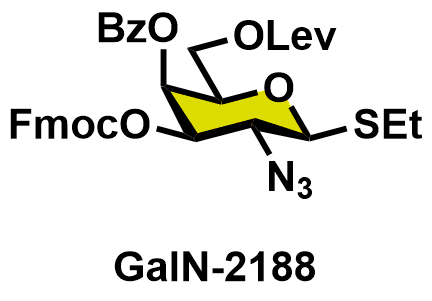
Ethyl 2-azido-4- O -benzoyl-2-deoxy-3- O -(9-fluorenylmethoxycarbonyl)-6- O -levulinoyl-1-thio-β-D-galactopyranoside
Ethyl 2-azido-4- O -benzoyl-2-deoxy-3- O -(9-fluorenylmethoxycarbonyl)-6- O -levulinoyl-1-thio-β-D-galactopyranoside is a synthetic thioglycoside derivative designed for advanced carbohydrate chemistry applications. This compound integrates multiple protecting groups to enable controlled reactivity during oligosaccharide synthesis.
Chemical Structure
The molecule is based on a β-D-galactopyranoside scaffold with the following modifications:
1-Thioethyl group : Replaces the anomeric oxygen, forming a thioglycoside linkage that enhances stability and serves as a glycosyl donor in synthetic reactions. Thioglycosides are commonly synthesized using methods such as triflic acid-mediated reactions, which offer efficient synthesis pathways.
4- O -benzoyl group : A permanent benzoyl ester protection at position 4, providing stability under acidic/basic conditions and enabling selective deprotection later.
2-Azido group : An azido group at position 2, which can be converted into an amino group under reducing conditions, offering a pathway for further functionalization.
3- O -Fmoc group : A 9-fluorenylmethoxycarbonyl (Fmoc) carbonate at position 3, acting as a temporary protecting group cleavable under basic conditions (e.g., piperidine).
6- O -levulinoyl group : A levulinoyl ester at position 6, acting as a temporary protecting group that can be cleaved under mild conditions.
Key Properties
Molecular formula : Estimated to be C29H29N3O8S ext{C}_{29} ext{H}_{29} ext{N}_3 ext{O}_8 ext{S} C29H29N3O8S based on analogous structures.
Stereochemistry : β-configuration at the anomeric center (C1), critical for mimicking biological glycosylation patterns.
Role in synthesis :
The thioglycoside moiety facilitates activation via thiophilic promoters (e.g., NIS/TfOH) for glycosylation reactions.
Benzoyl group ensures regioselective reactivity, while Fmoc allows orthogonal deprotection for sequential glycosylation.
Azido group provides a versatile handle for post-synthetic modifications, such as Staudinger ligation or click chemistry. Protecting groups like benzoyl and Fmoc play a crucial role in carbohydrate synthesis by influencing the reactivity and stereoselectivity of glycosylation reactions, as discussed in recent reviews on protecting group strategies.
Applications
This compound is used in solid-phase oligosaccharide synthesis to build complex glycans. Its design supports iterative coupling cycles, where the Fmoc group is selectively removed to expose the 3-OH for subsequent glycosylation. The azido group can be reduced to an amino group, enabling late-stage functionalization. Thioglycosides like this derivative are also explored as metabolic decoys to inhibit glycosylation processes.
Synthetic Considerations
Preparation : Likely synthesized via sequential protection:
Benzylation of galactose at position 4.
Fmoc protection at position 3.
Levulinoylation at position 6.
Azidation at position 2.
Thioglycoside formation at the anomeric position, which can be achieved using efficient methods like triflic acid-mediated synthesis.
Stability : Stable under standard glycosylation conditions but sensitive to conditions that cleave the levulinoyl group.
This multifunctional building block exemplifies advanced strategies in glycochemistry , balancing stability and orthogonality for automated glycan assembly.
Citations:
https://pmc.ncbi.nlm.nih.gov/articles/PMC6259426/
https://application.wiley-vch.de/books/sample/3527340106_c01.pdf
https://onlinelibrary.wiley.com/doi/10.1002/asia.201901621
https://patents.google.com/patent/WO2000042057A1/en
https://pubs.rsc.org/en/content/getauthorversionpdf/c9ob00573k
https://pubs.acs.org/doi/10.1021/ed074p1297
https://pubs.acs.org/doi/10.1021/ed076p79