About this product
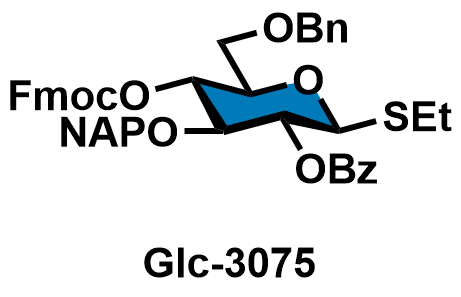
Ethyl 2-O-benzoyl-3-O-(2-naphthylmethyl)-4-O-(9-fluorenylmethoxycarbonyl)-6-O-benzyl-1-thio-β-D-glucopyranoside
Ethyl 2-O-benzoyl-3-O-(2-naphthylmethyl)-4-O-(9-fluorenylmethoxycarbonyl)-6-O-benzyl-1-thio-β-D-glucopyranoside is a strategically protected thioglycoside optimized for stereocontrolled glycosylation in carbohydrate synthesis. Its design leverages orthogonal protecting groups to enable precise regioselective deprotection during oligosaccharide assembly.
Core Structure
Scaffold : β-D-glucopyranoside with an ethylthio (–SEt) group at the anomeric (C1) position, serving as a thioglycoside donor activated by thiophilic promoters (e.g., NIS/AgOTf).
Protecting Groups
C2 : Benzoyl ester (–OBez)
Acts as a participating group via neighboring group participation (NGP) to enforce β-selectivity during glycosylation.
Removable under basic (e.g., NaOMe/MeOH) or acidic (e.g., hydrazine) conditions.
C3 : 2-Naphthylmethyl ether (–O-2-Nap)
Acid-labile (e.g., cleaved by TFA) with enhanced steric bulk compared to benzyl groups, providing stability during base-sensitive reactions.
C4 : 9-Fluorenylmethoxycarbonyl (Fmoc)
Base-labile (e.g., piperidine/DMF), ideal for solid-phase synthesis workflows.
C6 : Benzyl ether (–OBn)
Acid-stable but removable via hydrogenolysis (H₂/Pd-C), offering orthogonal compatibility with Fmoc and benzoyl groups.
Synthetic Utility
Orthogonal Deprotection Strategy :
Step 1 : Fmoc removal (base) → exposes C4-OH for glycosylation.
Step 2 : Benzoyl cleavage (base/acid) → unmask C2-OH for further coupling.
Step 3 : Benzyl/2-Nap removal (acid/hydrogenolysis) → finalize glycan assembly.
Glycosylation Control : The C2 benzoyl ensures β-selectivity via NGP, while the ethylthio donor enables activation under mild conditions.
Characterization
NMR : 1H^1 ext{H} 1H and 13C^13 ext{C} 13C NMR confirm substitution patterns (e.g., downfield shifts for benzoyl carbonyl at ~167 ppm, Fmoc aromatic protons at 7.1–7.8 ppm).
MS : ESI-MS validates molecular weight (expected [M+Na]⁺ ~900–950 Da).
Applications
Oligosaccharide Synthesis : Used to build branched or sterically hindered glycans via sequential glycosylation.
Solid-Phase Platforms : Fmoc compatibility supports automated glycomimetic synthesis.
This compound exemplifies advanced protecting group tactics in carbohydrate chemistry, balancing reactivity, selectivity, and orthogonal deprotection for complex glycan construction.
Citations:
https://pmc.ncbi.nlm.nih.gov/articles/PMC6259426/
https://pmc.ncbi.nlm.nih.gov/articles/PMC8423405/
https://pmc.ncbi.nlm.nih.gov/articles/PMC9506437/
https://pubs.rsc.org/en/content/articlehtml/2023/ob/d3ob00817g
https://pubs.acs.org/doi/10.1021/ed074p1297
https://onlinelibrary.wiley.com/doi/10.1002/9783527697014.ch5
https://par.nsf.gov/servlets/purl/10157801
https://onlinelibrary.wiley.com/doi/abs/10.1002/9783527697014.ch3