About this product
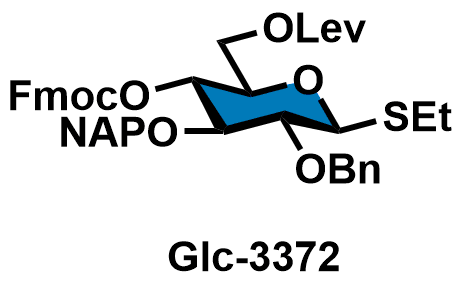
Ethyl 2-O-benzyl-3-O-(2-naphthylmethyl)-4-O-(9-fluorenylmethoxycarbonyl)-6-O-levulinoyl-1-thio-β-D-glucopyranoside
Ethyl 2-O-benzyl-3-O-(2-naphthylmethyl)-4-O-(9-fluorenylmethoxycarbonyl)-6-O-levulinoyl-1-thio-β-D-glucopyranoside is a multifunctional thioglycoside building block engineered for controlled glycosylation in complex carbohydrate synthesis. Its design integrates orthogonal protecting groups to enable sequential deprotection and stereoselective coupling.
Core Structure
Scaffold : β-D-glucopyranoside with an ethylthio (–SEt) group at the anomeric (C1) position, serving as a thioglycosyl donor activated by thiophilic promoters (e.g., NIS/AgOTf).
Protecting Groups
C2 : Benzyl ether (–OBn)
Acid-stable and removable via hydrogenolysis (H₂/Pd-C), providing compatibility with base-sensitive groups like Fmoc.
C3 : 2-Naphthylmethyl ether (–O-2-Nap)
Acid-labile (e.g., cleaved by TFA) with enhanced steric bulk compared to benzyl, directing glycosylation stereochemistry via steric hindrance.
C4 : 9-Fluorenylmethoxycarbonyl (Fmoc)
Base-labile (e.g., piperidine/DMF), ideal for solid-phase synthesis workflows.
C6 : Levulinoyl ester (–OLv)
Base-sensitive, removable under mild conditions (e.g., hydrazine) without affecting other groups.
Synthetic Utility
Orthogonal Deprotection :
Step 1 : Fmoc cleavage (base) exposes C4-OH for glycosylation.
Step 2 : Levulinoyl removal (base) unmasks C6-OH.
Step 3 : Benzyl/2-Nap deprotection (acid/hydrogenolysis) finalizes glycan assembly.
Reactivity : The ethylthio donor’s activation under mild conditions ensures compatibility with sensitive protective groups. The 2-naphthylmethyl group enhances α/β selectivity through steric effects.
Characterization
NMR : Distinct downfield shifts for Fmoc aromatic protons (~7.1–7.8 ppm), Lev carbonyl (~172 ppm), and benzyl/naphthylmethyl signals.
MS : ESI-MS confirms molecular weight (expected [M+Na]⁺ ~950–1000 Da).
Applications
Automated Glycan Assembly (AGA) : Fmoc compatibility supports solid-phase synthesis of glycans for therapeutic and diagnostic purposes
Complex Oligosaccharides : Enables regioselective glycosylation for biologically relevant glycoconjugates, such as protozoan surface glycans.
This compound exemplifies advanced strategies in carbohydrate chemistry, balancing reactivity, steric control, and orthogonal deprotection for precision in glycan synthesis.
Citations:
https://onlinelibrary.wiley.com/doi/10.1002/ajoc.201900397
https://repositorio.ul.pt/bitstream/10451/58145/1/TM_Eduardo_Sousa.pdf
https://pmc.ncbi.nlm.nih.gov/articles/PMC5301963/
https://pmc.ncbi.nlm.nih.gov/articles/PMC9182441/
https://www.mdpi.com/1420-3049/23/7/1712
https://onlinelibrary.wiley.com/doi/abs/10.1002/9783527697014.ch3
https://onlinelibrary.wiley.com/doi/10.1002/9783527697014.ch5
https://pubs.acs.org/doi/10.1021/acs.orglett.6b02241