About this product
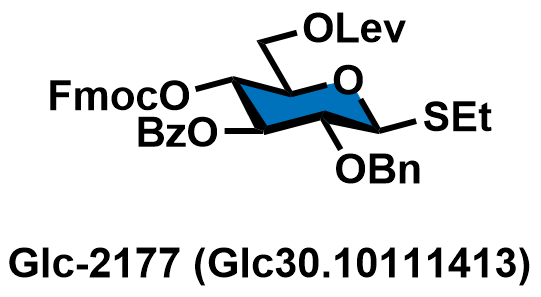
Ethyl 3-O-benzoyl-2-O-benzyl-4-O-(9-fluorenylmethoxycarbonyl)-6-O-levulinoyl-1-thio-β-D-glucopyranoside
Ethyl 3-O-benzoyl-2-O-benzyl-4-O-(9-fluorenylmethoxycarbonyl)-6-O-levulinoyl-1-thio-β-D-glucopyranoside is a protected thioglycoside derivative designed for controlled glycosylation reactions in carbohydrate chemistry. Its structure features multiple orthogonal protecting groups that enable selective deprotection during synthetic workflows.
Structural Features
Core Structure :
A β-D-glucopyranoside scaffold with an ethylthio group at the anomeric (C1) position, serving as a leaving group for glycosidic bond formation
Protecting Groups :
C2 : Benzyl ether (–OBn), providing acid-labile protection
C3 : Benzoyl ester (–OBez), offering base-stable but acid/oxidation-sensitive shielding
C4 : 9-Fluorenylmethoxycarbonyl (Fmoc), a base-labile group commonly used in solid-phase synthesis
C6 : Levulinoyl ester, a base-sensitive protecting group allowing selective removal under mild conditions (e.g., hydrazine)
Synthetic Utility
Orthogonal Deprotection : The combination of Fmoc (base-sensitive), levulinoyl (base-sensitive), and benzyl/benzoyl (acid-sensitive) groups enables sequential unmasking of hydroxyls for regioselective glycosylation
Glycosylation Reactivity : The ethylthio group at C1 facilitates activation via thiophilic promoters (e.g., NIS/AgOTf) for glycosyl donor activity
Characterization
Analytical Data : Similar derivatives are characterized by 1H^1 ext{H} 1H , 13C^13 ext{C} 13C , and 2D NMR to confirm stereochemistry and substitution patterns, alongside MS and IR for functional group validation
Physical Properties : Expected melting point range: 80–110°C (based on analogs).
Applications
Intermediate in oligosaccharide synthesis, particularly for constructing branched or sterically demanding glycans.
Fmoc protection aligns with automated solid-phase synthesis workflows for glycomimetics.
This compound exemplifies advanced protecting group strategies critical for precision in carbohydrate chemistry
Citations:
https://pubchem.ncbi.nlm.nih.gov/compound/9809160
https://www.mdpi.com/1422-8599/2024/3/M1847
https://eprints.nottingham.ac.uk/13296/1/Shaun's_thesis_final_version_19052013.pdf
https://www.guidechem.com/hotproduct/s-p1732.html
http://www.ftirsearch.com/features/libraries/PDFs/Aldrich%20Raman%20Condensed%20Phase%20Library.pdf